
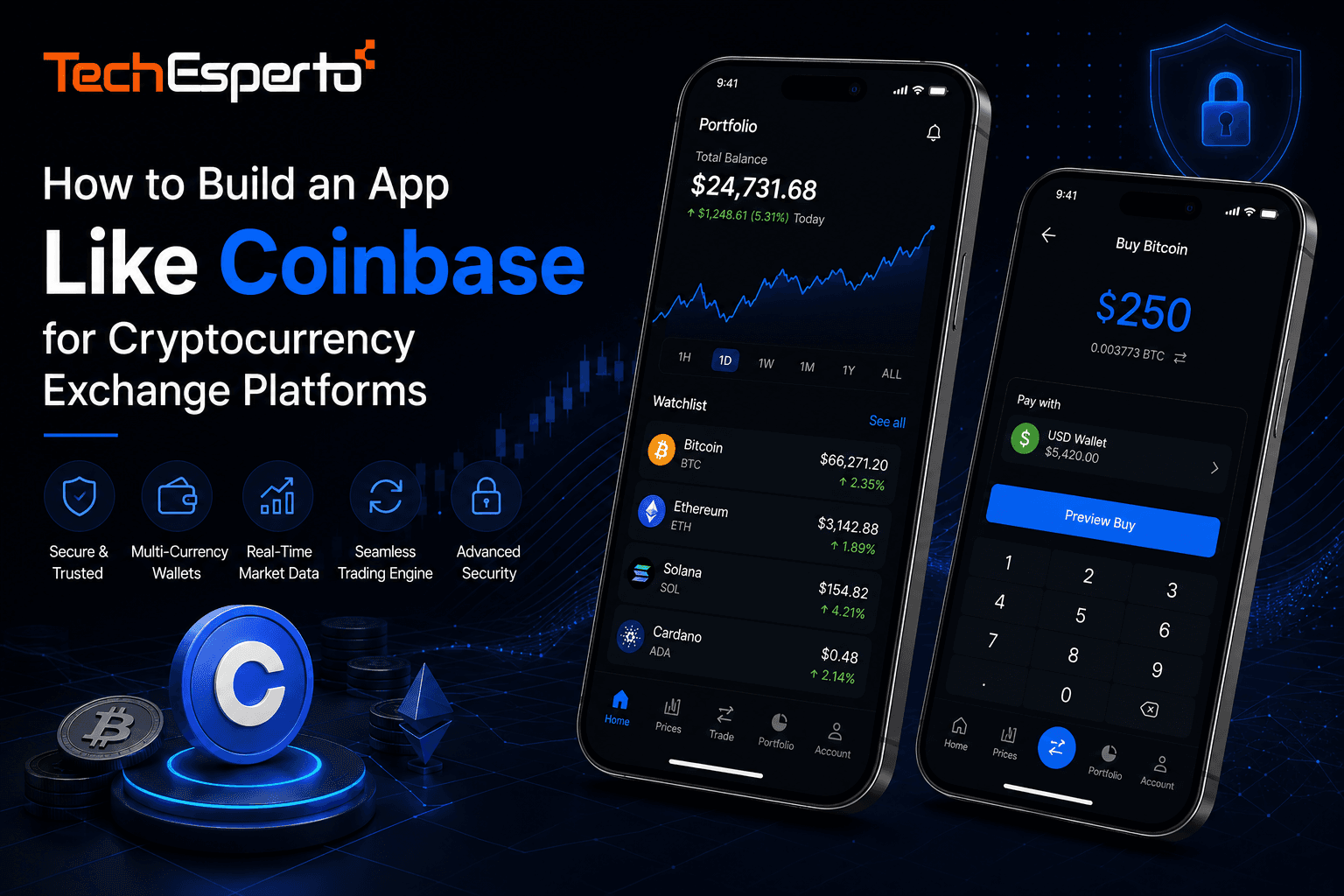
Building an app like Coinbase means developing a cryptocurrency exchange platform with wallet infrastructure, order execution, identity verification, and security systems that let users buy, sell, and hold digital assets. TechEsperto Solutions helps fintech founders plan features, choose the right tech stack, and estimate development costs for a Coinbase-style crypto exchange app.
Cryptocurrency exchange platforms succeed by making digital asset trading accessible to mainstream users while maintaining the security and regulatory compliance that handling real financial value requires. TechEsperto Solutions builds platforms like this as part of its broader fintech app development practice, and this guide covers what it takes to plan and build a Coinbase-style cryptocurrency exchange app.
What Is a Coinbase-Style Crypto Exchange App
A Coinbase-style app is a cryptocurrency exchange platform that lets users buy, sell, and hold digital assets through a simplified interface designed for mainstream users rather than only experienced crypto traders. Unlike a purely peer-to-peer crypto wallet, this model requires the platform to hold custody of user assets, execute trades against market liquidity, and maintain security infrastructure protecting both hot and cold wallet storage. Identity verification and regulatory compliance are core requirements rather than optional features, since cryptocurrency exchanges face significant regulatory scrutiny around anti-money laundering and know-your-customer obligations. Building this kind of platform means treating security architecture and compliance as foundational design requirements from the very first planning session, not features added after the core trading experience is built.
Simplified Buy and Sell Interface
Users can buy or sell supported cryptocurrencies through a straightforward interface without needing deep trading expertise.
Custodial Wallet Infrastructure
The platform holds custody of user digital assets, requiring secure hot and cold wallet architecture.
Identity Verification and Compliance
Know-your-customer verification confirms user identity during onboarding to meet regulatory requirements.
Real-Time Price Data
The app displays live pricing for supported cryptocurrencies.
Portfolio Tracking
Users can view their holdings and portfolio performance across supported digital assets.
Fiat Currency On-Ramp and Off-Ramp
Users can convert between traditional currency and cryptocurrency through linked bank accounts or cards.
Core Features You Need
A functional crypto exchange app needs identity verification to be both compliant and reasonably fast, since a verification process that is too slow or cumbersome drives away users while a process that is too lax creates regulatory and fraud risk. Wallet security needs to be built with a defense-in-depth approach, typically holding the majority of assets in offline cold storage while keeping a smaller portion in hot wallets for immediate transaction liquidity. Order execution needs to source liquidity reliably, whether through the platform’s own order book or by routing to external liquidity providers. Fiat on-ramp and off-ramp features need to work smoothly, since friction converting between traditional currency and crypto is a common point of user frustration.
Fast, Compliant Identity Verification
Verification needs to balance regulatory compliance requirements with a reasonably quick onboarding experience.
Cold and Hot Wallet Security Architecture
Security architecture typically holds most assets in offline cold storage with a smaller hot wallet for liquidity.
Reliable Order Execution
Order execution needs to source liquidity reliably, whether through an internal order book or external providers.
Smooth Fiat On-Ramp and Off-Ramp
Converting between traditional currency and cryptocurrency needs to work with minimal friction and delay.
Two-Factor Authentication
Strong authentication, including two-factor verification, protects account access given the value at stake.
Transaction History and Tax Reporting Tools
Transaction history and reporting tools help users track activity for tax and record-keeping purposes.
How the Business Model Works
Cryptocurrency exchange platforms typically generate revenue through trading fees charged on buy and sell transactions, often structured as a percentage of transaction value or a spread between buy and sell prices. Some platforms charge additional fees for fiat currency conversion or withdrawal to a bank account. Premium subscription tiers can offer reduced trading fees or advanced trading tools for more active users. Interest earned on customer cryptocurrency holdings, where the platform lends out or stakes user assets, can represent an additional revenue stream depending on the platform’s business model and applicable regulations. Understanding this fee structure early helps founders plan realistic unit economics, since transaction volume directly drives revenue in this model. [VERIFY: revenue practices involving lending or staking of customer assets carry significant regulatory considerations that vary by jurisdiction and should be confirmed with legal and compliance counsel.]
Trading Fees on Transactions
Trading fees, often a percentage of transaction value or a buy-sell spread, represent the primary revenue source.
Fiat Conversion and Withdrawal Fees
Additional fees may apply for converting cryptocurrency to fiat currency or withdrawing to a bank account.
Premium Subscription Tiers
Subscription tiers can offer reduced trading fees or advanced tools for active traders.
Interest or Staking Revenue on Customer Assets
Some platforms earn revenue through lending or staking customer cryptocurrency holdings, subject to regulatory considerations.
Institutional Trading Services
Separate institutional-focused services can represent a distinct revenue stream from retail trading.
Cryptocurrency Listing Fees
Some platforms charge fees to new cryptocurrency projects seeking to be listed for trading.
Key Technical Components
Building a crypto exchange platform requires wallet infrastructure supporting both hot and cold storage architecture, since the balance between security and transaction liquidity is central to the platform’s risk profile. Order matching and liquidity systems execute trades, either through an internal order book or by routing to external liquidity providers. Identity verification services support compliant onboarding, and blockchain integration connects the platform to the specific networks for each supported cryptocurrency. Security monitoring systems detect suspicious account activity, and the platform’s backend needs comprehensive transaction logging to support both security investigations and regulatory reporting requirements.
Wallet Infrastructure and Cold Storage
Wallet architecture balances hot wallet liquidity with cold storage security for the majority of held assets.
Order Matching and Liquidity Systems
Order execution systems match trades internally or route orders to external liquidity providers.
Identity Verification Integration
Verification services support compliant, efficient know-your-customer onboarding.
Blockchain Network Integration
The platform integrates with the specific blockchain networks for each supported cryptocurrency.
Security Monitoring and Fraud Detection
Monitoring systems detect suspicious account activity and potential fraud in real time.
Transaction Logging and Compliance Reporting
Comprehensive transaction logging supports security investigations and regulatory reporting obligations.
Development Process and Timeline
Building a crypto exchange platform typically starts with confirming which cryptocurrencies to support and the applicable regulatory framework for the target market, since these decisions significantly shape both technical architecture and compliance requirements. MVP scoping narrows the initial cryptocurrency selection and feature list, deferring advanced trading tools and institutional features to later phases. Security architecture and compliance systems need to be designed from the earliest planning stages, since retrofitting these after launch is far more difficult and risky than building them in from the start. Testing needs to include extensive security auditing given the direct financial risk involved, along with compliance workflow testing before launch. [VERIFY: regulatory registration requirements for operating a cryptocurrency exchange vary significantly by jurisdiction and should be confirmed with legal counsel before development begins.]
Discovery and Requirement Mapping
Early discovery confirms supported cryptocurrencies, target markets, and applicable regulatory requirements.
MVP Feature Scoping
MVP scoping narrows the initial cryptocurrency selection and core trading features for launch.
UI/UX Design
Design work focuses on making the trading experience approachable while maintaining necessary security steps.
Development and Integration
Development covers wallet infrastructure, order execution, and compliance systems in parallel.
Testing and Quality Assurance
Testing includes extensive security auditing and compliance workflow testing given the financial risk involved.
Launch and Post-Launch Support
Launch typically starts with a narrower cryptocurrency selection before expanding supported assets.
Common Challenges and How to Solve Them
Founders building a crypto exchange platform tend to face a specific set of challenges tied to security, regulation, and liquidity. Security is the highest-stakes technical challenge, since a security breach affecting custodial wallets can result in significant financial losses and irreparable damage to user trust. Regulatory requirements vary significantly by jurisdiction and are still evolving in many markets, requiring ongoing legal counsel involvement rather than a one-time compliance review. Achieving sufficient trading liquidity is important for a good user experience, since thin liquidity leads to poor pricing and slippage on trades. Recognizing these challenges early helps founders invest appropriately in security architecture and legal counsel from the earliest planning stages. [VERIFY: specific security certifications and regulatory licensing requirements should be confirmed with qualified security auditors and legal counsel before launch.]
Wallet and Custody Security
Security breaches affecting custodial wallets carry severe financial and reputational risk, requiring significant security investment.
Evolving Regulatory Requirements
Cryptocurrency regulation varies by jurisdiction and continues to evolve, requiring ongoing legal counsel engagement.
Achieving Sufficient Trading Liquidity
Thin liquidity leads to poor pricing and slippage, affecting the trading experience for users.
Identity Verification at Scale
Verification processes need to scale efficiently while maintaining compliance as the user base grows.
Managing Blockchain Network Changes
Supporting multiple cryptocurrencies requires ongoing maintenance as underlying blockchain networks update.
Differentiating from Established Exchanges
New entrants often succeed by focusing on a specific region, asset class, or underserved user segment.
FAQs
How much does it cost to build an app like Coinbase?
Building an app like Coinbase typically costs between $40,000 and $80,000 for an MVP with core trading and wallet features, and $80,000 to $200,000 for a full platform including advanced security and compliance systems. Enterprise-scale, multi-asset systems start at $200,000 and scale significantly with security and regulatory requirements.
How long does it take to build a crypto exchange app like this?
Timelines vary based on scope, but a crypto exchange with core trading and wallet features typically takes several months to build, with additional time needed for security auditing and regulatory compliance work before launch.
Do I need a license to operate a cryptocurrency exchange?
Licensing requirements for cryptocurrency exchanges vary significantly by jurisdiction and are still evolving in many markets, so this should be confirmed with legal counsel specializing in cryptocurrency regulation before development begins.
How is user custody of digital assets typically handled?
Most platforms hold custody of user assets using a combination of cold storage for the majority of holdings and hot wallets for the portion needed for immediate transaction liquidity, following security best practices for exchange operations.
What security measures are essential for a crypto exchange?
Essential security measures typically include cold storage architecture, two-factor authentication, ongoing security audits, and fraud monitoring, given the significant financial risk involved in holding custodial digital assets.
Can TechEsperto Solutions help build a platform like this?
Yes, TechEsperto Solutions builds custom fintech and ewallet app development platforms, including wallet infrastructure and identity verification systems, scoped around your target cryptocurrencies and regulatory environment.