Most CRM agency case studies are marketing — vague claims, no real numbers, and clients who’ve been edited into generic success stories. That’s not useful when you’re evaluating whether someone can actually deliver for your specific situation.
These case studies are different. Every one documents real client engagements, with real challenges, real architecture decisions, real cost ranges, and real measurable outcomes. Where clients agree to be named, we name them. Where NDAs apply, we describe the client by industry and scale (“Fortune 500 healthcare provider,” “Series B FinTech,” “regional manufacturing group”) without identifying specifics.
What you’ll find: SuiteCRM implementations, Salesforce migrations, AI deployments, integration projects, and managed support transitions across 19 industries and 20+ countries. The kind of detail that actually helps you assess whether we can solve your problem.
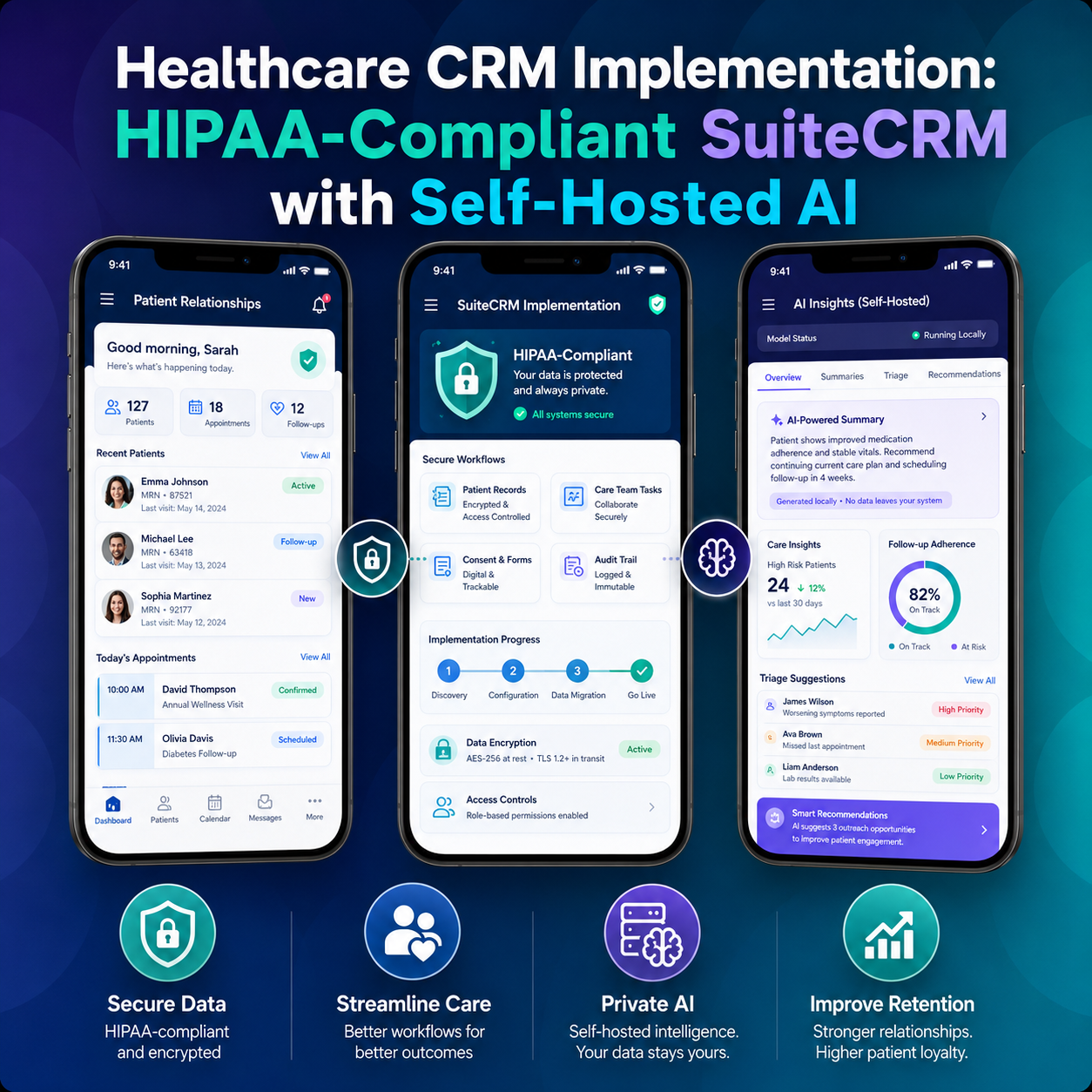
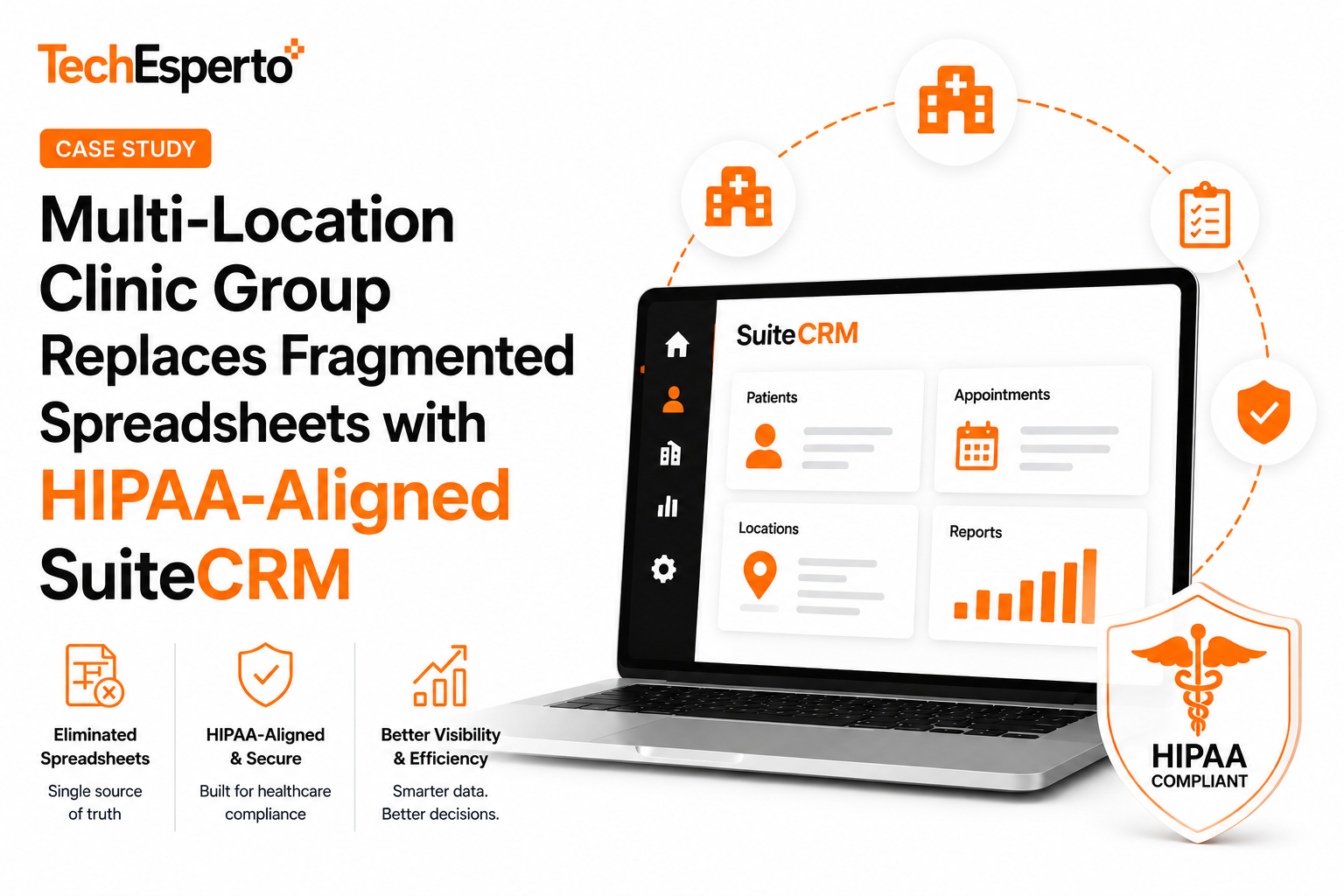
A multi-location healthcare provider migrated from a fragmented spreadsheet-based patient management system to a HIPAA-aligned SuiteCRM deployment with EMR integration. The result: unified patient lifecycle visibility across 12 clinic locations, automated referral routing, and a measurable improvement in appointment no-show rates.
Industry: Healthcare | Scale: Multi-location clinic group | Region: North America Investment: $45,000 implementation + $4,500/month managed support Timeline: 10 weeks discovery through go-live Key outcomes: Unified patient records across locations, 30% reduction in no-shows, audit-ready HIPAA documentation
Read the full Healthcare CRM case study →
For broader healthcare CRM context, see our Healthcare CRM solutions and SuiteCRM for Healthcare blog post.
A multi-location healthcare provider migrated from a fragmented spreadsheet-based patient management system to a HIPAA-aligned SuiteCRM deployment with EMR integration. The result: unified patient lifecycle visibility across 12 clinic locations, automated referral routing, and a measurable improvement in appointment no-show rates.
Industry: Healthcare | Scale: Multi-location clinic group | Region: North America Investment: $45,000 implementation + $4,500/month managed support Timeline: 10 weeks discovery through go-live Key outcomes: Unified patient records across locations, 30% reduction in no-shows, audit-ready HIPAA documentation
Read the full Healthcare CRM case study →
For broader healthcare CRM context, see our Healthcare CRM solutions and SuiteCRM for Healthcare blog post.
Case studies organized by industry vertical. Each links to the dedicated industry page for broader context.
See our Healthcare CRM solutions and SuiteCRM for Healthcare blog post for industry context.
Case studies covering end-to-end SuiteCRM deployments — from discovery through configuration, integration, training, and go-live. See our SuiteCRM Implementation service.
Featured: Healthcare multi-location deployment, FinTech compliance-aware deployment, Manufacturing distributor portal implementation.
Case studies covering end-to-end SuiteCRM deployments — from discovery through configuration, integration, training, and go-live. See our SuiteCRM Implementation service.
Featured: Healthcare multi-location deployment, FinTech compliance-aware deployment, Manufacturing distributor portal implementation.
Engagements where the primary outcome was significant cost reduction — typically Salesforce migrations or licensing rationalization.
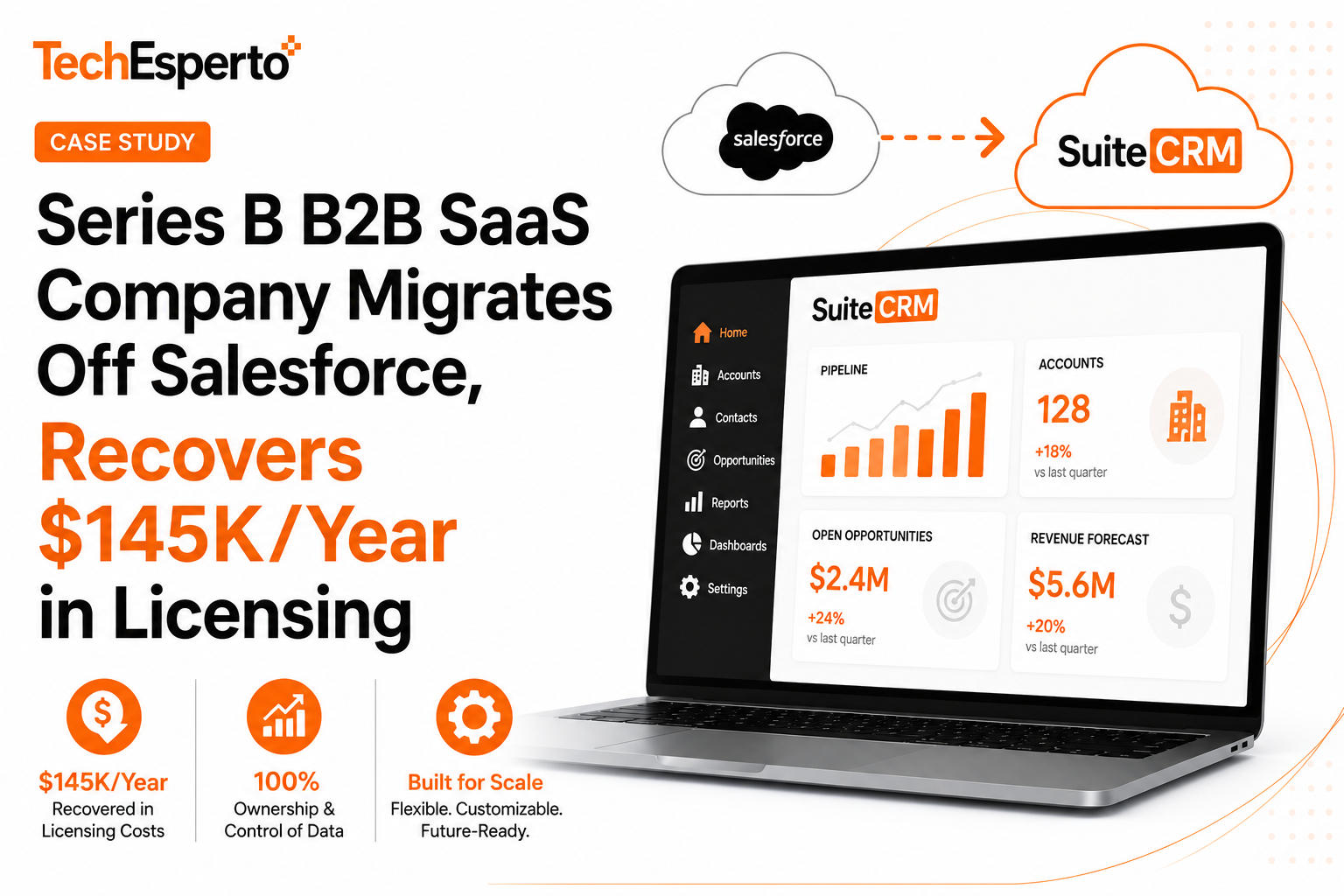
Featured: $145K/year SaaS Salesforce migration savings, $230K/year insurance brokerage migration savings, $80K/year wealth firm migration savings. For the broader economic case, see Salesforce Hidden Costs, SuiteCRM Cost Savings, and Signs Your CRM Is Costing You Money.
Engagements where the primary outcome was significant cost reduction — typically Salesforce migrations or licensing rationalization.
Featured: $145K/year SaaS Salesforce migration savings, $230K/year insurance brokerage migration savings, $80K/year wealth firm migration savings. For the broader economic case, see Salesforce Hidden Costs, SuiteCRM Cost Savings, and Signs Your CRM Is Costing You Money.
Every detailed case study follows the same structure so you can compare engagements directly:
Industry, scale (employee count, revenue range where shareable), geographic operations, business model. Where clients agree to be named, named. Where NDA applies, anonymized with enough industry context to be useful.
What the client was trying to solve. Specific problems — not generic “they needed a better CRM” language. Cost pressures, compliance gaps, growth constraints, system fragmentation, whatever the actual driver was.
What the alternative paths were (other agencies, other platforms, in-house build) and why they selected our approach. Helps you assess whether your situation matches.
Specific architecture decisions, integration patterns, customization depth, deployment model. With enough technical detail that someone evaluating us can assess our actual capability.
Real cost ranges (sometimes exact numbers when clients allow, sometimes ranges when NDA applies) and real timelines including discovery, build, and stabilization.
Measurable results 6 and 12 months post-launch. Where outcomes are quantifiable, quantified. Where outcomes are qualitative, described with specifics.
Honest notes about what worked, what didn’t, what we’d do differently. Most agency case studies skip this section because it doesn’t fit the marketing narrative. We include it because it’s actually useful.
If you want references specific to your industry, scale, or use case that aren’t published here, ask. We can share unpublished case study summaries and arrange reference calls under NDA where appropriate. Most published case studies represent the public-shareable version of clients who agreed to publication; we have broader experience that simply isn’t on the website.
To request specific references:
For broader vendor evaluation, see our guides on How to Choose a SuiteCRM Partner, the Ultimate CRM Buying Guide for 2026, and 5 Signs You Need a CRM Partner.
Why don’t you name more clients?
About half our clients allow public naming. The other half — particularly in healthcare, FinTech, and regulated industries — prefer their CRM provider not be public information. We respect those preferences. Where we can’t name, we describe by industry and scale with enough detail to be useful. Specific references available under NDA during sales conversations.
Are the cost numbers in case studies accurate?
Yes. Where exact numbers appear, they’re real. Where ranges appear, the actual number falls within the range. We don’t inflate cost numbers to make our pricing look cheaper or deflate them to look bigger. Honest math is more useful for everyone.
Are the outcome numbers in case studies accurate?
Yes. Where exact percentages appear, they’re real client-measured results. We don’t manufacture outcome metrics. If a client tells us they saw 30% no-show reduction, we say 30% — not 50%. Some outcomes are qualitative (“improved sales visibility”) because the client didn’t measure them quantitatively, and we don’t invent metrics that weren’t tracked.
Can I talk to a referenced client?
Yes, for serious sales conversations under NDA. Most published case study clients have agreed to take reference calls. We’ll arrange the call and brief them on what you’re looking to learn.
What if my industry isn’t represented in published case studies?
Can you share unpublished case studies under NDA?
Yes, for serious buyer conversations. NDA-protected case study summaries available during sales discussions for clients evaluating engagements above $25,000.
How do I use these case studies to evaluate fit?
Why are some case studies more detailed than others?
Depends on client willingness to publish detail. Clients who allow named publication often allow deeper detail. Clients under NDA often allow less. We publish what we can, and supplement with reference calls where appropriate.
Can you build a CRM like the one in [specific case study]?
Do you have case studies for the [specific industry/use case]?
How are case studies different from your portfolio?