
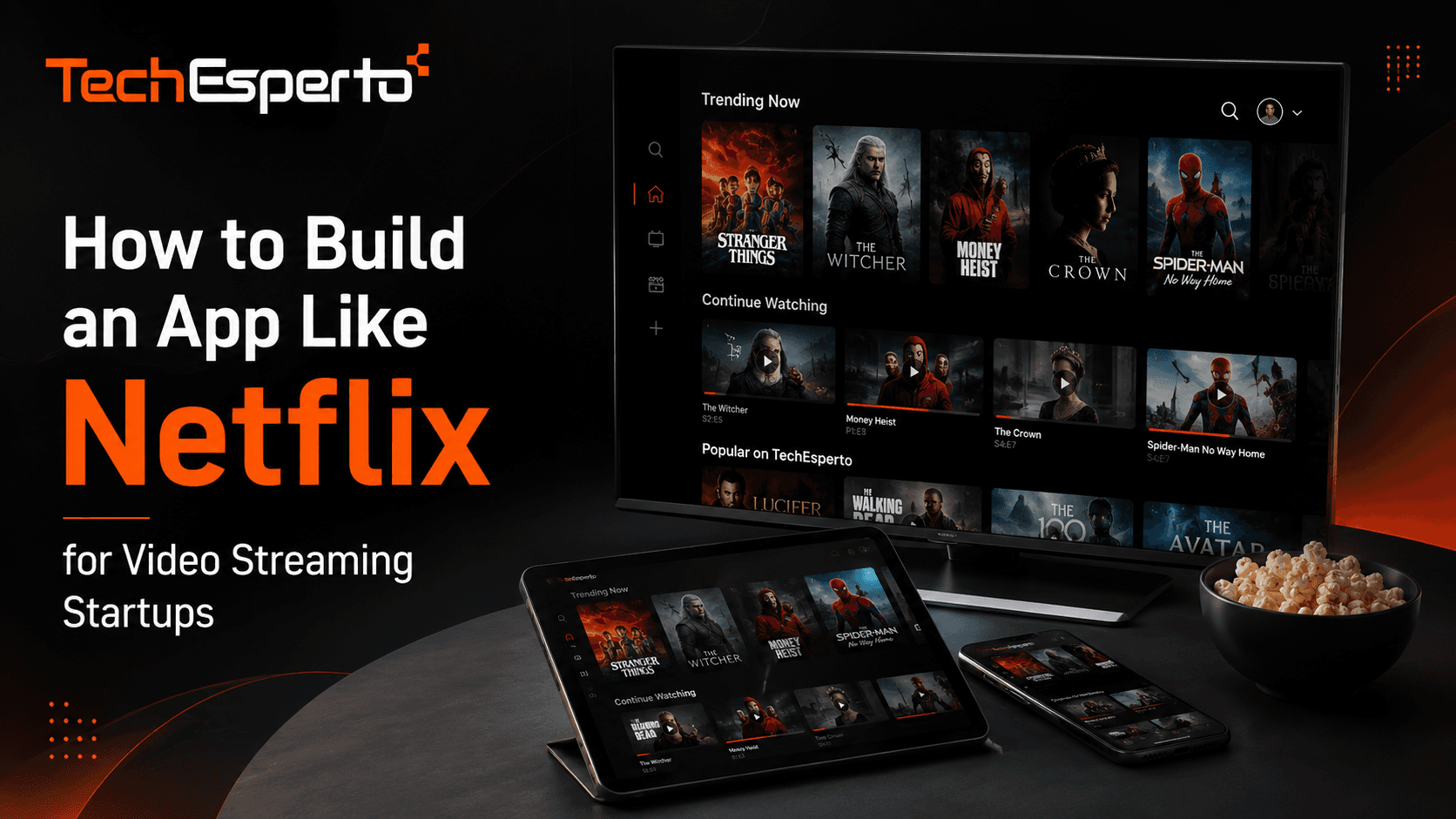
Building an app like Netflix means developing a video streaming platform with content management, adaptive playback, subscription billing, and recommendation features that work reliably across phones, tablets, smart TVs, and web browsers. TechEsperto Solutions helps content owners and streaming startups plan features, choose the right tech stack, and estimate development costs for a Netflix-style OTT platform.
Streaming platforms succeed by delivering video reliably across many devices while keeping viewers engaged through content discovery and recommendations. TechEsperto Solutions builds platforms like this as part of its broader OTT app development practice, and this guide covers what it takes to plan and build a Netflix-style video streaming app from the ground up.
What Is a Netflix-Style Streaming App
A Netflix-style app is a subscription-based video streaming platform that lets viewers browse a content library, stream video on demand, and manage their account across multiple devices. Unlike a simple video hosting site, this model requires content encoding for multiple device types and network speeds, subscription billing tied to account access, and recommendation logic that helps viewers find relevant content within a growing library. The platform also typically needs multi-profile support so different household members can have separate viewing histories and recommendations under one account. Building this kind of platform means planning for content delivery at scale from the start, since buffering or playback issues directly drive subscriber churn.
Content Library and Browsing
Viewers browse a categorized content library with search, genre filtering, and curated collections.
Adaptive Video Playback
Video quality adjusts automatically based on the viewer’s network conditions to minimize buffering.
Multi-Profile Account Support
A single subscription can support multiple user profiles, each with separate viewing history and recommendations.
Subscription Billing and Account Management
Viewers manage their subscription tier, payment method, and billing cycle directly through the app.
Content Recommendation Engine
Recommendation logic surfaces relevant content based on a viewer’s watch history and preferences.
Cross-Device Continuity
Viewers can start watching on one device and continue on another with playback position saved automatically.
Core Features You Need
A functional streaming platform needs content browsing and playback to work smoothly before any other feature matters, since viewers will abandon a platform with slow loading or frequent buffering regardless of how good the content library is. Search and discovery features need to help viewers find something to watch quickly, since a large library with poor navigation feels harder to use than a smaller, well-organized one. Subscription management needs to be simple enough that viewers can upgrade, downgrade, or cancel without contacting support for routine account changes. Once these fundamentals work reliably, recommendation and personalization features become the layer that keeps viewers engaged over the long term.
Content Search and Discovery
Search and browsing tools help viewers find content quickly within a growing library.
Adaptive Streaming Quality
Playback quality adjusts automatically based on network conditions to reduce buffering interruptions.
Multi-Device Playback
The same account works across phones, tablets, smart TVs, and web browsers with consistent access.
Download for Offline Viewing
Some platforms support downloading content for offline viewing on mobile devices.
Subscription Tier Management
Viewers can view, upgrade, downgrade, or cancel their subscription directly through account settings.
Parental Controls and Content Ratings
Content rating filters and parental controls help households manage what younger viewers can access.
How the Business Model Works
Netflix-style platforms typically generate revenue through recurring subscription fees, sometimes structured across multiple tiers based on video quality, number of simultaneous streams, or ad-supported versus ad-free access. Some platforms add advertising revenue through an ad-supported tier priced lower than the fully ad-free option, expanding the potential subscriber base to include price-sensitive viewers. Content licensing costs are typically the largest ongoing expense for platforms carrying third-party content, while platforms producing original content face different cost structures tied to production budgets. Understanding this revenue and cost structure early helps founders decide whether a single subscription tier or a multi-tier model fits their target content and audience.
Recurring Subscription Fees
Most revenue comes from recurring monthly or annual subscription fees tied to account access.
Tiered Pricing by Quality or Features
Subscription tiers can vary by video quality, number of simultaneous streams, or download availability.
Ad-Supported Tier Options
Some platforms offer a lower-priced tier that includes advertising to reach price-sensitive viewers.
Content Licensing Costs
Licensing third-party content is typically a major ongoing cost for platforms not producing original content.
Original Content Investment
Platforms producing their own content face production costs distinct from licensing fees.
Free Trial and Retention Strategies
Free trial periods and retention offers help convert new sign-ups into long-term subscribers.
Key Technical Components
Building a streaming platform requires several technical components working together to deliver a reliable viewing experience. Video encoding and content delivery infrastructure prepare and distribute video efficiently across different network conditions and device types. Subscription and billing systems manage recurring payments and tier changes, while a content management system lets the operator upload, organize, and tag content with metadata that powers search and recommendations. A recommendation engine analyzes viewing behavior to suggest relevant content, and digital rights management protects licensed content from unauthorized use. All of these systems need to work together without introducing playback delays.
Video Encoding and Content Delivery
Encoding and content delivery infrastructure prepare video for smooth playback across devices and network speeds.
Content Management System
The content management system lets operators upload, tag, and organize video content and metadata.
Subscription and Billing System
Billing systems manage recurring payments, tier changes, and failed payment handling.
Recommendation Engine
Recommendation logic uses viewing history and behavior to surface relevant content to each viewer.
Digital Rights Management
Digital rights management protects licensed content from unauthorized copying or redistribution.
Cross-Platform Client Apps
Client apps need to be built or adapted for phones, tablets, smart TVs, and web browsers.
Development Process and Timeline
Building a streaming platform typically starts with confirming the initial content library size and target devices, since supporting every smart TV platform from day one adds significant scope compared to launching on phones and web first. MVP scoping narrows the feature list to core browsing, playback, and subscription functions, deferring recommendation engine sophistication and multi-tier pricing to later phases. Video encoding pipeline setup needs to happen early, since this infrastructure underpins every other feature. Testing needs to cover playback across a range of real network conditions and devices, not just ideal conditions, since buffering issues under real-world use are the most common source of viewer complaints.
Discovery and Requirement Mapping
Early discovery confirms content library size, target devices, and monetization approach.
MVP Feature Scoping
MVP scoping narrows the feature list to core browsing, playback, and subscription functions.
UI/UX Design
Design work covers the viewer experience across supported device types, prioritized by target audience.
Development and Integration
Development covers the viewer app, content management system, and billing platform in parallel.
Testing and Quality Assurance
Testing covers playback across a range of real network conditions and devices before launch.
Launch and Post-Launch Support
Launch typically starts with a smaller content library and device set before expanding.
Common Challenges and How to Solve Them
Streaming startups tend to face a specific set of challenges tied to content delivery and licensing. Video encoding and delivery infrastructure can be expensive and technically complex to get right, especially at scale, which is why many platforms rely on established content delivery providers rather than building this from scratch. Content licensing negotiations can be slow and costly, which is why some platforms start with original or independently licensed content rather than competing for major studio deals immediately. Subscriber churn is an ongoing challenge that depends heavily on content freshness and recommendation quality, both of which take time to optimize after launch. Recognizing these challenges early helps founders plan realistic content acquisition and infrastructure budgets.
Video Delivery Infrastructure Complexity
Reliable video delivery at scale is technically complex, which is why many platforms use established content delivery providers.
Content Licensing Costs and Negotiation
Licensing third-party content can be slow and expensive, leading some platforms to start with original or independently sourced content.
Subscriber Churn Management
Churn depends heavily on content freshness and recommendation quality, both of which improve gradually after launch.
Multi-Device Consistency
Ensuring a consistent experience across phones, smart TVs, and web browsers takes ongoing testing and maintenance.
Recommendation Engine Quality
Recommendation accuracy improves over time as more viewing data accumulates, so early recommendations may feel less refined.
Competing with Established Platforms
New entrants often succeed by focusing on a specific genre or audience underserved by major streaming platforms.
FAQs
How much does it cost to build an app like Netflix?
Building an app like Netflix typically costs between $40,000 and $80,000 for an MVP with core streaming and subscription features, and $80,000 to $200,000 for a full platform including content management and multi-device support. Enterprise-scale, multi-device systems start at $200,000 and scale with content library size and device support.
How long does it take to build a streaming app like this?
Timelines vary based on scope, but a streaming app with core browsing and playback features typically takes several months from discovery through launch. Adding smart TV support or advanced recommendation features extends the timeline.
Do I need to build support for smart TVs from launch?
Not necessarily. Many platforms launch first on phones and web browsers, then add smart TV platform support once the core experience is proven, since each smart TV platform typically requires separate development work.
How does content licensing affect development costs?
Content licensing itself is a business cost separate from development costs, but the platform needs digital rights management features built in to support licensed content protection requirements, which does affect development scope.
Can a smaller streaming platform compete with major services?
Yes, smaller platforms often succeed by focusing on a specific genre, niche audience, or independent content library that major platforms do not prioritize, rather than trying to compete on total content volume.
Can TechEsperto Solutions help build a platform like this?
Yes, TechEsperto Solutions builds custom OTT app development platforms, including payment gateway integration for subscription billing, scoped around your content library and target devices.