
A regional on-demand delivery startup wanted to launch a delivery service in a new local market but needed a platform built quickly enough to capture early demand without sacrificing the dispatch reliability that determines whether a delivery service actually works. This case study covers how we built a three-sided delivery platform, customer, merchant, driver, and the impact it had on the company’s market launch.
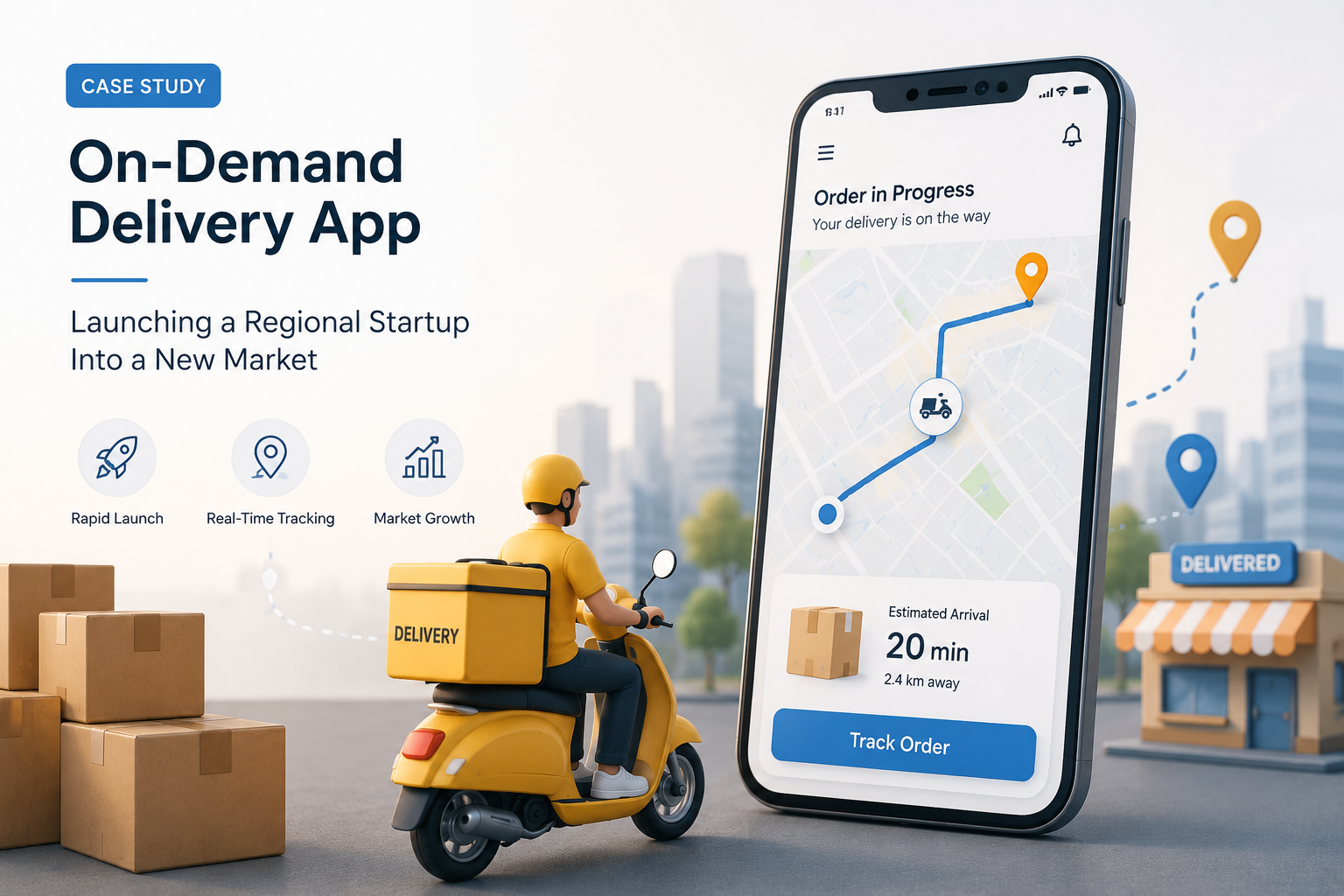
The startup faced a specific set of constraints common to new on-demand delivery launches.
The company needed to launch within a compressed timeline to capture early market demand before competitors could establish themselves in the same local market.
Without any existing dispatch or driver coordination system, the platform needed to be built from the ground up, covering customer ordering, merchant order management, and driver assignment simultaneously.
As a new market entrant, the company had limited data on exactly how demand would distribute across the day and across different order types, making flexible, easily adjustable dispatch logic important from the start.
We built a focused MVP designed to prove the core delivery loop quickly while remaining flexible enough to adjust as real usage data emerged.
Rather than building every conceivable feature, we prioritized the core loop, order, dispatch, delivery, payment, that needed to work flawlessly for the launch to succeed, deferring secondary features to a fast-follow release.
We built dispatch assignment logic that the company’s team could adjust as real demand patterns emerged, rather than hardcoding assumptions that might not match actual market behavior.
Recognizing that driver supply is often the harder side of a delivery marketplace to build, we invested particular attention in driver app usability and payout transparency to support driver retention from day one.
Following launch, the company successfully entered its target market with a platform that performed reliably under real conditions.
The platform launched within the company’s target timeline, allowing it to begin capturing market demand as planned.
Order-to-delivery dispatch performed reliably from day one, with the large majority of orders assigned to a driver within the target time window.
Driver retention in the initial launch period exceeded the company’s expectations, reflecting the attention paid to driver app usability and payout transparency during the build.
This launch reflects a pattern we see consistently: on-demand delivery platforms succeed when the MVP stays focused on the core dispatch loop and driver experience, rather than attempting every feature at once. If you’re planning a similar market entry, our on-demand app development team can help scope a launch-ready MVP for your specific market and timeline.
A focused MVP prioritizing the core order-dispatch-delivery loop gets a new delivery platform to market faster than attempting a full feature set at launch. Configurable dispatch logic allows adjustment as real demand data emerges, rather than locking in untested assumptions. Driver experience deserves early, deliberate investment given how much delivery platform success depends on driver supply and retention, and a compressed launch timeline is achievable without sacrificing dispatch reliability when scope is managed deliberately.