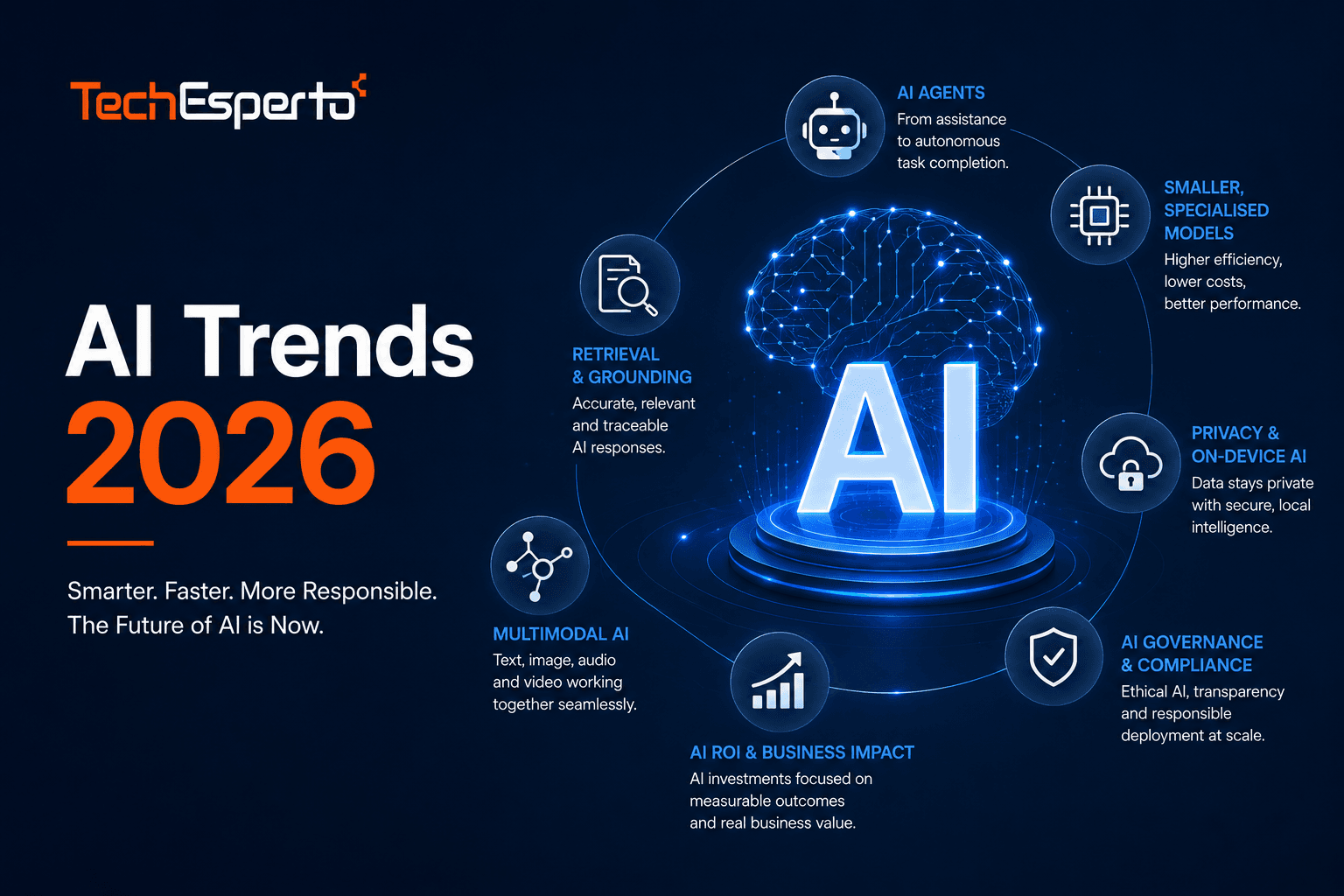
The AI trends 2026 conversation has shifted from capability demonstrations to deployment economics. Organisations that ran pilots through the previous two years are now deciding which reach production, and the criteria are unglamorous: cost per task, reliability under real conditions, and whether outputs can be audited. This guide covers the developments actually changing how businesses build and buy AI, from agentic systems and smaller specialised models to retrieval architectures and governance requirements, with an assessment of what each means for planning.
From Assistants to Agentic Systems
The most substantive shift is from systems that answer questions to systems that complete tasks. An assistant returns text a person then acts on. An agent takes actions itself, calling tools, querying systems, and chaining steps toward an outcome. This changes the value proposition considerably, because the labour saved is the whole task rather than the drafting portion. It also changes the risk profile, since a system taking actions can cause consequences a system producing text cannot.
Task Completion Rather Than Text Generation
Agents execute multi-step work against real systems, closing the gap between an AI suggestion and a completed outcome. This is where the measurable operational saving now sits for most organisations.
Tool Access as the Enabling Layer
Agents become useful when connected to the systems where work happens. Standardised tool interfaces have made AI agent development far more practical than bespoke integration work allowed previously.
Human Approval Gates on Consequential Actions
Production deployments increasingly place review points before actions with financial, legal, or customer impact. Full autonomy remains uncommon outside low-consequence internal workflows.
Reliability as the Limiting Factor
Multi-step tasks compound error rates, so a system reliable at each step can still fail frequently across a sequence. Evaluation frameworks matter more here than raw model capability.
Starting With Contained Internal Workflows
Most organisations begin with internal processes where errors are recoverable. Reviewing practical approaches to building an AI agent shows where the boundary between useful and premature currently sits.
Smaller Specialised Models Displacing Default Frontier Use
For a period the default was to route everything to the largest available model. That is changing on economics. Smaller models, sometimes fine-tuned for a narrow task, now handle many production workloads at a fraction of the cost and latency, with the frontier model reserved for genuinely difficult reasoning. This is producing tiered architectures where requests are routed by complexity, and it is one of the more consequential shifts for anyone managing an AI budget at volume.
Routing Requests by Task Complexity
Classification, extraction, and formatting rarely require frontier capability. Routing these to smaller models cuts cost substantially without noticeable quality difference on the tasks concerned.
Fine-Tuning for Narrow Repeated Tasks
Where a task is high-volume and well-defined, a tuned smaller model frequently outperforms a general model on both accuracy and cost, though it requires labelled examples and ongoing maintenance.
On-Device and Private Deployment
Smaller models make local and private-cloud deployment viable, which matters for data residency requirements and for latency-sensitive applications that cannot tolerate network round trips.
Managing a Multi-Model Architecture
Running several models introduces evaluation and versioning complexity. Deciding between approaches such as RAG vs fine-tuning should follow from task characteristics rather than default preference.
Treating Model Choice as Reversible
Model capability and pricing continue to move quickly. Architectures that abstract the model behind an interface allow substitution without rewriting application logic.
Retrieval and Grounding Becoming Standard Architecture
Grounding model outputs in your own verified content has moved from a technique to an assumed default for business applications. The reason is practical rather than theoretical: a model answering from your current documentation gives answers you can trace to a source, while a model answering from training data gives answers you cannot verify and that go stale. This has made data quality and content maintenance central to AI performance in a way that was not obvious two years ago.
Traceability as a Business Requirement
Citing the source behind an answer is now expected in regulated and enterprise contexts. It also makes wrong answers diagnosable, since you can see which document caused the error.
Content Quality Determining Output Quality
Retrieval systems inherit the accuracy of the content they search. Outdated documentation produces confidently wrong answers, which makes content ownership an AI concern rather than purely an operational one.
Structured Data Alongside Documents
Combining retrieval over documents with queries against operational databases produces answers grounded in both policy and current state, which is where most genuinely useful business applications sit.
Evaluation Frameworks Maturing
Measuring retrieval quality separately from generation quality has become standard practice, because failures in either produce the same symptom while requiring different fixes.
Foundations Before Sophistication
Retrieval performance depends on data organisation. Establishing that foundation through AI consulting services precedes any meaningful gain from architectural sophistication.
Where Budgets and Governance Are Moving
Spending patterns have changed shape. The exploratory budget that funded pilots is consolidating into fewer production deployments with measured returns, while a growing share goes to the surrounding infrastructure: evaluation, monitoring, governance, and the data work that makes systems reliable. This is a normal maturation pattern, and it means the questions asked of AI proposals now resemble those asked of any other capital investment.
Consolidation From Pilots to Production
Organisations are terminating pilots that never demonstrated measurable value and concentrating investment in the smaller number that did. Proof of return has replaced proof of concept as the threshold.
Infrastructure Absorbing a Larger Share
Monitoring, evaluation, and governance tooling now account for a meaningful portion of AI spend. These are what make deployments sustainable rather than what makes them impressive.
Compliance Requirements Shaping Design
Regulatory obligations increasingly influence architecture from the outset, particularly around data handling, disclosure, and auditability, rather than being addressed after a system is built.
Vision and Multimodal Reaching Production
Document processing, quality inspection, and visual search have become dependable production applications, with computer vision development now a routine rather than experimental investment.
Internal Capability Over Vendor Dependence
Organisations are building enough internal understanding to evaluate vendors and adapt systems, having found that complete outsourcing leaves them unable to judge what they are buying.
Frequently Asked Questions
What is the biggest AI trend for 2026?
The shift from assistants that generate text to agents that complete tasks against real systems. This changes the economics, because the saving covers the whole task rather than the drafting portion, and it changes the risk profile, since acting systems can cause consequences that text-producing systems cannot.
Are large frontier models still necessary?
For genuinely difficult reasoning, yes. For classification, extraction, and formatting, smaller models handle the work at far lower cost and latency. Tiered architectures routing by complexity are becoming standard, with frontier capability reserved for the requests that need it.
Should businesses build or buy AI capability in 2026?
Usually both. Buy the model and infrastructure layers, build the application logic, evaluation, and data preparation specific to your context. Complete outsourcing tends to leave organisations unable to assess whether what they purchased actually works.
Is AI adoption slowing down?
Adoption is consolidating rather than slowing. Pilots that never showed measurable return are being terminated while investment concentrates in fewer production deployments, alongside growing spend on the monitoring and governance that keep those deployments reliable.
How should we prioritise AI investment?
Start where tasks are high-volume, well-defined, and currently manual, and where errors are recoverable. These conditions produce measurable returns quickly and build internal capability before you attempt anything customer-facing or consequential.
What is changing about AI governance?
Compliance requirements are influencing architecture from the design stage rather than being applied afterwards. Data handling, disclosure of AI involvement, and the ability to audit decisions are becoming design constraints rather than documentation exercises.