The agile vs waterfall debate is usually framed as modern against outdated, which obscures the actual choice. Both are ways of managing uncertainty, and they make opposite bets about how much you can know at the start. Waterfall assumes requirements can be defined upfront and delivers against a fixed plan. Agile assumes they will change and delivers in increments that absorb that change. The right answer depends on your requirements stability, contracting model, and regulatory context. This guide compares them on the dimensions that decide real projects.
How Each Methodology Actually Works
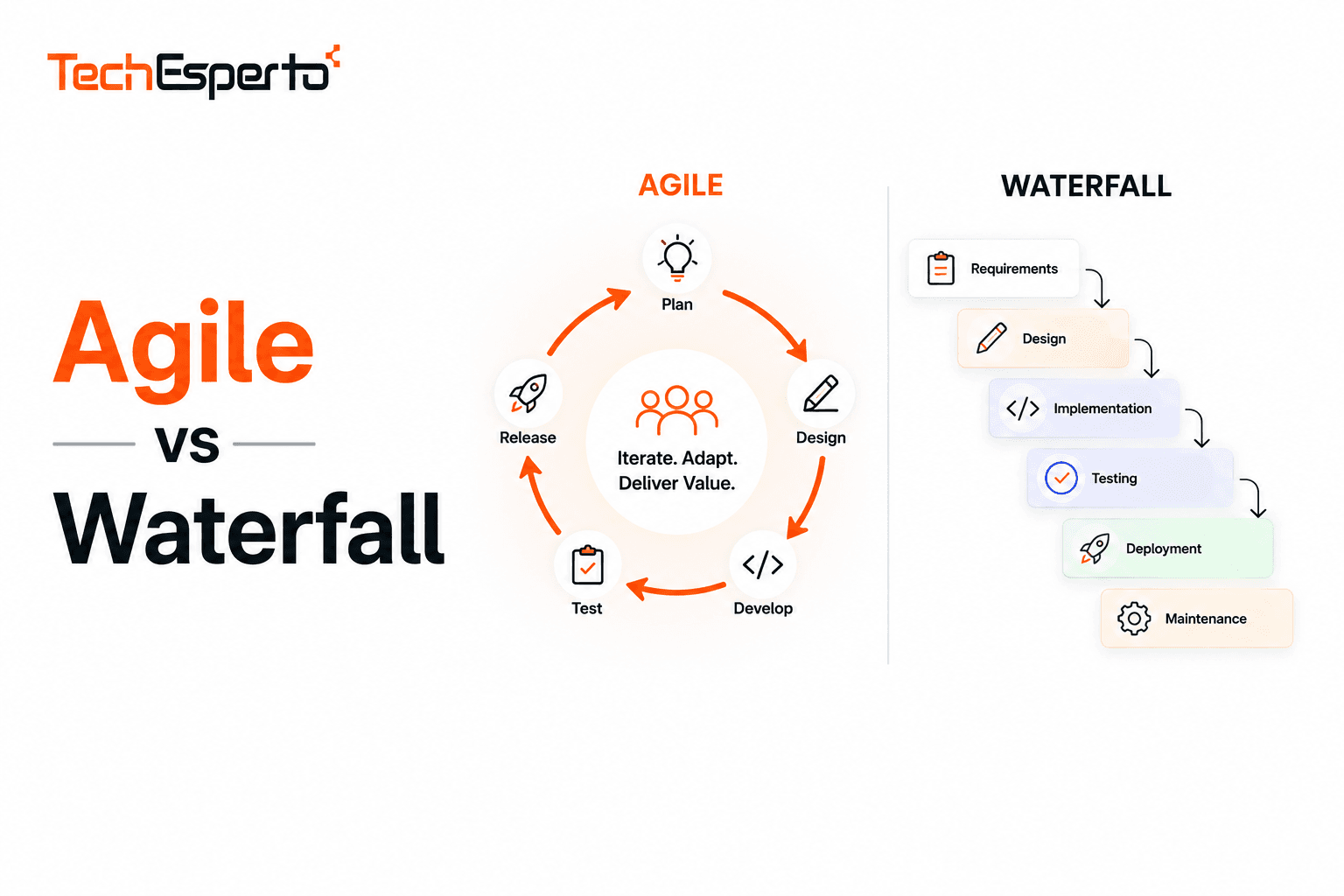
Both methodologies cover the same activities, requirements, design, build, test, and release. They differ in sequence and in how often they revisit earlier decisions. Waterfall completes each phase before the next begins, producing a full specification before development starts. Agile repeats the whole cycle in short iterations, delivering working software at the end of each and adjusting the plan based on what that iteration revealed. Understanding this structural difference explains most of the practical trade-offs that follow.
The Sequential Structure of Waterfall
Requirements are gathered and signed off, then design, then development, then testing, then release. Each phase has defined deliverables and approval gates, and work does not proceed until the preceding gate closes.
The Iterative Structure of Agile
Work is divided into short cycles, each producing something usable. Priorities are reassessed at every cycle boundary, so the plan is a living artefact rather than a document approved once at the start.
Where Requirements Are Decided
Waterfall front-loads requirement definition into a single detailed specification. Agile captures intent at a higher level and resolves detail progressively, as the team reaches each item and learns from what shipped before.
How Change Is Handled
Waterfall treats change as an exception managed through formal change control. Agile treats it as expected input, reprioritised into the backlog without renegotiating the entire plan or contract.
When Working Software Appears
Waterfall produces its first working build late in the project. Agile produces one early and repeatedly, which is the single largest practical difference for stakeholders who need to see progress rather than read about it.
Comparing Them on Cost, Risk, and Predictability
The genuine trade-off is between predictability and adaptability, and you cannot maximise both. Waterfall gives you a fixed scope, a fixed price, and a fixed date, at the cost of discovering problems late and paying heavily to change direction. Agile gives you the ability to respond to what you learn, at the cost of a scope that is not fully specified when you sign. Which trade you should accept depends on how confident you genuinely are about the requirements.
Budget Certainty Versus Budget Flexibility
Waterfall supports fixed-price contracts because scope is defined in advance. Agile typically uses time-based arrangements, trading upfront certainty for the ability to redirect spend toward what proves valuable.
When Risk Surfaces in the Project
Waterfall concentrates risk at integration and testing, late in the schedule when correction is most expensive. Agile distributes risk across iterations, surfacing problems while they remain cheap to address.
Accuracy of Timeline Estimates
Waterfall estimates look precise and frequently prove wrong, because they rest on assumptions untested until development. Agile estimates are ranges that tighten as the team establishes an actual delivery rate.
Visibility for Stakeholders
Waterfall reports progress against a plan through documentation. Agile demonstrates it through working software at each cycle, which sponsors generally find more convincing than percentage-complete reporting.
Choosing an Engagement Model to Match
Your methodology and commercial arrangement must align. Reviewing available engagement models before signing prevents the common failure of agile delivery inside a fixed-scope contract.
Deciding Which Approach Fits Your Project
Methodology choice follows from project characteristics, not preference. Projects with genuinely stable, well-understood requirements and formal approval obligations often run better under waterfall, because the overhead of iteration planning buys nothing when nothing is going to change. Projects exploring a market, building for users whose behaviour is unknown, or integrating with systems nobody has fully documented benefit from iteration, because the information needed to plan properly does not exist yet.
When Waterfall Is the Better Choice
Fixed regulatory deliverables, hardware dependencies with immovable dates, and contracts requiring detailed scope before signature all favour sequential delivery. Certainty matters more than adaptability in these conditions.
When Agile Is the Better Choice
New products, unvalidated user assumptions, and evolving markets favour iteration. If you expect to learn something during the build that changes what you should build, agile captures that value rather than discarding it.
Assessing Your Requirement Stability Honestly
The key question is whether your requirements are truly settled or merely written down. Documented assumptions are not validated requirements, and treating them as such is why many waterfall projects overrun.
Matching Methodology to Team Structure
Agile depends on a stable, available team and an empowered product owner. Without continuous availability, iterations stall. A dedicated development team provides the continuity agile requires to function.
Validating the Approach on Smaller Scope First
Running a contained MVP development cycle tests both the product assumption and the working relationship before committing to a longer engagement under either methodology.
Running a Hybrid Approach in Practice
Most established delivery organisations run neither methodology in pure form. They define scope and architecture more thoroughly upfront than agile orthodoxy suggests, then build iteratively within that frame. This suits clients who need a credible budget and date at the outset but want the flexibility to adjust detail as the product takes shape. The hybrid works when the boundaries are explicit: what is fixed, what can flex, and how changes are agreed.
Fixing Scope at the Outcome Level
Agree what the product must achieve and the major capabilities required, while leaving implementation detail open. This gives sponsors a stable commitment without forcing premature decisions about screens and flows.
Running Discovery as a Distinct Phase
A defined discovery period producing architecture, prototypes, and a prioritised backlog resolves the largest unknowns before the main build, which improves estimate quality substantially.
Setting an Explicit Change Protocol
Document how scope changes are raised, assessed, and approved, including their effect on timeline. Ambiguity here is where hybrid arrangements most often break down into disputes.
Keeping Documentation Proportionate
Regulated environments need audit trails that pure agile does not naturally produce. Maintain the documentation compliance requires without reverting to full specification-driven delivery.
Anchoring on a Defined Delivery Process
A documented delivery process with clear phase boundaries and handoffs lets hybrid arrangements stay disciplined rather than drifting into unstructured work.
Frequently Asked Questions
Is agile always better than waterfall?
No. Agile suits projects where requirements will evolve and early feedback has value. Waterfall suits projects with genuinely stable requirements, fixed regulatory deliverables, or contracts demanding full scope definition upfront. The methodology should follow the conditions rather than current industry preference.
Can you fix a price for an agile project?
You can fix a budget and a timebox rather than a detailed scope. The team delivers the highest-priority work within that envelope. Fixing both price and full scope while claiming agile delivery is the arrangement that most reliably produces conflict later.
Which methodology is faster?
Agile usually delivers usable software sooner because it ships increments rather than waiting for completion. Total duration to a fully finished product is comparable. The advantage is earlier value and earlier learning, not a shorter overall calendar.
What is the main risk of waterfall?
Discovering late that the specification was wrong. Because working software appears near the end, misunderstandings about requirements stay hidden through design and development, and correcting them at that point costs far more than it would have earlier.
Can agile work with fixed deadlines?
Yes, by holding the date fixed and letting scope flex. The team delivers the most valuable work by the deadline rather than attempting a complete feature list. This requires stakeholders willing to prioritise honestly rather than declaring everything essential.
What is a hybrid methodology?
An approach that defines scope, architecture, and budget more firmly upfront, then builds iteratively within that frame. It suits organisations needing commercial predictability without losing the ability to adjust detail as the product develops through real feedback.