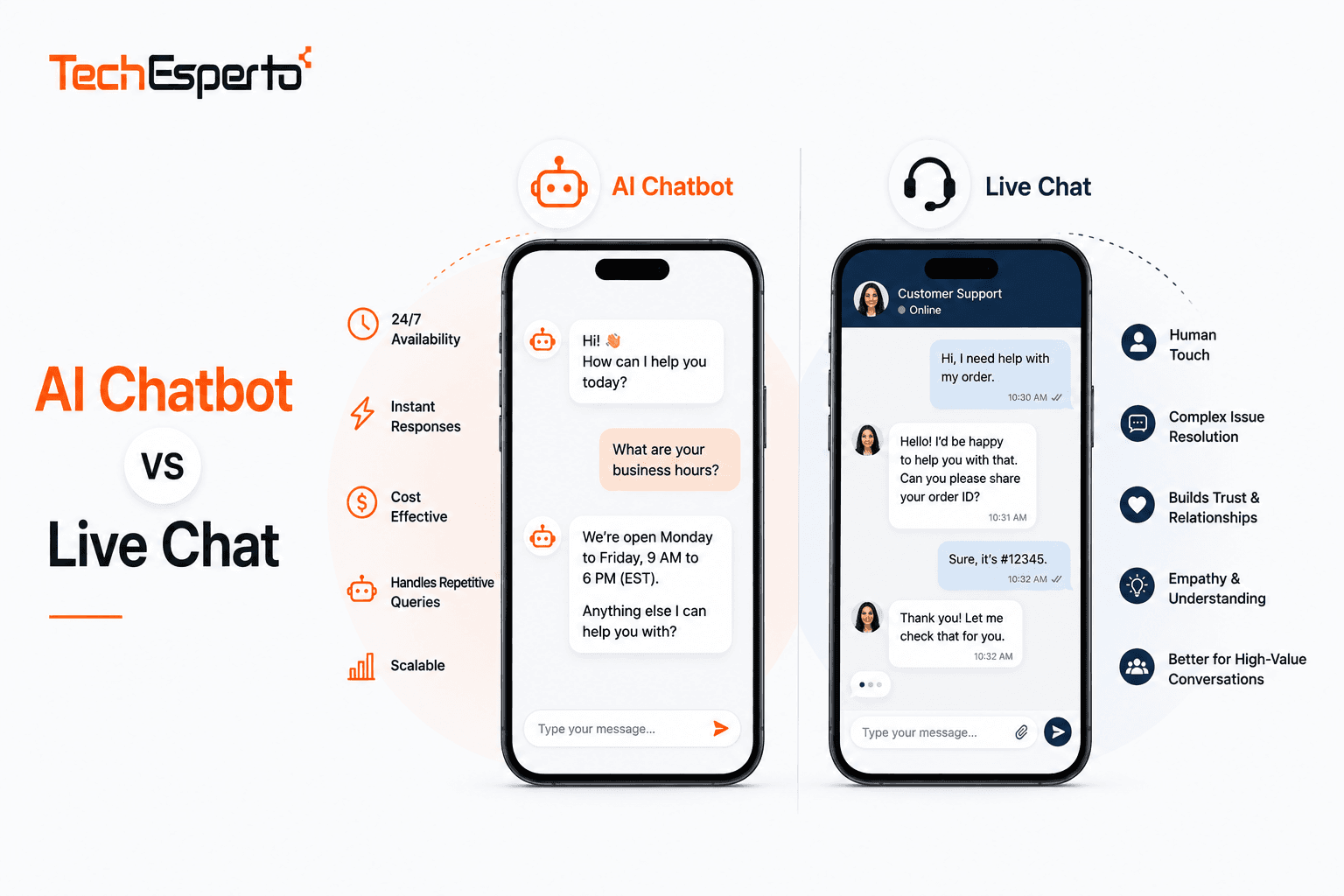
The AI chatbot vs live chat question is rarely an either-or decision in practice. Most support operations that work well run both, with a routing layer deciding which handles each conversation. The real questions are which contact types automation resolves reliably, where handing to a human protects the relationship, and how to move between them without making the customer repeat themselves. This guide compares the two on cost, resolution quality, and coverage, then sets out a routing model you can apply to your own contact mix.
Comparing the Two on What Actually Matters
Headline comparisons usually reduce to cost per conversation, which flatters automation by ignoring what happens when it fails. A chatbot that resolves a query instantly is cheaper and faster than any human alternative. A chatbot that fails to resolve one, and makes the customer repeat everything to an agent afterwards, costs more than routing directly to that agent would have. Comparing properly means measuring resolution and satisfaction alongside cost rather than in isolation from it.
Cost Per Conversation Versus Cost Per Resolution
Automated conversations cost a fraction of staffed ones, but only resolved conversations count. Measuring cost per resolution rather than per conversation reveals whether automation is genuinely reducing spend or just deferring it.
Availability and Response Time
Automation answers immediately at any hour, which matters for customers in other timezones and outside business hours. Live chat gives better outcomes on complex issues but only during staffed periods.
Handling Ambiguity and Emotion
Frustrated customers, unusual circumstances, and situations requiring judgement are where human agents remain clearly stronger. Routing these to automation damages the relationship more than the saved cost is worth.
Consistency of Information
Automation gives the same answer every time, which is an advantage where accuracy matters and a liability when the underlying content is wrong. Human agents vary but adapt.
Scaling Through Demand Peaks
Automation absorbs volume spikes without a queue forming. This is often the strongest practical argument for AI chatbot development in businesses with seasonal or campaign-driven contact patterns.
Deciding Which Conversations Automation Should Handle
The productive way to divide work is by conversation type rather than by percentage target. Some categories are reliably automatable: they have a definite answer, a stable process, and low emotional weight. Others are not, because they require judgement, carry financial or reputational risk, or involve a customer already unhappy. Auditing your actual contact reasons and sorting them into these groups produces a better routing design than deciding in advance what proportion of contacts automation should absorb.
Automating Definite-Answer Queries
Order status, opening hours, policy questions, and account details have single correct answers retrievable from a system. These are the highest-confidence automation candidates and usually the largest volume category.
Automating Guided Processes
Password resets, appointment booking, and returns follow fixed steps. Automation performs these consistently, provided the underlying systems expose the actions through reliable workflow automation.
Keeping Judgement Calls With Agents
Complaints, exceptions to policy, and anything involving discretion belong with humans. Automation applying rules rigidly in these situations produces technically correct answers that lose customers.
Keeping High-Value Interactions Staffed
Enterprise accounts, upsell conversations, and cancellation attempts justify human attention on commercial grounds alone, regardless of whether automation could technically handle the exchange.
Reviewing Language and Intent Coverage
Automation only handles what it understands. Assessing intent coverage through NLP development services shows which contact reasons your model handles confidently and which it should not attempt.
Designing the Handoff Between Bot and Agent
Most failures in hybrid support happen at the transition rather than inside either channel. A customer who has explained their problem to a bot and must explain it again to an agent has experienced worse service than if they had reached the agent immediately. Designing the handoff properly, including when it triggers, what transfers with it, and what the customer sees, determines whether automation improves the experience or simply adds a step before real help.
Triggering Escalation on Confidence, Not Attempts
Escalate when the system is uncertain rather than after a fixed number of failed exchanges. Repeated misunderstanding before handoff is the most common complaint about automated support.
Transferring Full Context With the Conversation
The agent should receive the transcript, identified intent, and any account data already retrieved. Making the customer repeat themselves negates the value of the automated portion entirely.
Offering an Agent Route at Any Point
A visible option to reach a person builds trust and is used less often than teams expect. Hiding it produces frustration and drives customers to other channels.
Setting Honest Expectations Upfront
Tell customers they are speaking with an assistant and what it can help with. Attempting to pass automation off as human damages credibility when the limitation eventually shows.
Extending the Model to Voice Channels
The same routing logic applies to phone contact, where AI voice agent development handles definite-answer calls and transfers judgement calls with context intact.
Measuring Performance and Improving Over Time
Automated support degrades without maintenance because customer questions change, products change, and the content behind the answers goes stale. Treating deployment as completion produces a system that performs well initially and slowly worsens. The operations that sustain results review failed conversations regularly, expand coverage where volume justifies it, and remove automation from categories where it consistently underperforms. This requires ownership and a measurement framework rather than occasional attention.
Tracking Containment and Satisfaction Together
Containment rate alone rewards refusing to escalate. Pairing it with satisfaction and repeat-contact rate shows whether contained conversations were genuinely resolved.
Reviewing Failed Conversations Weekly
Transcripts where the system failed are the most valuable training input available. Regular review identifies missing intents and incorrect answers faster than any other method.
Measuring Repeat Contact Rate
Customers returning within days with the same issue indicate false resolutions. This metric catches problems that containment and satisfaction scores both miss.
Keeping Source Content Current
Automated answers are only as accurate as the content behind them. Assign ownership for keeping that content updated as products and policies change, or accuracy erodes quietly.
Building Internal Capability to Iterate
Continuous improvement needs people who can adjust intents and flows. Access to AI chatbot developers turns the system into an improving asset rather than a fixed deployment.
Frequently Asked Questions
Should I replace live chat with an AI chatbot?
Rarely entirely. Automation handles definite-answer and guided-process queries well, but complaints, exceptions, and high-value conversations still benefit from human agents. Most successful operations run both with routing between them rather than replacing one channel with the other.
What percentage of support can a chatbot handle?
It depends on your contact mix rather than the technology. Businesses with a high share of status and policy queries automate a larger proportion than those handling complex or emotional issues. Audit your actual contact reasons before setting any target.
How do customers react to AI chatbots?
Positively when the assistant resolves their issue quickly and identifies itself honestly, negatively when it loops without understanding or hides the route to a person. Reaction tracks resolution quality far more closely than it tracks any preference for human contact.
When should a chatbot escalate to a human?
When confidence in understanding drops, when the customer requests it, and when the topic falls into categories you have designated for human handling. Escalating on uncertainty rather than after repeated failed attempts produces a much better experience.
Is live chat more expensive than automation?
Per conversation, yes. Per resolution, not always. Automation that fails and then requires an agent anyway costs more than direct routing would have, which is why cost comparisons should use resolution rather than conversation as the unit.
Can both channels run at the same time?
Yes, and most effective setups do. Automation handles first contact and resolves what it can confidently, transferring everything else to agents with full context attached so the customer never restarts their explanation.