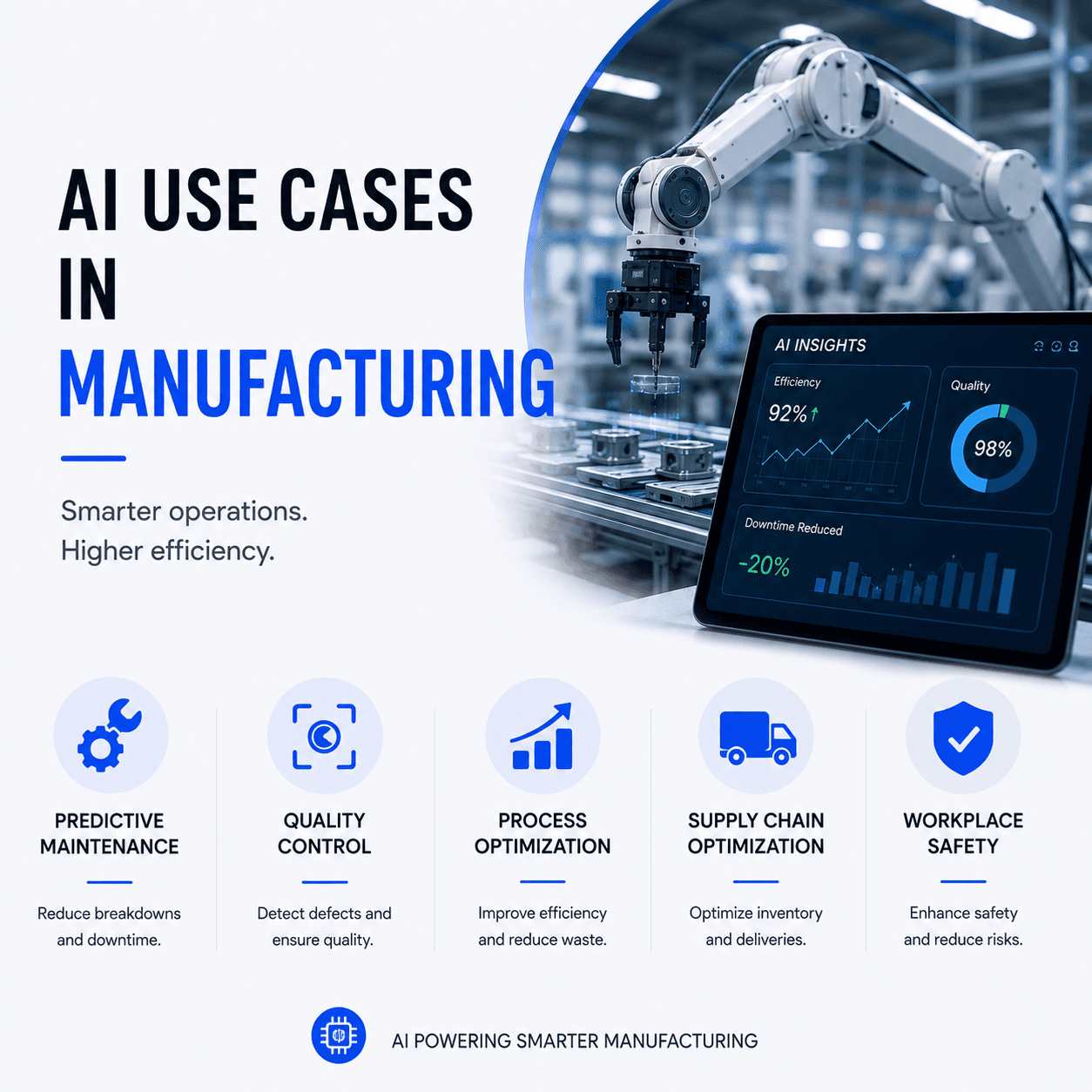
Manufacturing has better conditions for AI than most sectors, because processes are repetitive, outcomes are measurable, and sensor data already exists in volume. The use cases below are the ones that reach production most reliably, presented with what each actually requires rather than what it promises. The pattern that distinguishes success is unglamorous: a specific decision someone makes repeatedly, historical data covering enough failures or defects to learn from, and a person able to act on the output.
Predictive Maintenance
Predictive maintenance is the most established manufacturing AI application and the one with the clearest financial case, since unplanned downtime has a known cost per hour. It is also the one most often attempted without sufficient data, because predicting failures requires historical examples of failures, and well-maintained equipment produces few of them.
What It Actually Does
Predicts component failure ahead of occurrence from sensor patterns, converting unplanned downtime into scheduled maintenance during planned windows.
What Data It Requires
Sensor history covering multiple documented failures per failure mode, with maintenance records accurate enough to label when failures actually occurred.
Where It Commonly Fails
Insufficient failure examples, maintenance logs too imprecise to label against, or sensors measuring something unrelated to the failure mechanism.
The Realistic Starting Point
Anomaly detection flagging deviation from normal operation, which needs no failure history. Our predictive analytics work usually begins here.
How Value Is Measured
Reduction in unplanned downtime hours against a documented baseline, which is why capturing that baseline before deployment matters.
Visual Quality Inspection
Automated visual inspection is the manufacturing use case with the highest success rate, because the task is narrow, the data is generated continuously, and the comparison against human inspection is direct. Where defects are visible and consistent, this works well and repays quickly.
What It Actually Does
Identifies visible defects from camera images at line speed, either flagging for human review or rejecting automatically depending on your error tolerance.
What Data It Requires
Labelled images of both acceptable and defective output, covering each defect type. Rare defects need deliberate collection rather than waiting for occurrence.
Why Lighting and Fixturing Matter Most
Consistent illumination and part positioning affect accuracy more than model choice. Most inspection failures trace to the physical setup rather than the software.
Handling Novel Defects
Models detect what they were trained on. New defect types pass unnoticed, so periodic human sampling remains necessary rather than optional.
Human Review Path
Uncertain classifications route to an inspector rather than being forced into a decision. This is a product requirement, not a fallback.
Demand Forecasting and Planning
Forecasting is where AI competes against established statistical methods rather than against nothing, which makes the comparison honest and sometimes unfavourable. Machine learning helps where many external factors matter, and it frequently does not beat conventional forecasting on stable products with regular demand.
What It Actually Does
Predicts demand by product and period using history plus external factors, feeding production planning and inventory decisions.
What Data It Requires
Several years of demand history at usable granularity, plus the external variables you believe matter, available at forecast time rather than only retrospectively.
The Honest Comparison
Established statistical forecasting is a strong baseline. Measure against it rather than against no forecast, since sometimes it wins.
Where Machine Learning Genuinely Helps
Many interacting variables, promotional effects, and irregular demand patterns that classical methods handle poorly.
Connecting to Planning Systems
A forecast nobody acts on returns nothing. Our ERP integration work delivers output into the planning process itself.
Process Optimisation and Scheduling
This category covers using AI to set process parameters or sequence production, and it is the hardest to deploy because the output drives physical action with real consequences. Success depends heavily on how much authority the system is given and how carefully that is bounded.
What It Actually Does
Recommends process settings or production sequences optimising for yield, throughput, energy use, or changeover time within defined constraints.
Why Constraints Matter More Than Optimisation
The system must respect safety limits, material requirements, and equipment capability absolutely. Constraint handling is most of the engineering work.
Recommendation Before Automation
Start with suggestions an operator accepts or overrides, and track override rates. High overrides mean the model is missing something operators know.
Data Requirements
Process parameter history paired with outcome measurements. Many plants record parameters and outcomes in unlinked systems, which must be joined first.
Integration Into Operations
Recommendations appearing where scheduling already happens. Our business process automation work handles that placement.
Choosing Where to Start
The sequencing decision matters more than the technology choice. Manufacturers that begin with a contained, well-instrumented use case build the data foundations and internal confidence that later projects depend on. Those that begin with an ambitious plant-wide initiative frequently stall and damage appetite for years afterwards.
Start Where Data Already Exists
Choose the process with the best existing sensor coverage and record keeping. Data collection projects delay AI projects by many months.
Prefer Tolerable Error
Applications where a wrong output is caught and corrected succeed far more often than those requiring near-certainty to be safe.
Capture the Baseline First
Measure current downtime, defect rate, or forecast accuracy before deployment. Without it you cannot demonstrate improvement and funding disappears.
Confirm Someone Can Act
Every output needs a person or system able to respond. Predictions arriving where nobody can act on them produce no value regardless of accuracy.
Sequence for Reuse
The data pipelines and evaluation practice from the first project reduce the cost of the second. Our AI consulting services engagements plan for that reuse deliberately.
FAQs
What is the most successful AI use case in manufacturing?
Visual quality inspection has the highest deployment success rate, because the task is narrow, image data is generated continuously, and accuracy is directly comparable to human inspection. Predictive maintenance has the clearest financial case but stricter data requirements.
What data do I need for predictive maintenance?
Sensor history covering multiple documented instances of each failure mode, plus maintenance records precise enough to label when failures actually occurred. Insufficient failure examples is the most common blocker, since well-maintained equipment produces few of them.
Can I do predictive maintenance without failure history?
Not prediction, but anomaly detection is achievable. It flags deviation from normal operating patterns without needing labelled failures, which provides value immediately and builds the data foundation for genuine prediction later.
Does AI forecast demand better than statistical methods?
Sometimes. Established statistical forecasting is a strong baseline that machine learning does not always beat, particularly on stable products with regular demand. Machine learning helps where many interacting external variables and irregular patterns are involved.
What limits AI visual inspection accuracy?
Physical setup more than model choice. Inconsistent lighting and part positioning cause most inspection failures. Models also only detect defect types they were trained on, so novel defects pass unnoticed without periodic human sampling.
Where should a manufacturer start with AI?
With the process that already has the best sensor coverage and record keeping, a tolerable error rate, a measured baseline, and someone able to act on the output. Data collection projects delay AI projects by many months.