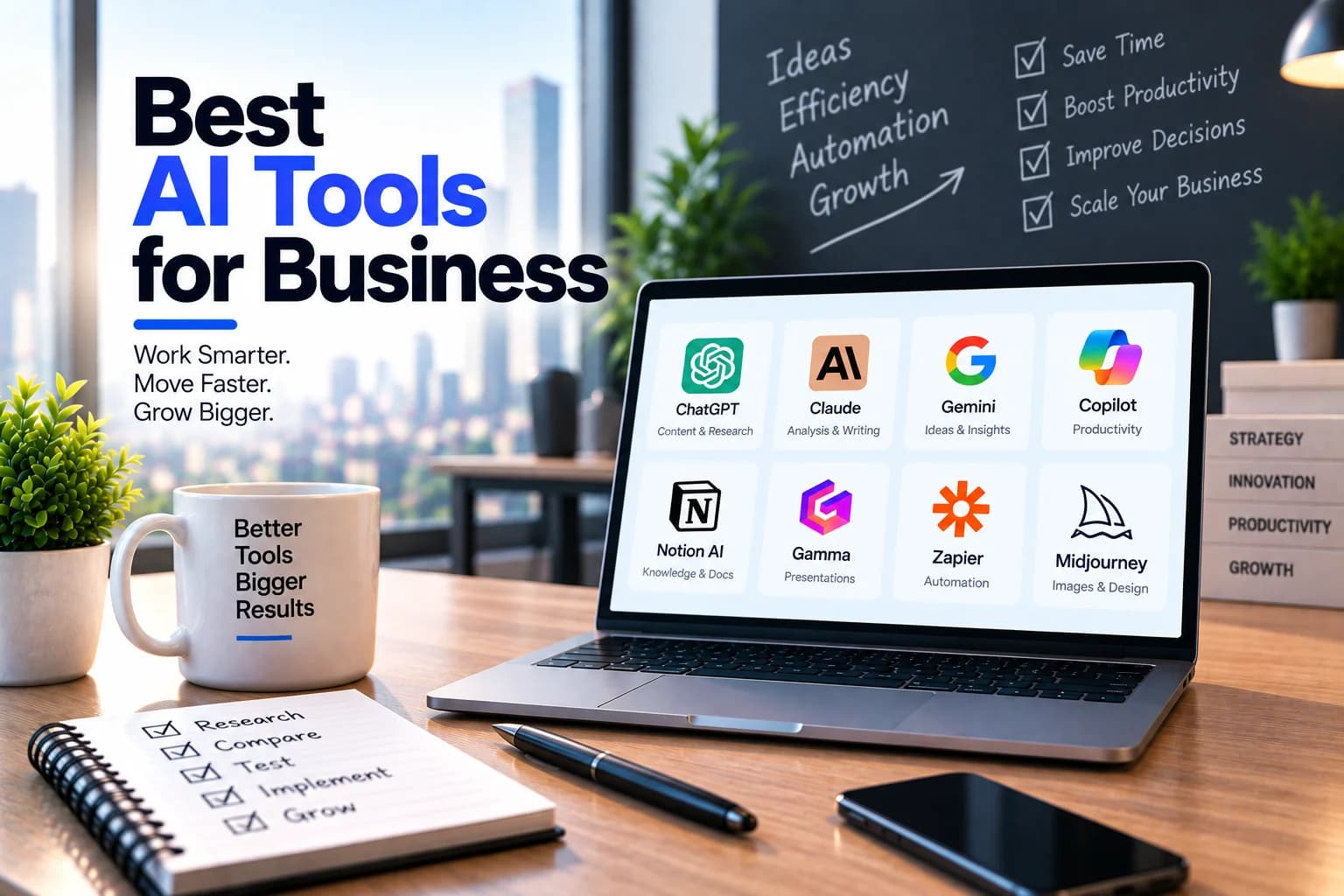
Most AI tool lists are inventories of what exists rather than guidance on what to adopt. The useful question is which functions currently have tools good enough to change how work gets done, and which do not. This page covers four areas where the answer is yes, gives the test for whether a specific tool is worth adopting, and deliberately excludes conversational assistants, which are covered separately.
The Test Before Adopting Anything
Tool proliferation costs more than licence fees, through training, security review, and data governance. Applying a consistent test prevents accumulating subscriptions nobody uses.
Does It Replace a Real Task?
Name the specific task and how long it currently takes. Tools adopted without a named task become subscriptions people forget they have.
Does It Fit Existing Workflow?
Output arriving where work already happens gets used. A separate tool people must remember to visit does not, regardless of quality.
Where Does Your Data Go?
Business documents and customer information passing through third-party services need reviewing. This constrains selection more than capability does.
Can You Measure the Change?
Capture how long the task takes now. Our AI consulting services engagements establish that baseline before adoption rather than after.
Writing and Document Work
The most mature category, and the one delivering the clearest time savings today because the work is high volume and errors are caught in review.
Drafting and Editing
First drafts of proposals, reports, and correspondence, reviewed and revised by the person responsible. The gain is time on composition rather than removing the writer.
Document Extraction
Pulling structured data from invoices, contracts, and forms that arrive as documents rather than feeds. Reliable, high volume, and immediately measurable.
Summarisation of Long Material
Producing summaries of reports, transcripts, and case files so people read the relevant part rather than the whole document.
Where the Tools Sit
Increasingly inside the office suites and document systems people already use, which is why adoption here has been faster than in other categories.
The Governance Point
Anything containing customer or commercial information needs a processing review. Our business process automation work covers where these fit safely.
Analytics and Data Work
A more mixed category. The tools are genuinely useful for exploration and genuinely unreliable as a source of truth, and understanding that boundary is what determines whether adoption helps.
Natural Language Querying
Asking questions of a dataset without writing queries. Useful for exploration, and the answers need verification before anyone acts on them.
Assisted Analysis and Explanation
Generating explanations of what changed in a dataset and why, which speeds up investigation without replacing judgement.
Where It Goes Wrong
Confident answers derived from a misunderstood data model. The output looks authoritative regardless of whether the query was correct.
The Prerequisite Nobody Mentions
These tools amplify your data quality in both directions. Our data analytics work addresses definitions and modelling before layering anything on top.
Process Automation
Where AI handles the reading and classification steps that rule-based automation cannot, which is a meaningful extension rather than a replacement of existing automation.
Classification and Routing
Categorising inbound requests, documents, and correspondence and directing them appropriately. High volume, tolerant of correction, easy to measure.
Extraction Feeding Automation
Reading unstructured input, then handing structured output to conventional automation. This pairing is more reliable than either alone.
Exception Handling
Flagging cases that do not fit the rules for human review rather than forcing them through. Frequently the highest-value use.
Where It Belongs Architecturally
Inside the process rather than beside it. Our workflow automation work integrates these steps into existing flows.
Coding Assistants
The category with the clearest measurable effect on output, and the one carrying specific risks that teams frequently adopt without addressing.
What They Do Well
Boilerplate, test generation, unfamiliar language syntax, and explaining existing code. The gain is largest on routine work rather than on difficult problems.
Where Review Matters Most
Generated code compiles and looks plausible while being subtly wrong. Review standards should be higher for generated code, not lower.
The Security Consideration
Generated code can introduce vulnerabilities and outdated patterns. Dependency scanning and security review remain necessary regardless of source.
The Team Effect Worth Watching
Junior developers can ship code they do not fully understand. Our dedicated development team practice treats review depth as the control for this.
Measuring Honestly
Lines produced is not output. Measure delivery of working, reviewed, maintainable features against the previous baseline.
FAQs
What AI tools actually help businesses today?
Document drafting and extraction, summarisation of long material, classification and routing in processes, exception flagging, and coding assistants. All are high volume, tolerant of review, and measurable against current handling time.
How do I decide whether to adopt an AI tool?
Name the specific task it replaces and how long that takes now, confirm the output arrives where work already happens, review where your data goes, and capture a baseline so the change can be measured rather than asserted.
Are AI analytics tools reliable?
Useful for exploration, unreliable as a source of truth. They produce confident answers that may rest on a misunderstood data model, so output needs verification. They also amplify existing data quality problems rather than fixing them.
Do AI coding assistants actually speed up development?
On routine work such as boilerplate, tests, and unfamiliar syntax, measurably. The gain is smaller on difficult problems. Review standards should rise rather than fall, since generated code can be plausible and subtly wrong.
What is the risk of adopting too many AI tools?
Cost beyond licence fees, through training, security review, and data governance for each vendor. Tools adopted without a named task become forgotten subscriptions, and each one processing business data is another review to maintain.
Where should a business start with AI tools?
Document work, because it is the most mature category with the clearest time savings, the errors are caught in review, and the tools increasingly sit inside the software people already use rather than requiring a separate destination.