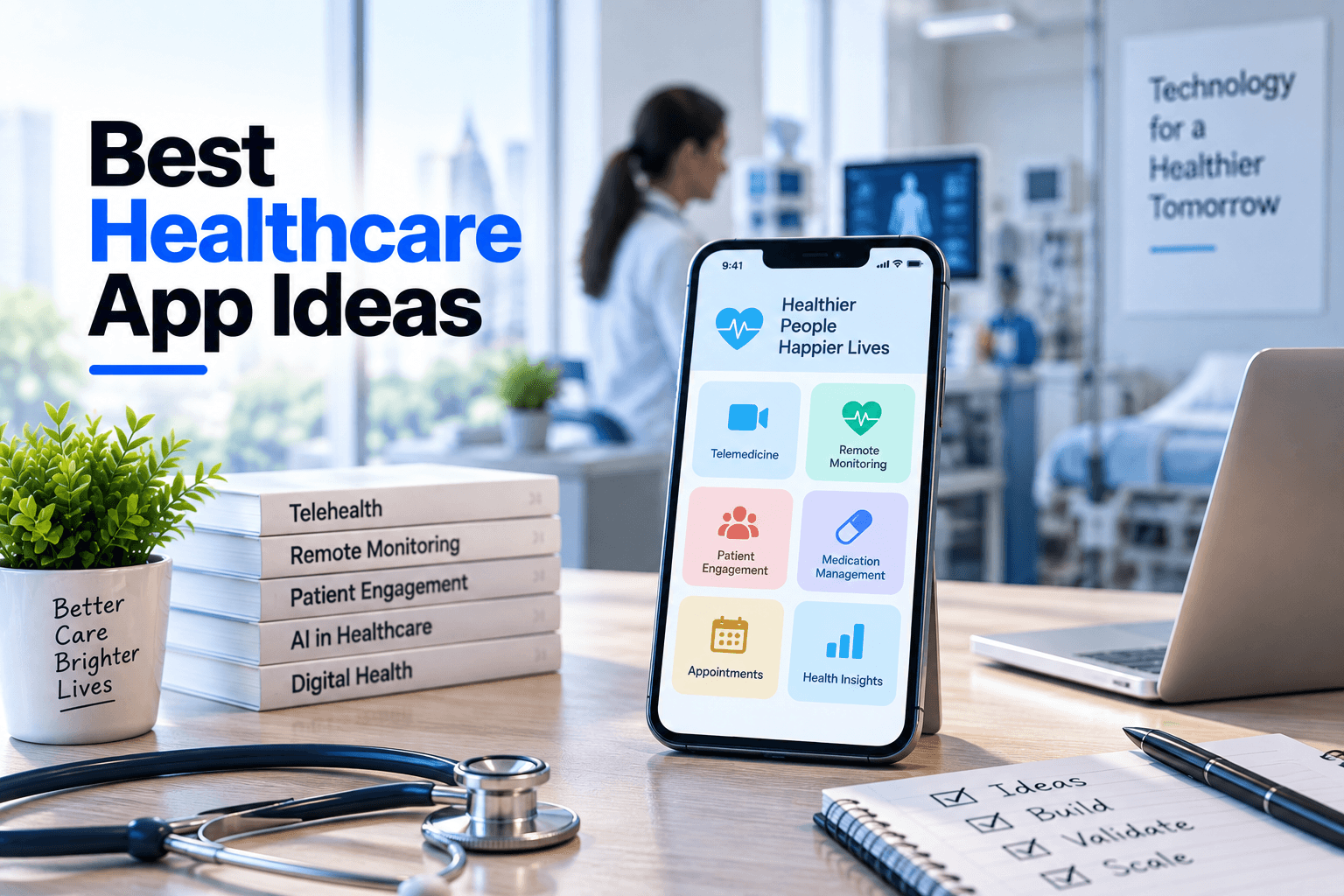
Healthcare app ideas fail for reasons unrelated to their clinical merit. If nobody is paid for the activity and it adds work to a clinician’s day, it does not get adopted regardless of the evidence behind it. Those two filters, reimbursement pathway and workflow burden, explain most of the difference between healthcare products that scale and those that stay in pilots. This page assesses ideas against them, covering the categories that reach adoption and the ones that consistently do not.
The Two Filters That Decide Everything
Apply these before assessing clinical value. An idea failing either one needs reshaping, and an idea failing both should be abandoned however compelling it sounds.
Who Pays and Through What Mechanism
Somebody must have a budget line or a reimbursement code. Products relying on an organisation finding new money for an unfunded activity rarely scale.
Does It Add or Remove Clinician Work
Anything adding clicks to a clinical day gets abandoned. Time must be visibly saved in the same session for a tool to survive.
Where Clinical Risk Sits
Products assessing symptoms or guiding care may become regulated devices, with validation and evidence requirements that change the project entirely.
Whether It Reaches the Record
Data trapped in a separate app has limited clinical value. Our api-integration-services work handles the record integration that determines usefulness.
Administrative and Operational Tools
The most reliably adopted category is software removing administrative burden rather than doing anything clinical. It is unglamorous, it has clear budget owners, and it avoids device regulation entirely.
Scheduling and Capacity Management
Appointment booking, cancellation handling, and clinic utilisation. Directly tied to revenue and staff time, with an obvious budget owner.
Referral and Pathway Coordination
Tracking referrals between providers, which currently happens through faxes, letters, and phone calls in many systems.
Documentation and Coding Support
Reducing the time clinicians spend on notes and coding. This is what health systems are actively spending on because the burden is measurable.
Patient Communication and Preparation
Reducing non-attendance and cancellations through better preparation information. Our software development work in this area measures against attendance rates.
Care Coordination and Chronic Condition Management
Where ongoing management is reimbursed, software supporting it has a payment pathway. This category has genuine clinical value and a viable commercial model, which is an unusual combination in healthcare.
Chronic Condition Monitoring
Supporting management of conditions where continuous data changes decisions. Viable where monitoring is reimbursed and pilots-only where it is not.
Post-Discharge Follow-Up
Reducing readmissions, which carries a clear financial case wherever readmission penalties apply to the provider.
Medication Adherence Support
Straightforward technically and among the more clinically valuable applications, since non-adherence is a substantial cost driver.
Multi-Provider Care Plans
Coordinating care across providers for complex patients. Our healthcare software solutions work covers the interoperability this demands.
Staff-Facing Clinical Tools
Products serving clinicians and staff rather than patients frequently have clearer adoption paths, because the buyer and the user are in the same organisation and the value is measurable in time.
Clinical Reference and Decision Support
Surfacing relevant guidance at the point of care, positioned as information rather than direction to stay clear of device classification.
Handover and Shift Communication
Structured handover between shifts and teams, which is a recognised safety risk currently handled with paper and memory.
Task and Workflow Management
Coordinating clinical tasks across teams. Unglamorous and directly affects both safety and staff experience.
Mobile Access to Records
Clinicians accessing records securely on the move. Our mobile-app-development work handles the authentication and offline requirements this involves.
Ideas That Consistently Struggle
These categories attract founders repeatedly and reach adoption rarely. The reasons are structural, so better execution does not resolve them.
Consumer Symptom Checkers
Safety and liability exposure has not been solved by better models, and there is no clear payer. Repeatedly launched and repeatedly constrained.
General Wellness Apps Seeking Clinical Credibility
Consumer wellness products struggle to establish clinical validity, and without it they have no route into reimbursed care.
Patient-Facing Records Aggregators
Patients want their records available and rarely engage with them repeatedly, which leaves no retention and no payer.
Products Requiring Clinician Data Entry
Anything asking clinicians to enter data for someone else’s benefit fails at adoption, regardless of how valuable the aggregate data would be.
Standalone Tools Outside the Record
Products not integrated into the clinical record create duplicate work. Our cloud consulting work treats integration as a precondition rather than a phase two item.
FAQs
What makes a healthcare app idea viable?
A clear payer with a budget line or reimbursement code, and a workflow effect that removes rather than adds clinician work. Ideas failing either filter rarely scale, regardless of clinical merit or evidence quality.
Why do healthcare apps fail to get adopted?
Usually because they add clicks to a clinician’s day, or because no existing payment mechanism covers the activity. Both are commercial and operational problems rather than clinical or technical ones.
What healthcare app categories work best?
Administrative and operational tools addressing scheduling, referrals, documentation, and patient communication; care coordination where ongoing management is reimbursed; and staff-facing tools for handover, task management, and mobile record access.
Are consumer symptom checkers a good idea?
They have been launched repeatedly and constrained repeatedly by safety and liability exposure, with no clear payer. The clinical governance requirement has not been resolved by improved models, which keeps this category difficult.
Does a healthcare app need to integrate with the medical record?
For clinical use, effectively yes. Data in a separate application creates duplicate work and has limited clinical value, which is why standalone tools outside the record struggle to sustain adoption after initial enthusiasm.
Where should a healthtech founder start?
By confirming who pays and through what mechanism, then measuring the workflow effect in clinician clicks. Those two answers determine viability more than the clinical concept, and both can be established before building anything.