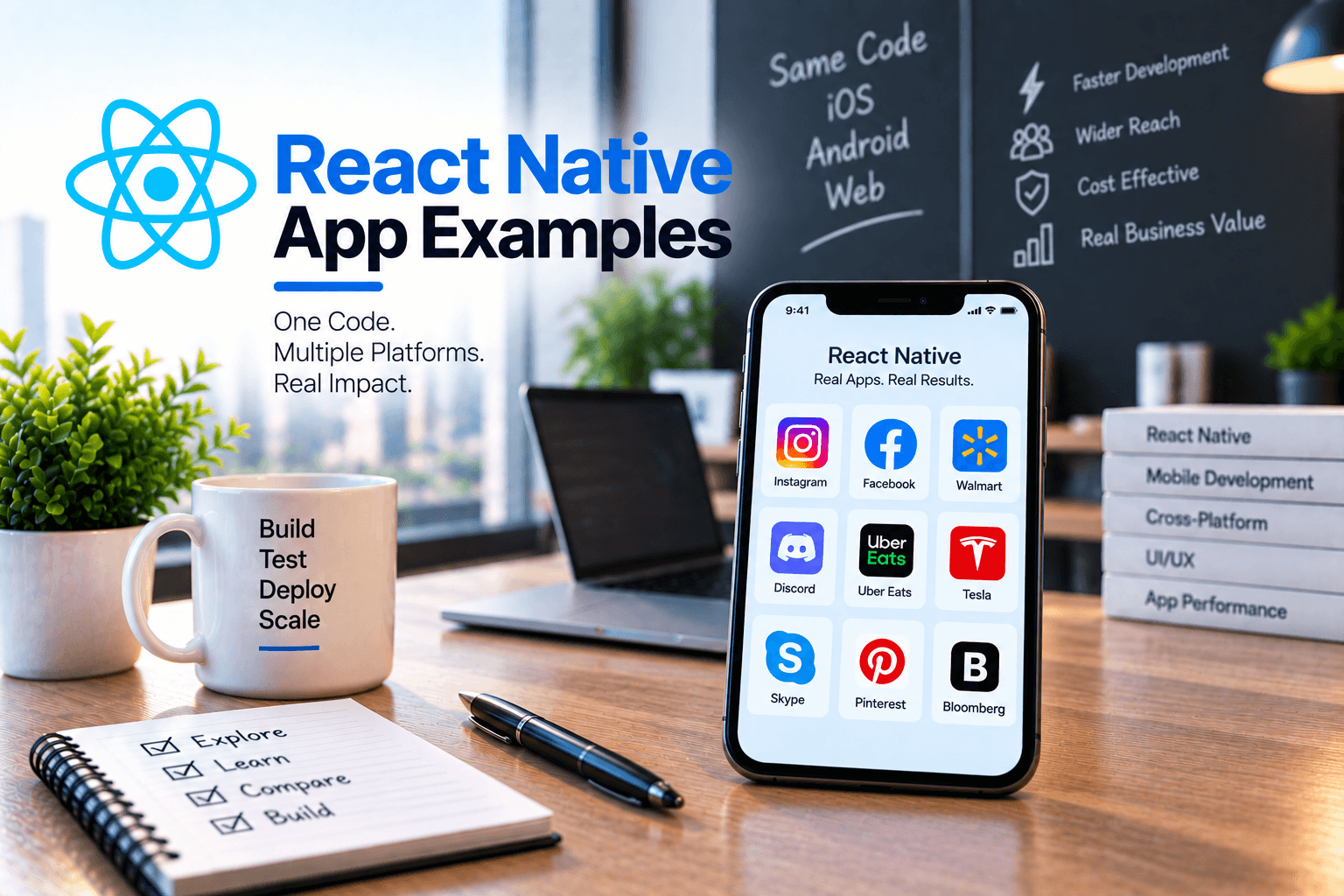
React Native’s most informative examples are not the apps built with it from scratch. They are the established native applications that adopted it for specific features while keeping everything else native. That capability, adding React Native to an existing app rather than replacing it, is what distinguishes the framework and what most example lists overlook entirely. This page covers production applications and what each demonstrates about where the framework fits.
Incremental Adoption Inside Native Apps
The brownfield pattern is React Native’s distinctive strength: adding it to an existing native application feature by feature, without committing the whole product.
Microsoft Office, Outlook and Teams
(cite index=”28-1″>These use brownfield integration, with React Native handling specific features inside existing native apps.</cite> That is a substantial commitment inside applications with enormous user bases.
Microsoft Xbox and Skype
(cite index=”28-1″>Built with React Native from the start</cite>, showing the same organisation using both approaches depending on the product.
React Native for Windows
(cite index=”28-1″>Microsoft also maintains React Native for Windows</cite>, which extends the framework beyond mobile and represents meaningful investment from a company that is not its owner.
Why Brownfield Matters Commercially
It means adoption does not require a rewrite. Our cross-platform app development work uses this to de-risk migration for clients with working native apps.
Consumer Applications at Scale
The large consumer examples answer the reliability question, and several have been running React Native in production for many years rather than as recent experiments.
(cite index=”28-1″>One of the earliest high-profile adopters within Meta</cite>, which is meaningful because Meta maintains the framework and uses it in its own flagship products.
Discord
(cite index=”27-1″>Discord remains a documented React Native application</cite>, notable for real-time communication with demanding interface responsiveness.
Shopify
(cite index=”27-1″>Shopify is a documented React Native adopter</cite>, which is a commerce platform where reliability directly affects merchant revenue.
Bloomberg
(cite index=”27-1″>Bloomberg uses React Native</cite>, which places it in a context with dense data display and professional users.
Retail and Brand Applications
Retail examples show the framework used where the mobile app shares logic with an existing web product, which suits organisations already invested in JavaScript.
PUMA
(cite index=”23-1″>PUMA built a React Native app sharing core functionality with their web app while incorporating mobile-specific features including augmented reality try-on.</cite>
Why Shared Logic Helps Retail
Catalogue, pricing, and account logic already exist in web applications. Reusing that rather than reimplementing reduces both cost and divergence.
Mobile-Specific Features Still Possible
The PUMA example shows native capability being used alongside shared code rather than shared code limiting what the app can do.
Where This Applies
Organisations with existing JavaScript teams and web products. Our web application development work frequently precedes this kind of mobile build.
What the New Architecture Changed
The most current and least-covered fact about React Native is that its long architectural transition is complete, which invalidates a great deal of older comparison content.
The Bridge Is Gone
(cite index=”27-1″>The New Architecture with JSI, Fabric, and TurboModules has completely retired the old JavaScript bridge, and as of React Native 0.82 it is the only architecture available with no legacy fallback.</cite>
Why This Matters for Evaluation
Most performance criticism of React Native describes the bridge. Comparisons written before this transition completed are describing a framework that no longer exists in that form.
Performance Position Now
(cite index=”27-1″>The New Architecture has closed most of the performance gap that used to be the framework’s biggest weakness.</cite>
What to Ignore in Older Content
Bridge-related performance arguments. Our mobile app development assessments use current architecture behaviour rather than inherited assumptions.
What the Examples Collectively Show
Reading the set together produces a clearer picture than any individual adoption, and it points at a different kind of project from the Flutter examples.
JavaScript Teams Are the Common Factor
Nearly every example is an organisation with substantial existing JavaScript capability. That is the strongest predictor of a successful React Native adoption.
Native Components Mean Platform Feel
(cite index=”27-1″>React Native renders using actual native UI components</cite>, so applications feel platform-appropriate rather than identically branded across both.
Incremental Adoption De-Risks It
Brownfield integration means you can test the framework on one feature rather than betting a product on it.
Where It Is Still Not the Answer
Heavy graphics, sustained computation, and deep platform integration. Our software development scoping tests these before recommending either framework.
FAQs
What apps are built with React Native?
Documented examples include Instagram, Discord, Shopify, Bloomberg, PUMA, and Microsoft’s Xbox and Skype. Microsoft Office, Outlook, and Teams use it for specific features inside otherwise native applications.
What is brownfield React Native adoption?
Adding React Native to an existing native application for specific features rather than rebuilding the whole product. Microsoft Office, Outlook, and Teams use this pattern, and it lets organisations test the framework without committing a product to it.
Is React Native still slower than native?
Less than it was. The New Architecture with JSI, Fabric, and TurboModules has retired the old JavaScript bridge entirely, and as of version 0.82 there is no legacy fallback. Most published performance criticism describes the bridge.
Do apps built with React Native look native?
Generally yes, because it renders using actual native UI components. That means applications feel platform-appropriate but also look different on iOS and Android, which requires deliberate work if you want identical presentation.
Is React Native a good choice for a team with web developers?
It is the strongest predictor of success. Nearly every major adoption comes from an organisation with substantial existing JavaScript capability, since the framework lets those developers build mobile applications without learning a new language.
Should I choose React Native or Flutter?
React Native suits teams with JavaScript expertise, products wanting platform-native feel, and organisations with existing native apps to extend incrementally. Flutter suits teams wanting identical rendering across platforms and a single codebase reaching desktop too.