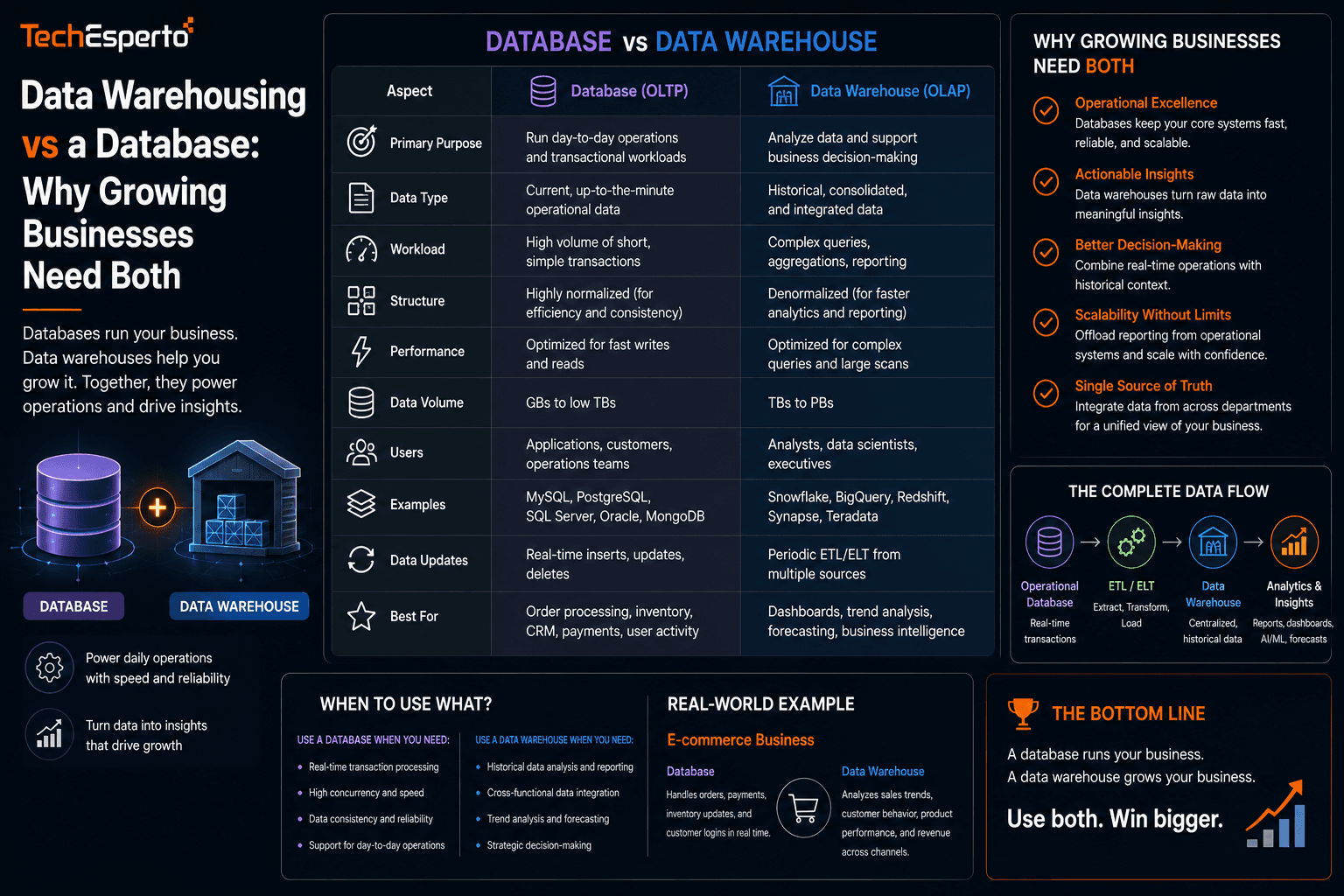
Data warehousing vs a database is a comparison that confuses a lot of growing businesses because both store data and both use similar underlying technology, which makes it easy to assume one can simply replace the other. In reality, they are built to solve different problems, and most businesses reach a point where they genuinely need both working together rather than choosing one over the other.
What an Operational Database Is Built For
A standard operational database, the kind powering a CRM or an application’s day-to-day functionality, is optimized for fast, frequent reads and writes of individual records. Its job is to support live transactions, such as updating a customer record or processing an order, as quickly as possible, and its structure is optimized around that goal rather than around analyzing large volumes of historical data.
What a Data Warehouse Is Built For
A data warehouse is structured specifically for analysis across large volumes of historical data, often pulled together from multiple different source systems. Rather than optimizing for fast individual record updates, it is optimized for complex queries that aggregate and analyze data across time, such as calculating trends across several years of sales history pulled from multiple systems at once.
Why Running Analytics Directly on an Operational Database Causes Problems
Performance Impact on Live Systems
Running large, complex analytical queries directly against an operational database can slow down the very system that live users and transactions depend on, since the database’s resources are being consumed by a heavy analytical query rather than the fast, simple transactions it was designed to prioritize.
Difficulty Combining Data From Multiple Sources
Most businesses have data spread across several systems, such as a CRM, an ERP, and a marketing platform, and an operational database only contains its own system’s data. Meaningful analysis often requires combining data across all of these sources, which an operational database is not structured to do efficiently on its own.
How a Data Warehouse Solves Both Problems
A data warehouse pulls data from multiple source systems into a single structure specifically designed for this kind of cross-system analysis, without putting analytical query load on the operational systems businesses depend on for daily operations. This separation allows both the operational systems and the analytical layer to be optimized for what each one actually needs to do well, rather than compromising one to serve the other.
When a Business Actually Needs a Data Warehouse
Not every business needs a data warehouse immediately. Early-stage businesses with a single data source and modest analytical needs can often get by comfortably using reporting tools directly against their operational database. The need for a warehouse typically emerges once a business has data spread across multiple systems, needs to analyze data over long historical periods, or finds that analytical queries are noticeably affecting the performance of live systems. This is a common consideration in broader data analytics planning, where the decision to introduce a warehouse is based on actual analytical demands rather than adopted preemptively before it is genuinely needed.
Connecting a Warehouse to Business Intelligence Tools
A data warehouse on its own is just organized storage. Its value is realized when connected to business intelligence tools that let teams build reports and dashboards drawing on the consolidated data, without those queries ever touching the operational systems that need to stay fast and responsive for daily business activity.
Key Takeaways
Operational databases are optimized for fast, frequent transactions supporting live systems, while data warehouses are optimized for complex analysis across large volumes of historical, multi-source data. Running heavy analytical queries directly on an operational database risks degrading performance for the live systems that depend on it. The need for a data warehouse typically emerges as data grows across multiple sources and analytical demands increase. And a data warehouse delivers its full value when paired with business intelligence tools built to query it directly, separate from operational systems.
Frequently Asked Questions
Can a business use its operational database for reporting instead of a data warehouse?
For simple reporting needs and a single data source, this can work reasonably well. As data volume, complexity, and the number of source systems grow, a dedicated warehouse generally becomes necessary to avoid performance issues.
Does setting up a data warehouse require replacing existing databases?
No, a data warehouse works alongside existing operational databases, pulling data from them rather than replacing them, since both serve different and complementary purposes.
How often does data need to move from an operational database into a data warehouse?
This depends on business needs, ranging from real-time or near-real-time syncing for time-sensitive analysis to daily or weekly batch updates for less urgent reporting needs.
Is a data warehouse only useful for large enterprises?
No, though the need typically becomes more pressing as a business scales. Growing businesses with data spread across multiple systems can benefit from a warehouse well before reaching enterprise scale.
What is the relationship between a data warehouse and business intelligence tools?
A data warehouse provides the consolidated data foundation, while business intelligence tools provide the reporting and visualization layer that teams actually use to interpret and act on that data.