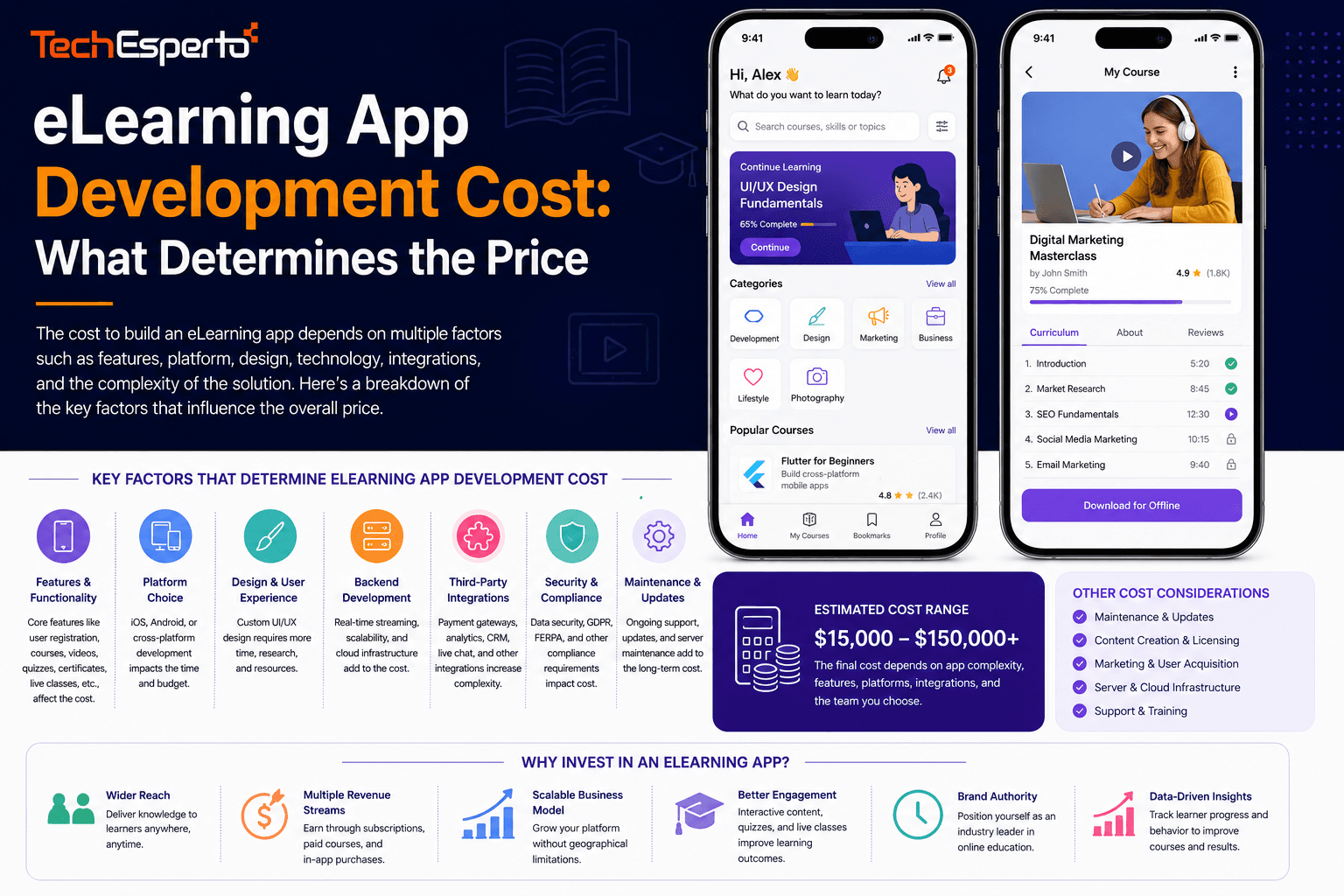
eLearning app development cost typically ranges from $40,000 to $80,000 for an MVP with core course and lesson features, $80,000 to $200,000 for a full platform with content management and progress tracking, and $200,000 or more for enterprise-scale, multi-subject systems. Actual cost depends on content complexity, gamification, and assessment features required.
Edtech founders and training organizations often need a realistic cost picture before committing to building a custom learning app. TechEsperto Solutions builds eLearning platforms as part of its broader education app development practice, and this guide breaks down what actually drives cost up or down for learning-focused software projects.
What Determines eLearning App Development Cost
eLearning app development cost is shaped by the format and structure of the learning experience as much as by typical app development factors. Content structure matters significantly, since a platform built around short, bite-sized lessons with gamification costs differently than one built around long-form video courses or live instructor-led sessions. Assessment and certification features, where included, add development scope tied to quiz logic, grading, and certificate generation. Progress tracking and analytics requirements affect cost depending on how detailed the reporting needs to be for learners, instructors, or institutional administrators. Content management tooling for instructors or curriculum designers also affects cost, since more flexible content creation tools require more development investment than a simpler, more rigid content structure.
Learning Content Format and Structure
Bite-sized gamified lessons, long-form video courses, and live instructor sessions each carry different development requirements.
Assessment and Certification Features
Quiz logic, grading systems, and certificate generation add development scope where included.
Progress Tracking and Reporting Depth
Reporting requirements for learners, instructors, or institutional administrators affect development scope.
Content Management Tooling Flexibility
More flexible content creation tools for instructors require more development investment than rigid content structures.
Gamification and Engagement Mechanics
Streaks, points, and achievement systems add development scope beyond straightforward content delivery.
Live Session and Video Conferencing Integration
Supporting live instructor-led sessions adds infrastructure cost beyond self-paced content delivery.
Cost by Development Approach
eLearning platforms typically fall into one of three general investment levels, reflecting different degrees of feature completeness and target audience scale. An MVP approach focuses on core course delivery, basic progress tracking, and essential content management to validate a learning concept before expanding further. A full platform approach builds out content management, assessment, and progress tracking with a more complete feature set suited to an established education business or funded startup. An enterprise-scale approach supports multiple subjects, institutional licensing, and advanced analytics across a broader learner base. Choosing the right starting point depends on whether the goal is validating a new learning format or scaling an already-proven curriculum.
MVP or Single-Module Build ($40,000 to $80,000)
An MVP focuses on core course delivery, basic progress tracking, and essential content management for initial validation.
Full Platform Build ($80,000 to $200,000)
A full platform includes content management, assessment, and progress tracking for an established education business.
Enterprise-Scale Build ($200,000+)
Enterprise-scale systems support multiple subjects, institutional licensing, and advanced analytics.
Choosing the Right Starting Point
The right approach depends on whether the goal is validating a new format or scaling an established curriculum.
Phased Development Strategy
Many edtech projects start with an MVP covering one subject and expand curriculum breadth as demand is proven.
Budget Allocation Around Content Development
Budget planning should account for curriculum content creation time alongside the technical development timeline.
Cost by App Component
Within an eLearning platform, different components represent different shares of overall development effort. The learner-facing app typically receives significant design investment, since engagement and ease of use directly affect course completion rates. The content management system, used by instructors or curriculum designers, requires investment proportional to how flexible and self-service the content creation tools need to be. Progress tracking and gamification systems, where included, require investment tied to how sophisticated the engagement mechanics are. Assessment tools, including quiz logic and certificate generation, represent a distinct development component separate from core content delivery.
Learner App Investment
The learner app requires significant design investment since engagement directly affects course completion rates.
Content Management System Investment
Content tools require investment proportional to how flexible and self-service the content creation process needs to be.
Progress Tracking and Gamification Investment
Gamification and progress systems require investment tied to how sophisticated the engagement mechanics are.
Assessment and Certification Investment
Quiz logic, grading, and certificate generation represent development scope distinct from core content delivery.
Admin and Reporting Dashboard Investment
Admin tools require investment to give instructors or institutions visibility into learner progress and engagement.
Live Session Infrastructure Investment
Video conferencing integration for live sessions requires investment beyond self-paced content delivery.
Key Cost Drivers and Add-Ons
Beyond core app components, several specific features tend to meaningfully affect overall development cost for eLearning platforms. Adaptive learning logic, adjusting content difficulty or sequencing based on learner performance, adds algorithmic complexity beyond a fixed curriculum path. Offline content access, letting learners download lessons for use without an internet connection, adds development and content syncing scope. Social and community features, such as discussion forums or peer interaction, add functionality beyond individual self-paced learning. Institutional licensing features, supporting bulk enrollment and administrative reporting for schools or businesses, add a distinct set of requirements beyond individual consumer use. Multi-language support adds both development and ongoing content translation cost for platforms serving diverse audiences.
Adaptive Learning Algorithm Complexity
Adjusting content difficulty or sequencing based on performance adds algorithmic complexity beyond a fixed curriculum.
Offline Content Access
Downloadable lessons for offline use add development and content syncing scope.
Social and Community Features
Discussion forums and peer interaction add functionality beyond individual self-paced learning.
Institutional and Bulk Licensing Features
Bulk enrollment and administrative reporting for schools or businesses add distinct development requirements.
Multi-Language Content Support
Supporting multiple languages adds both development and ongoing content translation cost.
Third-Party LMS or Integration Requirements
Integrating with existing learning management systems used by institutional customers adds integration cost.
Ongoing Costs After Launch
Development cost is only part of the total investment required to operate an eLearning platform, since ongoing costs continue after launch. Cloud infrastructure costs scale with learner volume and content library size, particularly for video-heavy platforms with significant streaming bandwidth needs. Content creation and curriculum maintenance represent an ongoing cost separate from technical development, since course material needs regular updates to stay relevant and accurate. App maintenance, including bug fixes and platform compatibility updates, requires continued developer time after the initial build. Instructor or content creator support, along with customer support for learners, represent ongoing operational costs distinct from development investment.
Cloud Infrastructure and Video Streaming Costs
Infrastructure costs scale with learner volume and content library size, particularly for video-heavy platforms.
Content Creation and Curriculum Maintenance
Ongoing content updates to keep curriculum relevant and accurate represent a significant cost separate from development.
App Maintenance and Platform Updates
Ongoing maintenance and compatibility updates require continued developer time after launch.
Instructor and Content Creator Support Operations
Supporting instructors or content creators using the platform represents an ongoing operational cost.
Learner Customer Support
Customer support operations for learners represent an ongoing cost distinct from technical development.
Institutional Account Management
Supporting institutional customers with bulk licensing requires ongoing account management investment.
How to Reduce Development Costs Without Cutting Corners
Edtech founders looking to manage development costs have several legitimate options that do not compromise the learning experience quality. Starting with a focused MVP covering one subject area, rather than building for a broad multi-subject curriculum from day one, is the most effective way to control initial cost. Using established video hosting and streaming infrastructure, rather than building custom video delivery from scratch, saves significant development time and ongoing infrastructure cost. Deferring advanced features like adaptive learning algorithms or institutional licensing to a post-launch phase lets founders validate the core learning format before investing further. Investing in content development quality early, even if it delays some technical features, often matters more for learner outcomes and retention than an extensive feature set.
Start with a Focused Single-Subject MVP
Launching with one subject area controls cost while validating the learning format and target audience.
Use Established Video Hosting and Streaming Infrastructure
Leveraging existing video infrastructure saves significant development time compared to building custom streaming from scratch.
Defer Advanced Features to Later Phases
Adaptive learning algorithms and institutional licensing can be added once the core platform proves demand.
Prioritize Content Quality Alongside Technical Features
Strong curriculum content often matters more for learner outcomes than an extensive technical feature set.
Consider Cross-Platform Development Frameworks
Cross-platform frameworks can reduce cost compared to fully separate native builds, depending on target device preferences.
Plan for Phased Budget Allocation
Allocating budget across an initial launch and planned expansion phases helps manage overall investment risk.
FAQs
How much does eLearning app development typically cost?
eLearning app development typically costs between $40,000 and $80,000 for an MVP with core course and lesson features, and $80,000 to $200,000 for a full platform including content management and progress tracking. Enterprise-scale, multi-subject systems start at $200,000 and scale with content complexity and feature requirements.
What is the biggest cost driver in eLearning app development?
Content structure and format, whether bite-sized gamified lessons, long-form video courses, or live instructor sessions, along with assessment and progress tracking depth, tend to be the largest cost drivers in this category.
Does gamification significantly increase development cost?
Gamification does add development scope, since streak tracking, points, and achievement systems require dedicated engineering work beyond straightforward content delivery, though the specific cost impact depends on how sophisticated the mechanics need to be.
Can I reduce cost by launching with a single subject first?
Yes, starting with a focused MVP covering one subject area is the most effective way to control initial development cost, with additional subjects and curriculum breadth added once the learning format is validated.
Are there ongoing costs beyond initial development?
Yes, ongoing costs include cloud infrastructure and video streaming that scale with learner volume, content creation and curriculum maintenance, and continued app maintenance, all separate from the initial development investment.
How can TechEsperto Solutions help estimate my specific project cost?
TechEsperto Solutions provides a detailed cost estimate after a scoping call covering your subject matter, content format, and feature requirements, since exact pricing depends on these project-specific factors.