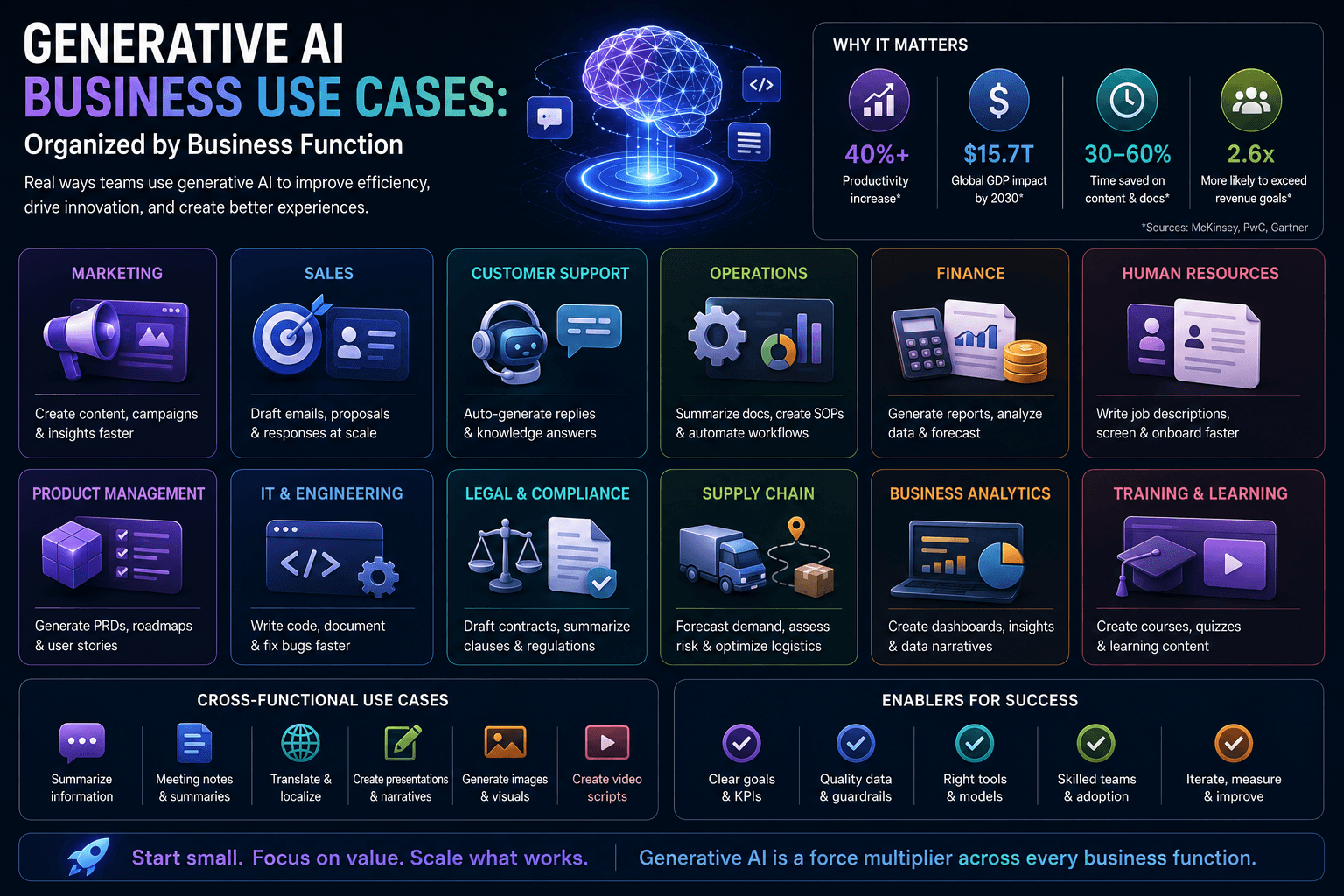
Generative AI business use cases become far more actionable when organized by function, marketing, operations, finance, sales, rather than treated as a single generic category, since the specific application, and the risk and value tradeoffs involved, differ significantly depending on which part of the business is using it. A marketing team drafting campaign copy and a finance team summarizing reports face very different accuracy requirements and workflows, even though both technically fall under “generative AI use cases.” This post breaks down generative AI applications by business function, so you can identify where it fits your organization’s specific operational structure.
Marketing and Content Functions
Marketing is often the most visible and mature area of generative AI adoption within a business.
Content and Copy Drafting
Generating first drafts of blog posts, social media copy, and email campaigns for human review and refinement significantly speeds up content production without replacing the editorial judgment that keeps brand voice consistent.
Campaign Personalization at Scale
Generative AI can help create variations of marketing messages tailored to different audience segments, allowing more personalized outreach than manually writing unique content for every segment individually.
Creative Ideation and Brainstorming
Using generative AI to quickly explore multiple creative directions or campaign concepts speeds up the early ideation phase, even though final creative decisions still benefit from human judgment and brand expertise.
Operations and Internal Process Functions
Behind the scenes, generative AI supports operational efficiency in ways that don’t always get the same attention as customer-facing applications.
Documentation and Reporting
Summarizing lengthy operational data, meeting notes, or process documentation into clear, readable reports reduces the manual synthesis work that consumes significant time across many operational roles.
Internal Knowledge Assistance
Employees searching scattered internal documentation for answers can instead query an AI assistant grounded in that documentation, surfacing relevant information faster than manual search across multiple systems.
Process Documentation Generation
Drafting standard operating procedures or training materials based on existing processes gives operations teams a faster starting point than writing comprehensive documentation entirely from scratch.
Finance and Analysis Functions
Finance teams are finding specific, well-scoped applications for generative AI that respect the accuracy demands of financial work.
Financial Report Summarization
Summarizing lengthy financial reports or analyst documents for internal stakeholders reduces review time while keeping the underlying detailed report available for anyone needing to verify specifics.
Drafting Financial Communications
Generating first drafts of investor updates or internal financial summaries for human review speeds up communication preparation without removing the careful verification financial communications require.
Sales and Customer-Facing Functions
Sales teams use generative AI to support, rather than replace, the relationship-driven aspects of the sales process.
Personalized Outreach Drafting
Generating personalized first-draft outreach messages based on prospect research speeds up sales development work while still allowing sales representatives to refine and personalize further before sending.
Proposal and Presentation Drafting
Drafting initial proposal content or presentation materials based on a specific deal’s context gives sales teams a faster starting point than building every proposal manually from a blank template.
Choosing the Right Use Cases for Your Business Functions
The generative AI applications that deliver real value tend to match the specific function’s actual pain points, repetitive drafting work, scattered internal knowledge, manual summarization, rather than applying a generic AI feature across the business without considering how each function actually operates. Our generative AI development team can help identify and scope the right applications for your specific business functions and priorities.
Key Takeaways
Generative AI business use cases vary meaningfully by function, marketing, operations, finance, sales, each with distinct accuracy requirements and workflow considerations. Marketing applications tend to be the most mature, focused on content drafting and personalization at scale. Operations and internal knowledge applications reduce time spent on documentation and manual search, often without the same visibility as customer-facing use cases, and finance and sales applications work best when scoped to draft-and-review workflows that respect the accuracy and relationship demands specific to each function.
Frequently Asked Questions
Which business function typically adopts generative AI first?
Marketing tends to be an early adopter given the natural fit with content drafting and campaign personalization, though operations and internal knowledge applications often follow closely given their clear, measurable time-saving potential.
Is generative AI safe to use for financial reporting and communications?
It can be, when scoped to drafting and summarization with human review and verification built into the workflow, rather than relying on AI output for final, unverified financial communications or decisions.
Can generative AI replace sales representatives?
No. Generative AI supports sales work by speeding up drafting and research synthesis, but the relationship-building and negotiation aspects of sales still depend on human judgment and rapport that AI doesn’t replace.
How do I identify the right generative AI use case for my specific department?
Identifying where your specific department currently spends the most time on repetitive drafting, summarization, or manual information search tends to reveal the most promising, high-value starting points for generative AI adoption.
Does every business function need its own separate AI implementation?
Not necessarily separate implementations, but each function’s specific use case, knowledge base, and accuracy requirements should be scoped individually, even if underlying infrastructure like retrieval systems can be shared across functions.
How do I get started with generative AI across my business functions?
The right starting point and sequencing depends on your organization’s specific priorities and existing capabilities, so a detailed AI consultation is the most reliable way to map a realistic path forward.