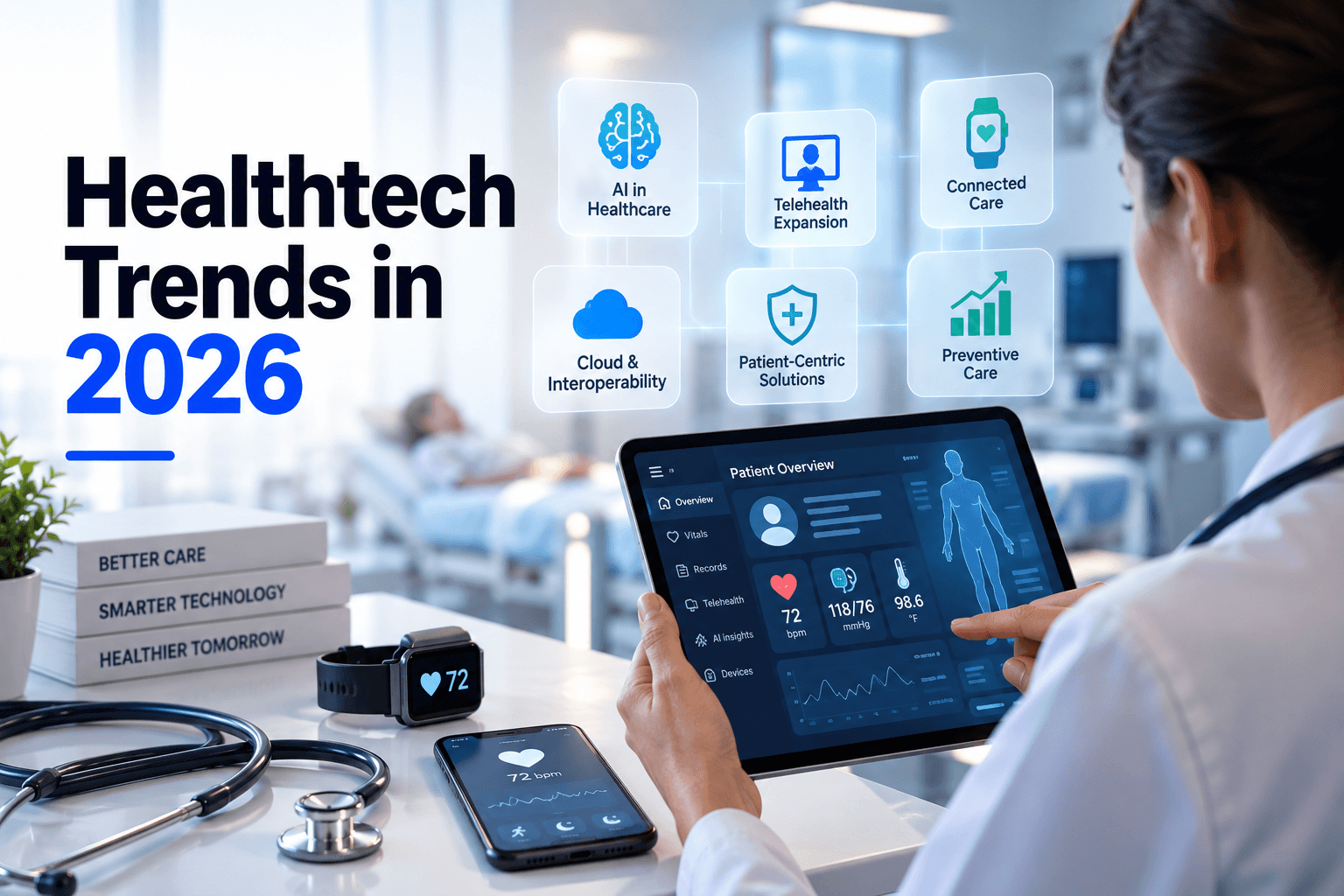
Healthtech moves slower than its coverage suggests, because reimbursement and clinical workflow determine adoption more than capability does. A product that works clinically and has no payment pathway does not scale, and one that adds clinician clicks gets abandoned regardless of its evidence base. This piece covers the trends actually shipping into health systems, the constraints that decide which ones spread, and several widely promoted directions that have consistently underdelivered against their forecasts.
Interoperability Is Finally Being Enforced
Data exchange has been a stated priority in healthcare for two decades and has become a genuine one only as regulation began mandating specific standards and penalising information blocking. This is the most consequential current change because it alters what third-party products can access.
FHIR as the Practical Standard
Modern API-based exchange is now the expected route rather than an emerging one, though coverage of specific resources still varies considerably between vendors.
Patient Access Requirements
Regulatory requirements for patient data access have created API surfaces that applications can build on, which was not previously possible at scale.
Legacy Interfaces Persist Regardless
HL7 v2 messaging remains widespread in hospital operations. Products claiming pure FHIR integration frequently discover this during implementation. Our API integration services work handles both.
Access Does Not Mean Easy Access
Vendor developer programmes involve review, sandbox access, and approval that run on their timeline. Budget calendar time separately from engineering time.
What This Enables
Products that read from and write to the record rather than sitting alongside it, which is the difference between adoption and shelfware.
Virtual Care Settled Into Hybrid
Virtual consultation expanded rapidly, contracted, and settled into a stable pattern rather than either replacing in-person care or disappearing. Understanding where it stuck is more useful than either the expansion narrative or the retreat narrative.
Where It Persisted
Follow-up appointments, medication reviews, mental health, and specialist access in underserved areas. Consultations not requiring physical examination.
Where It Did Not
Initial assessments and anything needing examination or diagnostics. The clinical limitation was real rather than a matter of habit.
Reimbursement Determined Everything
Adoption tracked payment parity almost exactly. Where virtual visits were reimbursed comparably they persisted, and where they were not they contracted sharply.
Integration Beat Standalone
Virtual care embedded in existing patient relationships outperformed standalone platforms, which struggled with continuity and record access.
What Product Teams Should Take From This
Design for hybrid pathways rather than virtual-first. Our healthcare software solutions work assumes mixed delivery as the default.
Documentation Burden Is the Active Problem
Clinician time spent on documentation rather than patients is the problem health systems are currently spending on, and it is where AI has found its most credible healthcare application. This is notable because it is administrative rather than diagnostic, which is why it deploys.
Ambient Documentation Capture
Recording consultations and generating draft notes for clinician review. The value is time returned rather than any clinical judgement.
Why This Deploys More Readily Than Diagnostics
Errors are caught in review by the clinician who was present, and the output is a draft rather than a decision. That keeps it clear of device regulation.
Coding and Billing Support
Suggesting codes from documentation for coder review. High volume, rule-adjacent, and directly tied to revenue capture.
The Adoption Test Is Clicks
Any tool adding steps to a clinician’s workflow gets abandoned. Time saved must be visible in the same session to survive.
Where Caution Remains Necessary
Anything approaching diagnosis or triage carries device classification and patient safety exposure. Our AI consulting services engagements draw that boundary explicitly.
Remote Monitoring Depends on Reimbursement
Remote patient monitoring has clinical evidence behind it and adoption that tracks payment pathways rather than evidence. Where monitoring is reimbursed it scales, and where it is not it stays in pilots regardless of outcomes data.
Chronic Condition Management
Blood pressure, glucose, and weight monitoring for chronic conditions, where continuous data genuinely changes management decisions.
Post-Discharge Monitoring
Reducing readmissions through follow-up monitoring, which has a clear financial case where readmission penalties apply.
The Data Volume Problem
Continuous monitoring generates more data than clinicians can review. Thresholds and escalation logic are the product rather than the data collection.
Device Reliability and Adherence
Patient adherence and device reliability determine outcomes more than analytics sophistication. Unworn devices produce no data.
Infrastructure Requirements
Ingestion, storage, and alerting at volume with clinical-grade availability. Our cloud consulting work covers the compliant infrastructure this needs.
What Has Consistently Underdelivered
Several healthtech directions have received sustained attention and investment without producing proportionate clinical deployment. Naming them is useful for anyone planning a product roadmap.
Consumer Wearables Driving Clinical Decisions
Data volume increased and clinical integration remained limited, largely because consumer-grade accuracy and unvalidated measures do not support clinical action.
Symptom Checkers as Triage
Repeatedly launched and repeatedly constrained by safety and liability concerns. The clinical governance requirement has not been solved by better models.
Blockchain for Health Records
Piloted extensively with minimal production deployment. The actual problem was interoperability and permissions, which standards addressed more directly.
Diagnostic AI Replacing Specialists
Genuine capability in narrow imaging tasks, deployed as assistance rather than replacement, and gated by validation and regulatory requirements.
The Planning Implication
Our custom software development scoping in healthcare prioritises reimbursement pathway and workflow fit above technical capability, because those determine adoption.
FAQs
What is the most significant healthtech trend right now?
Interoperability enforcement. Regulatory mandates around API-based exchange and information blocking have created data access that did not previously exist at scale, which changes what third-party products can build.
Did virtual care adoption reverse?
It contracted from its peak and settled into a stable hybrid pattern rather than disappearing. It persisted for follow-ups, medication reviews, mental health, and specialist access, and adoption tracked reimbursement parity almost exactly.
Why does ambient clinical documentation deploy more easily than diagnostic AI?
Because errors are caught in review by the clinician who was present, the output is a draft rather than a decision, and it stays clear of medical device classification. The benefit is clinician time returned rather than clinical judgement.
What determines healthtech adoption more than technology?
Reimbursement pathway and clinical workflow fit. A product with no payment mechanism does not scale, and one that adds clicks to a clinician’s day gets abandoned regardless of its evidence base or technical quality.
Is FHIR enough for healthcare integration?
Not on its own. HL7 v2 messaging remains widespread in hospital operations, and FHIR resource coverage varies between vendors. Products assuming pure FHIR integration frequently discover legacy interface requirements during implementation.
What should a healthtech product prioritise first?
Confirmed reimbursement pathway, workflow fit measured in clinician clicks, and integration with the record rather than sitting alongside it. Technical capability is rarely the constraint on adoption in this sector.