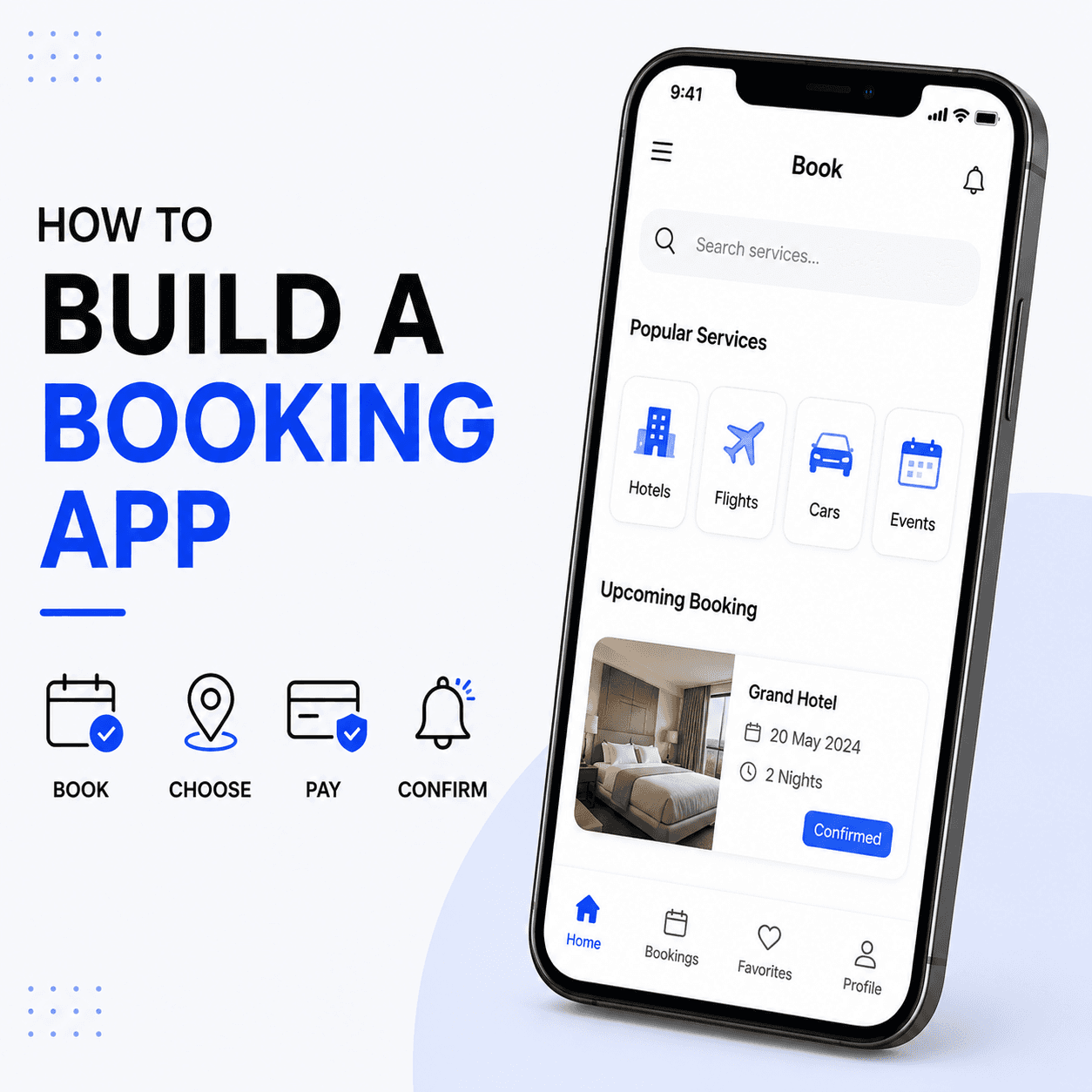
Building a booking app is a concurrency problem. Two people will attempt the same slot at the same moment, and how your system handles that determines whether the product is trustworthy. Everything else, including the interface, calendar views, and notifications, is ordinary work. This guide covers availability modelling, locking strategies that prevent double bookings, timezone handling, cancellation and modification logic, and synchronisation with external calendars.
Availability Modelling
Availability is harder to model than it appears because it is derived rather than stored. What is bookable depends on defined working hours, existing bookings, buffers between appointments, resource capacity, holidays, and exceptions. Modelling it as a simple list of open slots breaks as soon as any of those rules changes, which is why this decision belongs before the first sprint.
Rules Rather Than Slot Lists
Store the rules that generate availability, meaning schedules, durations, and buffers, then compute open slots on request. Storing slots directly makes rule changes into data migrations.
Resource Capacity and Types
A slot may accommodate one booking or many, and may require several resources simultaneously such as a room and a person. Model resources explicitly from the start.
Buffers and Setup Time
Gaps before and after bookings for preparation or travel. These affect availability computation directly and are commonly omitted from initial models.
Recurring Schedules and Exceptions
Weekly patterns with one-off overrides for holidays and closures. Exceptions are the norm rather than an edge case in real scheduling.
Performance of Availability Queries
Computing availability across a date range for many resources is expensive. Cache computed windows and invalidate on booking or rule change through your API development layer.
Preventing Double Bookings
This is the defining technical requirement. A booking system that occasionally double books is worse than useless, because the failure is visible to two customers and requires human intervention to resolve. Optimistic display with authoritative confirmation is the pattern that works, and it must be enforced at the database level rather than in application logic.
Enforce Uniqueness in the Database
A constraint preventing overlapping bookings for the same resource. Application-level checks alone lose races under concurrent load regardless of how carefully written.
Short-Lived Holds During Checkout
Reserve a slot briefly while the customer completes payment, releasing it on timeout. This prevents loss during checkout without stranding inventory indefinitely.
Transactional Confirmation
Validate availability and create the booking in one transaction. Checking then writing as separate operations is precisely where double bookings originate.
Idempotent Booking Requests
Network retries must not create duplicate bookings. Idempotency keys are essential rather than a refinement, since mobile connections retry frequently.
Clear Failure Handling
When a slot is taken during checkout, tell the customer immediately and offer alternatives rather than failing ambiguously after payment.
Timezones and Time Handling
Timezone bugs in booking systems are common, embarrassing, and entirely avoidable. They surface as appointments an hour out, bookings appearing on the wrong day, and recurring schedules drifting after daylight saving transitions. The rules are simple and must be applied without exception, because a single place that stores local time undermines everything else.
Store Instants in UTC
All timestamps stored in UTC without exception. Local time is a presentation concern applied at display, never a storage format.
Keep the Resource Timezone Separate
Store the resource’s timezone alongside its schedule, since availability rules are defined in local time even when bookings are stored as instants.
Handle Daylight Saving Explicitly
Transitions create days with missing or duplicated hours. Recurring schedules must be recomputed against the calendar rather than by adding fixed intervals.
Display in the Viewer’s Timezone
Show times in the customer’s zone with the zone stated. Ambiguous times in cross-timezone bookings produce missed appointments.
Test Transition Dates Deliberately
Include daylight saving boundaries in your test cases. Our DevOps services pipelines can run these as standing regression tests.
Cancellation and Modification Logic
Cancellation and rescheduling carry commercial rules that need encoding carefully, because they interact with payments, availability release, and notification. This is where booking systems accumulate the most business logic, and where undocumented behaviour generates the most support load and dispute.
Policy Windows and Fees
Free cancellation windows, partial refunds, and no-show handling. Encode these as configurable rules rather than hardcoded conditionals.
Releasing Availability Promptly
Cancelled slots must return to availability immediately and invalidate cached windows, otherwise you lose revenue on slots the system still considers taken.
Rescheduling as an Atomic Operation
Moving a booking must acquire the new slot and release the old one together. Doing this sequentially can leave a customer with neither.
Refund Coordination
Cancellation triggers refund processing with its own failure modes. Our payment gateway integration work handles partial refunds and reconciliation.
Audit Trail of Changes
Record every state change with who made it and when. Booking disputes are common and resolvable only with a reliable history.
Calendar Sync, Sequencing and Pitfalls
External calendar synchronisation is expected by any provider-facing booking product, and it is a two-way integration with real failure modes. Combined with a sensible build order, the pitfalls below cover the majority of what goes wrong on booking projects.
Two-Way Calendar Synchronisation
Bookings appear in the provider’s calendar and external events block availability. Our API integration services work handles the token refresh and conflict resolution this requires.
Suggested Build Order
Resource and schedule modelling, then availability computation, then booking with locking, then payment, then cancellation and rescheduling, then calendar sync, then notifications.
Pitfall: Storing Slots Instead of Rules
Precomputed slot tables make every schedule change a data migration and cannot express buffers or exceptions cleanly.
Pitfall: Application-Level Concurrency Checks
Checking availability then writing without a database constraint loses races under real concurrency, producing double bookings that survive testing.
Pitfall: Storing Local Time
Any local time in storage produces timezone bugs that surface unpredictably, particularly around daylight saving transitions.
Pitfall: Stale Availability Caches
Caching computed availability without invalidating on booking and cancellation shows unavailable slots as open and lost revenue as taken.
FAQs
How do you prevent double bookings?
Enforce a database constraint preventing overlapping bookings for the same resource, validate and create the booking within a single transaction, and use short-lived holds during checkout. Application-level checks alone lose races under concurrent load.
Should availability be stored or calculated?
Calculated from stored rules, meaning schedules, durations, buffers, and exceptions. Storing precomputed slot lists turns every schedule change into a data migration and cannot express buffers or one-off exceptions cleanly.
How should timezones be handled in a booking app?
Store all timestamps in UTC, store each resource’s timezone alongside its schedule, apply local time only at display, state the timezone explicitly to users, and recompute recurring schedules against the calendar rather than adding fixed intervals.
What causes timezone bugs in booking systems?
Storing local time anywhere, and handling recurring schedules by adding fixed intervals rather than recalculating against the calendar. Daylight saving transitions then produce appointments an hour out or on the wrong day entirely.
How should rescheduling be implemented?
As one atomic operation acquiring the new slot and releasing the old one together. Sequential release then acquire can leave the customer with no booking if the new slot is taken in between.
Does a booking app need calendar synchronisation?
For provider-facing products, generally yes. Providers keep their own calendars and expect bookings to appear there and external commitments to block availability. It is a two-way integration requiring token refresh handling and conflict resolution.