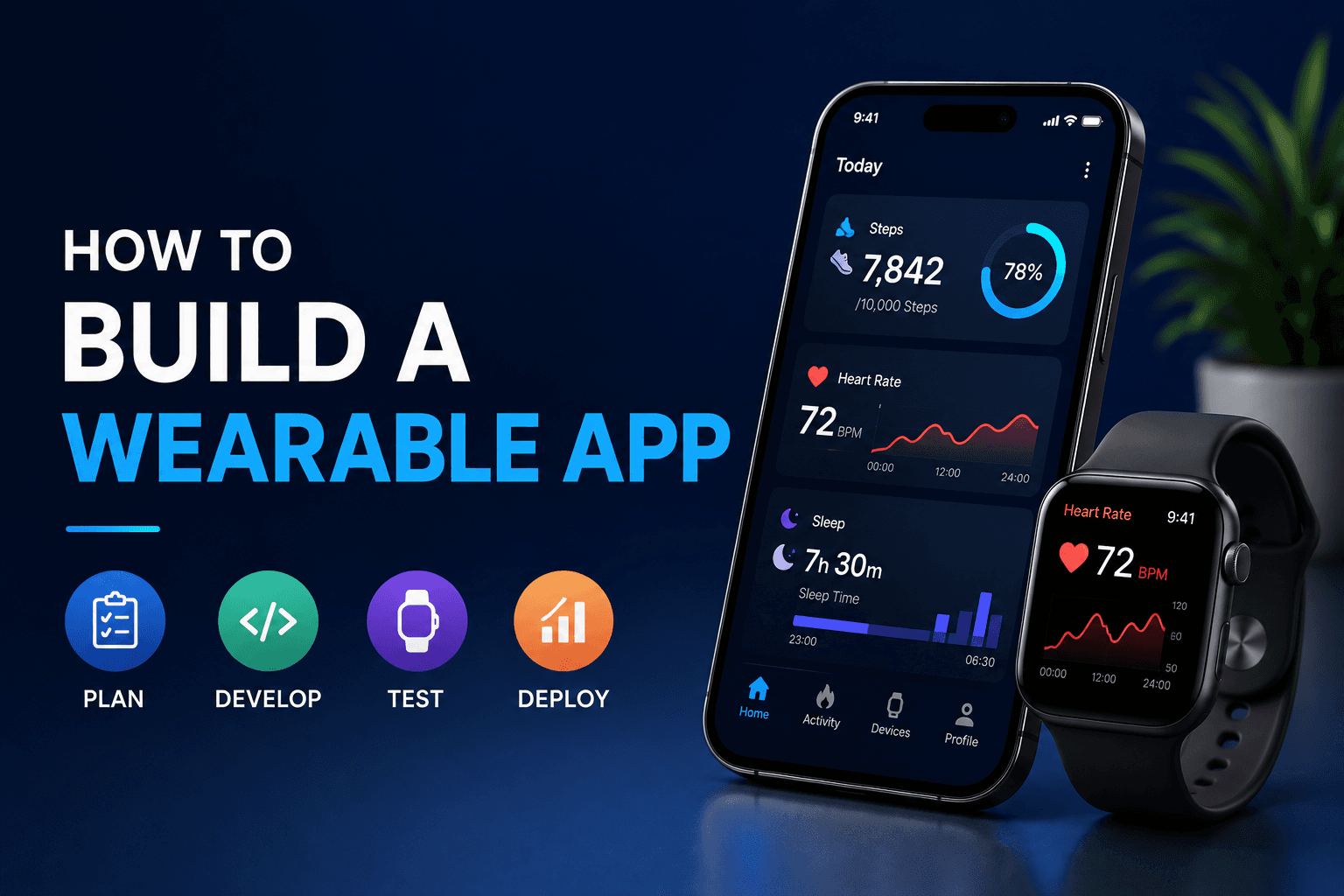
Building a wearable app is mostly an exercise in constraint. The screen is small, the battery is tiny, connectivity is intermittent, and interactions last seconds rather than minutes. The most common failure is treating the watch as a small phone and porting an existing interface onto it, which produces something technically functional that nobody uses. This guide covers the architectural relationship with a companion app, platform decisions, the constraints that shape everything, and how sensor data should actually be handled.
The Companion App Relationship
The first architectural decision is how much your wearable app depends on a phone. Standalone apps work without a paired device, which is better for users and considerably harder to build given battery and connectivity limits. Most wearable apps are companions to a phone app, and the boundary between what runs where determines both battery life and reliability.
Deciding What Runs on the Watch
Keep the watch responsible for capture and display. Heavy processing, synchronisation, and network calls belong on the phone wherever the interaction permits.
Handling Data Transfer Between Devices
Transfer is asynchronous and unreliable, since the phone may be out of range or asleep. Queue locally and reconcile rather than assuming delivery.
Designing for Standalone Operation
Some watches have their own connectivity. Even then, treat network access as intermittent and design around local capability first.
Sharing Logic Without Sharing Interface
Business logic can be shared with the phone app, but interfaces cannot. Our mobile app development work structures this separation deliberately.
Platform Decisions
Wearable platforms diverge more than phone platforms, which limits how much you can share. Cross-platform frameworks that work well for phones have weaker support here, and the platform-specific interaction models differ enough that a single shared interface tends to feel wrong on both. Expect more platform-specific work than an equivalent phone project.
Apple Watch Development
Tightly integrated with the paired iPhone, with a defined interaction model and strong health data access. Our iOS app development work covers the companion relationship.
Wear OS Development
More device variety and hardware fragmentation, closer to Android development conventions. Our Android app development work handles the resulting device matrix.
Cross-Platform Limitations
Framework support for wearables lags behind phone support considerably. Assume platform-specific interface work even when sharing logic across the companion apps.
Fitness Tracker and Proprietary Platforms
Many devices are not general application platforms at all and expose only data through an API. Confirm what is possible before scoping anything.
Constraints That Shape Everything
Every wearable design decision traces back to four constraints. Working with them produces apps people use, and working against them produces apps that drain batteries and get uninstalled. These are not optimisation targets to address later, they are the parameters the product must be designed within from the start.
Battery Is the Hardest Limit
Screen time, sensor polling, and radio use all consume disproportionately. An app that measurably shortens watch battery life gets removed regardless of its usefulness.
Interactions Last Seconds
People glance at watches rather than using them. Any interaction requiring sustained attention belongs on the phone, and forcing it onto the watch fails.
Screen Space Is Severely Limited
One piece of information and at most one or two actions per screen. Dense layouts ported from phone interfaces are unreadable and unusable.
Connectivity Is Intermittent
The phone may be absent and the network unavailable. Local storage with later reconciliation is the default assumption rather than a fallback.
Handling Sensor Data
Sensor data is why most wearable apps exist, and it is where the battery and reliability trade-offs concentrate. The temptation is to sample at high frequency because the data is available. The discipline is sampling at the lowest rate your feature genuinely needs, since sampling rate translates directly into battery consumption and user retention.
Sample at the Lowest Adequate Rate
Determine the minimum frequency your feature requires and use it. High-frequency polling is the largest avoidable battery cost in most wearable apps.
Process on Device Where It Reduces Transfer
Aggregating raw readings into summaries before transfer saves both battery and bandwidth compared with streaming everything to the phone.
Handle Gaps and Noise Explicitly
Sensor data has missing periods and implausible readings. Decide how to handle both, since presenting bad data as fact undermines trust quickly.
Use Platform Health Frameworks
Both platforms provide health data stores with permission handling built in. Using them is better than parallel collection and expected by users.
Design the Backend for Bursty Sync
Data arrives in batches when connectivity returns rather than steadily. Our API development work handles this ingestion pattern specifically.
Interface and Interaction Design
Wearable interface design is subtraction rather than adaptation. Start from the single most valuable piece of information and add only what earns its place. The most successful wearable apps do one thing that benefits from being on the wrist, and defer everything else to the phone where there is room for it.
Design for a Glance
Assume two seconds of attention. The primary information should be readable without interaction, scrolling, or navigation.
Minimise Required Input
Text entry on a watch is poor. Prefer taps, presets, and voice, and move anything requiring real input to the phone.
Use Complications and Notifications Well
Watch face complications and notifications are where most wearable engagement actually happens, often more than the app interface itself.
Respect Platform Interaction Conventions
Crown, gestures, and navigation patterns differ per platform and users have strong expectations. Our UI/UX design work follows each platform rather than unifying them.
Test on the Wrist, Not in a Simulator
Simulators cannot convey glanceability, outdoor readability, or whether an interaction works while moving. Field testing is not optional here.
FAQs
Do wearable apps need a companion phone app?
Most do. Standalone operation is possible on watches with their own connectivity, but battery and processing constraints mean the phone usually handles synchronisation, heavy processing, and network work while the watch handles capture and display.
Can I build a wearable app cross-platform?
Only partially. Framework support for wearables lags well behind phone support, and the interaction models differ enough that a shared interface tends to feel wrong on both platforms. Share business logic, expect platform-specific interface work.
What is the biggest constraint in wearable app development?
Battery. Screen time, sensor polling, and radio use all consume disproportionately, and an app that measurably shortens watch battery life gets uninstalled regardless of usefulness. Sampling rate decisions have the largest single effect.
How should wearable apps handle sensor data?
Sample at the lowest frequency the feature genuinely needs, aggregate on device before transferring rather than streaming raw readings, handle gaps and implausible values explicitly, and use the platform health frameworks rather than collecting in parallel.
How much can you fit on a watch screen?
One piece of primary information and at most one or two actions. Assume roughly two seconds of attention, with the key information readable without scrolling or navigation. Dense layouts ported from phone designs are unusable.
Do I need to test on real devices?
Yes, on the wrist rather than in a simulator. Glanceability, outdoor screen readability, and whether interactions work while walking cannot be assessed on a desktop simulator, and those factors determine whether the app gets used.