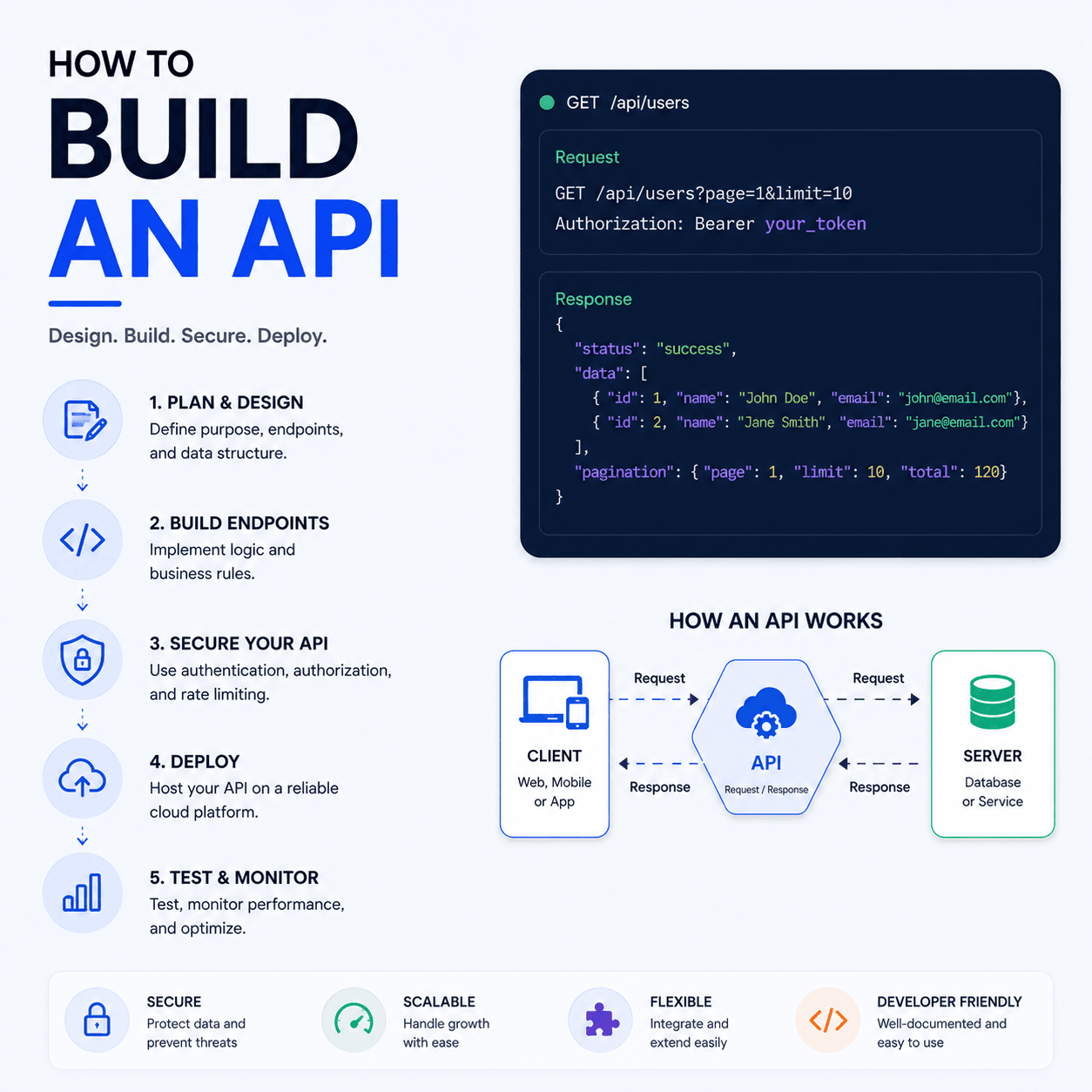
Building an API well means getting a handful of decisions right before you write the first endpoint, because those decisions become contracts you cannot easily change once anyone depends on them. Resource design, authentication, versioning, error format, and pagination all fall into that category. This guide covers each in the order you should decide them, along with rate limiting and the operational concerns that determine whether integrators find your API dependable.
Resource and Endpoint Design
Good API design is mostly consistency. Integrators learn your conventions once and then predict the rest, which is what makes an API pleasant to work with. Inconsistency forces them to check the documentation for every call. Settle naming, structure, and response shape conventions before implementation and apply them without exception.
Model Resources, Not Actions
Endpoints represent things rather than operations, with HTTP methods expressing the action. Action-named endpoints multiply without limit and become impossible to predict.
Keep Naming Consistent
Pick plural or singular, pick a case convention, and never deviate. Inconsistent naming is the most common complaint integrators raise about internal APIs.
Design Response Shapes Deliberately
Consistent envelope structure, predictable field naming, and explicit typing. Returning different shapes from similar endpoints forces defensive parsing everywhere.
Avoid Over-Fetching and Under-Fetching
Return what clients need without requiring several calls to assemble a screen. Our API development work shapes responses against actual client requirements.
Write the Contract First
Define the specification before implementing, so both sides build against something fixed. Retrofitting a specification onto existing endpoints documents accidents as design.
Authentication and Authorisation
Authentication is a decision with long consequences, since changing it after integrators have built against it requires coordinated migration. The choice depends on who calls your API. Server-to-server integration has different needs from a mobile client, and third-party access has different needs again.
Choosing the Mechanism
API keys suit server-to-server integration. Token-based flows suit user-context calls. Delegated authorisation suits third-party access on a user’s behalf.
Scoping Credentials Narrowly
Credentials granting only what the integration needs. Broad-scope keys turn any leak into a full compromise rather than a limited one.
Enforcing Authorisation per Resource
Every request validates permission to the specific object requested, not merely that the caller is authenticated. This is the most common serious API vulnerability.
Token Lifetime and Rotation
Short-lived access tokens with refresh, and a documented rotation path for long-lived keys. Credentials that never expire eventually leak somewhere.
Never Accepting Client-Supplied Identity
Identity comes from the validated credential, never from a request field. Trusting a client-supplied user identifier is a complete authorisation bypass.
Versioning Strategy
Versioning is the decision most often deferred and most expensive to defer, because by the time you need it you have integrators depending on current behaviour. Decide the scheme before your first release even if you launch with one version, and publish the policy so integrators know what to expect.
Choosing a Versioning Approach
Path-based versioning is the most visible and simplest to reason about. Header-based versioning keeps URLs stable at the cost of discoverability.
Defining What Breaks Compatibility
Removing fields, renaming them, changing types, or tightening validation all break clients. Adding optional fields generally does not. Publish this distinction.
Supporting Multiple Versions
Decide how many versions you will maintain simultaneously and for how long, because each one carries ongoing testing and maintenance cost.
Deprecation With Real Notice
Published notice periods, deprecation headers on affected responses, and direct contact with known integrators rather than relying on release notes.
Additive Change Where Possible
Most evolution can be additive rather than breaking. Our enterprise software development integrations depend on providers preferring this.
Rate Limiting, Errors and Pagination
These three are where an API feels either professional or improvised. All are straightforward to implement and all are frequently done inconsistently, which forces integrators to write defensive code around your API’s unpredictability rather than against its contract.
Rate Limiting With Clear Communication
Limits per credential, headers reporting remaining quota and reset time, and a distinct status code when exceeded. Undocumented throttling looks like an outage.
One Consistent Error Format
A single structure across every error, containing a machine-readable code, a human-readable message, and the offending field where applicable.
Distinguishing Retryable Failures
State clearly which errors are transient and worth retrying and which are permanent. Without this, clients either retry pointlessly or fail unnecessarily.
Cursor-Based Pagination
Cursors rather than offsets, so inserts and deletes during iteration do not cause skipped or duplicated records. Offset pagination breaks silently on active data.
Idempotency for Write Operations
Idempotency keys on creation endpoints so retries do not duplicate records. Essential for anything creating orders, payments, or bookings.
Operations, Documentation and Pitfalls
An API is a product with consumers, so it needs the operational treatment of one. Documentation quality and reliability determine whether integrators persist or abandon, and both are usually decided by choices made during the build rather than afterwards.
Documentation as Part of Done
No endpoint ships undocumented. Our API documentation template covers the structure that documentation should follow.
Observability per Endpoint
Latency, error rate, and usage tracked per endpoint and per consumer. You need to know which integrator is affected by a change before they tell you.
Pitfall: Deferring the Versioning Decision
Deciding versioning after integrators exist means either breaking them or maintaining an unversioned legacy path indefinitely.
Pitfall: Inconsistent Conventions
Different naming, casing, or response shapes across endpoints forces integrators to treat every call as a special case, which is the most common source of frustration.
Pitfall: Offset Pagination on Active Data
Records shift between pages as data changes, silently skipping or duplicating items. Integrators discover this as missing data rather than as an error.
Pitfall: Interface-Level Authorisation Only
Validating that a caller is authenticated without checking their permission to the specific resource is the most frequently exploited API flaw. Our DevOps services pipelines can include tests for it.
FAQs
What should I decide before building an API?
Resource naming and structure conventions, authentication mechanism, versioning scheme, error response format, and pagination approach. Each becomes a contract you cannot change easily once integrators depend on it, so settle all five before implementing endpoints.
How should API versioning work?
Choose path-based or header-based versioning before your first release, publish which changes count as breaking, state how many versions you support simultaneously, and give real deprecation notice with headers on affected responses and direct contact to known integrators.
What authentication should an API use?
API keys for server-to-server integration, token-based flows for user-context calls, and delegated authorisation for third-party access on a user’s behalf. Scope credentials narrowly so a leak is limited rather than total, and rotate long-lived keys.
Why is cursor pagination better than offset?
Because offsets shift when records are inserted or deleted during iteration, silently skipping or duplicating items. Cursors reference a position in the data rather than a count, so results stay consistent even while the underlying data changes.
What is the most common API security mistake?
Validating that a caller is authenticated without checking their permission to the specific resource requested. If changing an identifier in a request returns another user’s data, no amount of frontend logic protects you.
Do I need idempotency keys?
For any endpoint creating something, yes. Network retries are common, particularly from mobile clients, and without idempotency they produce duplicate orders, payments, or bookings. It is far cheaper to build in than to reconcile afterwards