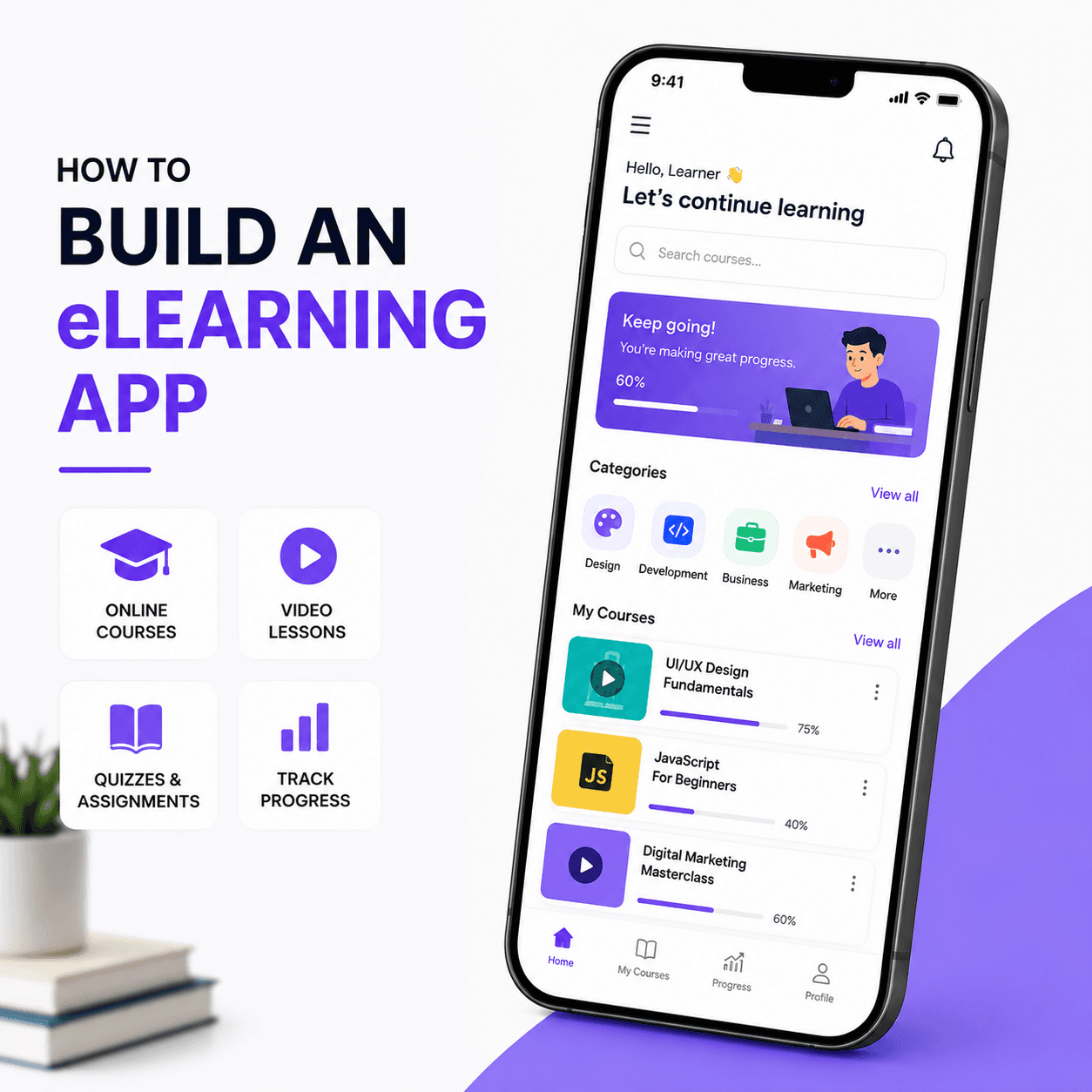
Building an eLearning app centres on two things: delivering content reliably and recording accurately what each learner did. The second is harder than it sounds, because progress tracking has to survive interrupted sessions, offline use, and multiple devices while remaining trustworthy enough to support certification. This guide covers content modelling, the interoperability standards that matter, progress and completion tracking, video delivery, and assessment architecture.
Content and Course Modelling
Course structure determines what your product can support later, and it is frequently modelled too simply at the start. A flat list of lessons works until someone needs prerequisites, learning paths, or the same lesson reused across courses. Modelling the hierarchy and reuse properly at the beginning avoids restructuring once real course catalogues arrive.
Separating Content From Structure
Store learning objects independently of the courses referencing them, so one lesson can appear in several courses without duplication or divergence.
Modelling Hierarchy Deliberately
Courses, modules, lessons, and activities as distinct levels. Flat structures cannot express prerequisites or sequencing rules without awkward workarounds.
Prerequisites and Learning Paths
Rules controlling what unlocks when, evaluated against learner progress. This is business logic and belongs in a rules layer rather than scattered through the interface.
Versioning Course Content
Content changes while learners are mid-course. Decide whether they continue on the version they started or move to the current one, since both have consequences.
Multi-Format Content Support
Video, documents, interactive activities, and external embeds. Our web application development work handles the varied rendering this requires.
Interoperability Standards
Standards matter here more than in most application categories, because organisations buying learning software expect content portability and reporting compatibility. Supporting them is significant work, so decide early based on your actual market rather than adding it later under commercial pressure from a large prospect.
SCORM Support
The long-established packaging and tracking standard. Widely expected in corporate learning, and its runtime communication model constrains how you host and track content.
xAPI for Detailed Tracking
A more flexible standard recording granular learning statements to a separate store. Better for analytics and for learning happening outside your application.
LTI for Platform Integration
Allows your content to be launched from institutional learning management systems, which is essential in education markets and largely irrelevant in consumer ones.
Deciding What to Support
Corporate buyers usually require SCORM, institutions require LTI, and consumer products may need neither. Our custom software development scoping settles this against your target market.
The Cost of Retrofitting
Standards affect content packaging, hosting, and tracking architecture. Adding support later is substantial rework rather than a feature addition.
Progress and Completion Tracking
Tracking is the part learners and administrators actually judge. Progress that resets, loses position, or reports completion incorrectly destroys trust immediately, and where certification is involved it becomes a compliance problem rather than a usability one. The architecture has to assume interruption as the normal case.
Defining Completion Precisely
Percentage viewed, activities finished, or assessment passed. Ambiguous completion definitions produce disputes with learners and with the organisations paying for them.
Recording Position Continuously
Save position frequently enough that an interrupted session resumes accurately, without generating excessive write traffic on every second of playback.
Reconciling Across Devices
Learners switch between phone and desktop mid-course. Last-write-wins loses progress, so reconcile by furthest position rather than most recent write.
Handling Offline Progress
Offline activity queues locally and syncs later, potentially conflicting with progress made elsewhere. Define the merge rules explicitly.
Auditability for Certification
Where completion carries formal weight, records need timestamps, immutability, and an audit trail. Our api-development work builds this as a first-class concern.
Video Delivery and Assessment
Video is usually the primary content type and the dominant infrastructure cost, while assessment is where the most intricate business logic accumulates. Both benefit from using established infrastructure rather than building from scratch, then spending effort on the learning-specific behaviour around them.
Adaptive Video Streaming
Multiple renditions with adaptive playback rather than a single file, so learners on poor connections get a usable experience rather than buffering.
Playback Position and Analytics
Track position, completion, and rewatched segments. Repeatedly rewatched sections indicate content that is unclear, which is useful editorial signal.
Content Protection Proportionate to Risk
Signed URLs and expiring tokens suit most products. Full digital rights management is expensive and rarely justified outside high-value licensed material.
Assessment Engine Design
Question banks, randomisation, attempt limits, and scoring rules. Model these as configurable rather than hardcoding one assessment behaviour.
Server-Side Answer Validation
Correct answers never sent to the client before submission. Client-side scoring in a certification context is trivially defeated and undermines the credential.
Offline Learning, Sequencing and Pitfalls
Offline capability is a genuine requirement in eLearning rather than a convenience, since learners study while commuting and in places with poor connectivity. It is also the source of most synchronisation complexity. Combined with a sensible build order, the pitfalls below cover most of what derails these projects.
Offline Content and Sync
Downloadable lessons with local progress recording and later reconciliation. Our cloud consulting work covers the sync infrastructure and conflict handling.
Suggested Build Order
Content model and authoring, then delivery and playback, then progress tracking, then assessment, then standards support, then offline, then reporting.
Pitfall: Flat Course Structure
Modelling courses as lesson lists prevents prerequisites and reuse, requiring restructuring once catalogues grow beyond a handful of courses.
Pitfall: Infrequent Progress Saving
Saving only at lesson boundaries loses position on interruption, which learners experience as the app losing their work.
Pitfall: Last-Write-Wins Sync
Naive conflict resolution across devices erases progress. Reconcile by furthest completion rather than most recent timestamp.
Pitfall: Deferring Standards Support
SCORM and LTI affect packaging, hosting, and tracking architecture. Adding them after a large prospect asks is substantial rework under deadline pressure.
FAQs
What is SCORM and do I need it?
SCORM is a long-established standard for packaging and tracking learning content. Corporate buyers commonly require it for content portability and reporting compatibility. Consumer products often need neither SCORM nor LTI, so decide based on your actual target market.
What is the difference between SCORM and xAPI?
SCORM packages content with a defined runtime for tracking within a learning management system. xAPI records granular learning statements to a separate store and can capture activity outside your application, making it better suited to detailed analytics.
How should learning progress be tracked?
Save position frequently enough that interrupted sessions resume accurately, define completion precisely rather than ambiguously, reconcile across devices by furthest position rather than latest write, and maintain an audit trail where completion carries formal weight.
How do I handle progress sync across devices?
Reconcile by furthest completion rather than most recent write. Last-write-wins erases progress when a learner uses two devices, which is common and produces support complaints that are hard to resolve after the fact.
Should answers be validated on the client or server?
Always on the server. Correct answers must never reach the client before submission. Client-side scoring is trivially defeated by inspecting the application, which undermines any credential the assessment supports.
Does an eLearning app need offline support?
Usually yes. Learners study while commuting and in poor connectivity, so downloadable content with local progress recording is a genuine requirement. It is also the main source of synchronisation complexity, so define merge rules explicitly.