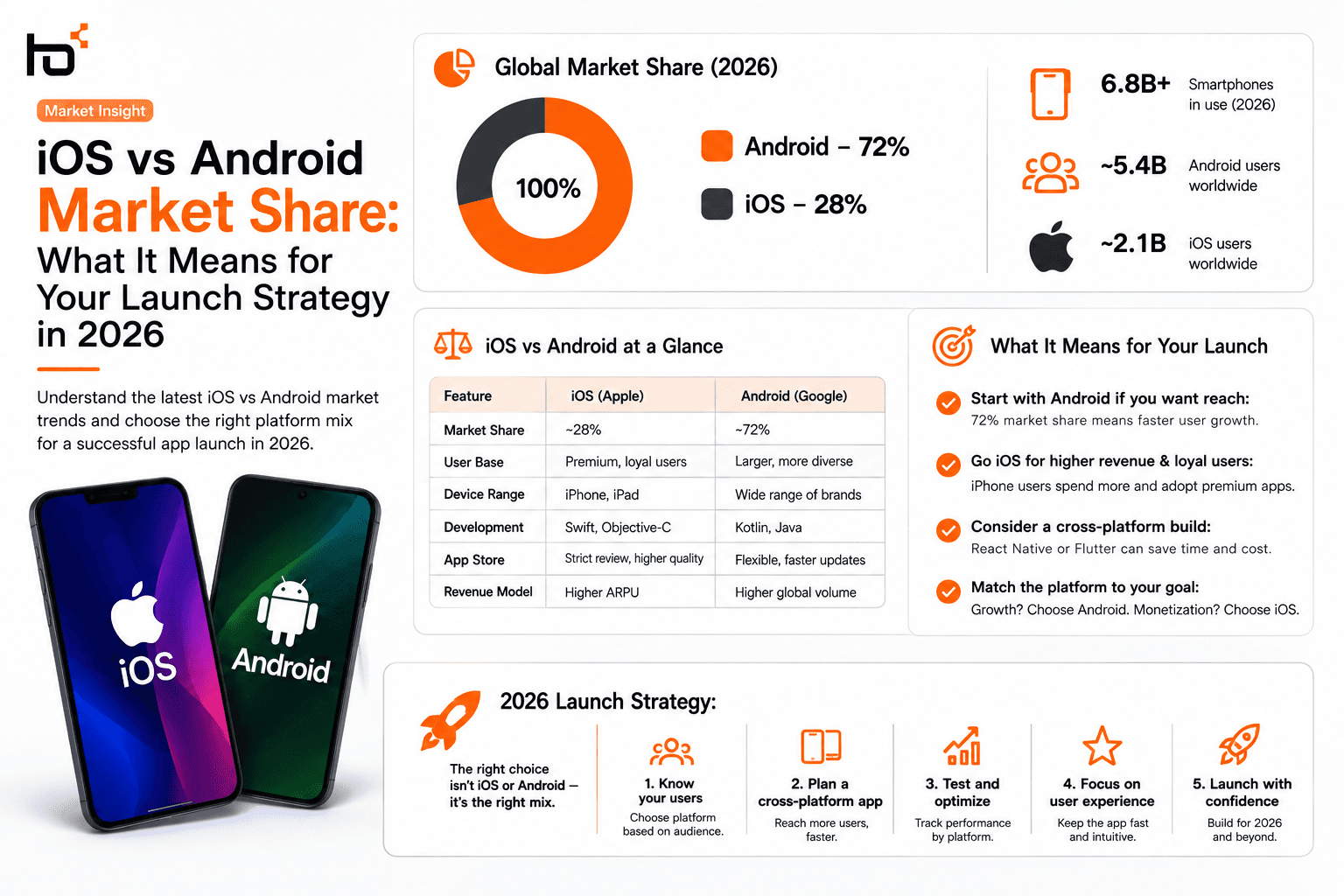
Understanding iOS vs Android market share by region and demographic helps you decide which platform to prioritize first if budget or timeline forces a sequential launch rather than simultaneous release. Global market share splits differently by country, income level, and age group, which matters more for your specific launch decision than a single global average number. This guide focuses on the strategic decision-making, not just raw statistics. Our mobile app development team can help align platform priority with your specific target market.
Why Market Share Alone Isn’t the Full Picture
Global market share figures can mislead if your actual target audience skews differently from the global average, which is common for many specific business use cases and demographics.
Regional Variation Matters More Than Global Averages
iOS and Android market share varies significantly by country and region, so your specific target market’s platform split matters far more than a blended global figure.
Income and Demographic Skew
iOS users skew toward higher income brackets in many markets, which matters if your app’s business model depends on in-app purchases or a demographic with specific spending patterns.
App Category Affects Platform Priority
Certain app categories perform differently by platform based on existing user behavior patterns, so category-specific data is more useful than generic market share statistics.
Making the Platform Priority Decision
Once you understand your specific target market’s platform split, the decision becomes about sequencing rather than an either-or choice for most growing businesses.
Start With Your Core Target Market’s Dominant Platform
If budget requires a sequential launch, prioritize the platform your specific target demographic actually uses most, not the platform your team happens to prefer.
Consider Monetization Model Fit
If your business model depends on in-app purchases, understanding platform-specific spending behavior in your target market can meaningfully affect platform priority.
Plan the Second Platform Launch Timeline
Launching sequentially doesn’t mean ignoring the second platform indefinitely — build a realistic timeline for expansion based on early results from your first platform.
Use Cross-Platform Development to Reduce This Trade-Off
Cross-platform frameworks can reduce the cost of the sequential-launch decision significantly, letting you reach both platforms without duplicating full native development effort.
FAQs
Should I always launch on the platform with higher market share?
Not necessarily. Your specific target demographic’s platform preference and spending behavior often matter more than raw global market share numbers.
Does market share affect app store discoverability?
Not directly, though a larger user base on one platform can mean more overall search volume and competition within that specific app store.
How does iOS vs Android market share vary by country?
Significantly. Some markets lean heavily iOS, others heavily Android, so understanding your specific target region’s split is more useful than a global average figure.
Is it better to build cross-platform to avoid this decision entirely?
Often, yes, for many business types. Cross-platform development lets you reach both platforms without the cost of building two completely separate native codebases.
Do iOS users spend more on apps than Android users?
In many markets, yes, iOS users have historically shown higher average in-app spending, though this varies by app category and region.
How do I find market share data for my specific target audience?
Look for platform statistics segmented by your specific target country, age group, or industry vertical, rather than relying solely on broad global figures.