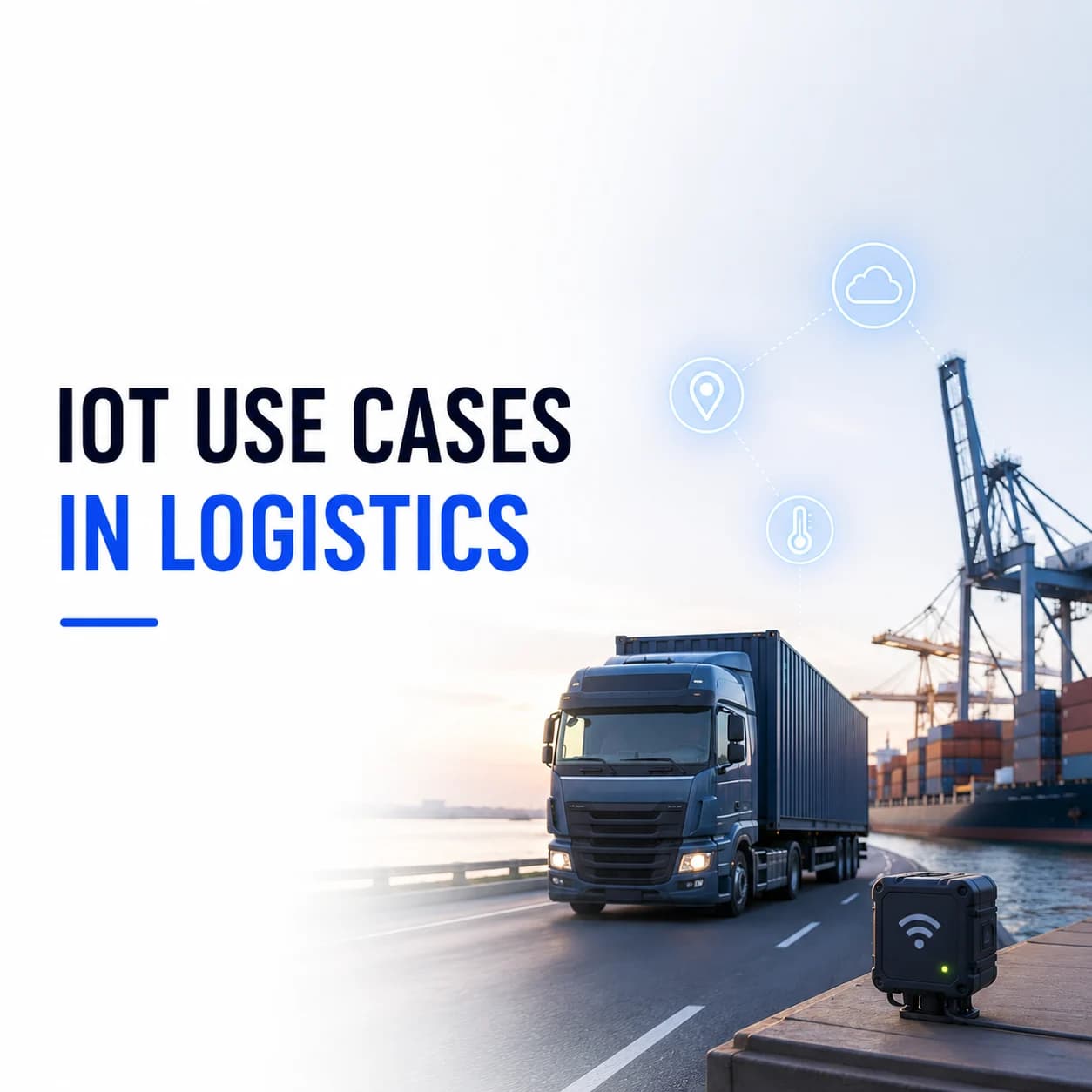
Logistics is one of the few sectors where IoT delivers value that is easy to quantify, because the things being measured, meaning vehicles, assets, and temperature-controlled goods, have direct and known costs attached. The use cases below cover fleet telematics, asset tracking, cold chain monitoring, and warehouse sensing. Each section deals with the connectivity and data realities involved, since the difficulty in logistics IoT is rarely the sensor and almost always intermittent connectivity and getting the data somewhere useful.
Fleet Telematics
Telematics is the most mature logistics IoT application, with established hardware and a clear financial case built on fuel, maintenance, and utilisation. The engineering challenge is less about collecting data than about turning continuous streams from many vehicles into something operations staff act on daily.
Location and Route Adherence
Continuous position reporting against planned routes, surfacing deviation and delay while there is still time to respond rather than afterwards.
Fuel and Driving Behaviour
Harsh braking, acceleration, idling, and speed patterns. Directly linked to fuel cost and accident risk, and measurable per driver.
Vehicle Health and Diagnostics
Engine and diagnostic data enabling maintenance before breakdown. The same data supports predictive maintenance once enough failure history accumulates.
Utilisation and Capacity Analysis
Understanding how fully vehicles are used across routes and periods, which frequently reveals recoverable capacity nobody had measured.
Delivering It Into Operations
Streams matter only if they reach dispatchers. Our dashboard development work builds the operational view this requires, and our fleet and logistics case studies show comparable delivery work.
Asset and Container Tracking
Tracking non-powered assets such as trailers, containers, pallets, and returnable packaging is a different problem from vehicle telematics, because there is no vehicle power supply. Battery life becomes the governing constraint and it dictates how often anything can be reported.
Battery Life as the Design Constraint
Reporting frequency determines battery life directly. Multi-year deployments require infrequent reporting, which means position is periodic rather than continuous.
Connectivity Options and Trade-Offs
Cellular gives coverage at power cost, low-power wide-area networks extend life at lower bandwidth, and short-range tags need gateway infrastructure at known points.
Loss and Shrinkage Reduction
Returnable assets disappear at material cost. Even infrequent position reporting substantially improves recovery rates.
Dwell Time and Utilisation
Understanding how long assets sit idle where. Frequently reveals that the fleet is larger than needed rather than insufficient.
Handling Sparse Data
Periodic reporting means gaps. Interpolate carefully and present uncertainty honestly rather than showing inferred positions as fact.
Cold Chain Monitoring
Cold chain is the logistics IoT use case with the clearest compliance dimension, since temperature excursions in pharmaceutical and food transport carry regulatory consequences and product loss. That makes the data evidentiary rather than merely operational, which raises the requirements on it considerably.
Continuous Temperature Recording
Logging throughout transit rather than at handover points, which is what identifies where in the journey an excursion actually occurred.
Real-Time Excursion Alerting
Alerts while intervention is still possible. A record showing a shipment spoiled is far less valuable than a warning that let someone act.
Evidentiary Data Requirements
Records must be tamper-evident with reliable timestamps and calibration traceability, since they may be relied upon in a dispute or inspection.
Connectivity Gaps in Transit
Vehicles cross areas without coverage. Devices must log locally and upload on reconnection rather than losing the period entirely.
Integration With Quality Processes
Excursion data needs to reach quality and compliance workflows. Our api-integration-services work handles that routing.
Warehouse and Yard Sensing
Inside facilities, connectivity and power are less constrained, which makes denser sensing practical. The applications here are about knowing where things are and how space is used, both of which are commonly tracked in systems that have drifted from physical reality.
Location Tracking Inside Facilities
Indoor positioning for equipment and inventory, addressing the routine problem of stock the system says exists but nobody can locate.
Environmental Monitoring
Temperature and humidity in storage areas, both for product protection and for compliance in regulated storage.
Equipment Utilisation
Forklift and handling equipment usage, informing fleet sizing and maintenance scheduling with actual rather than assumed usage.
Yard and Dock Management
Trailer position and dock occupancy, reducing search time and improving turnaround at the point where delays compound.
Reconciling Sensors With Systems
Sensor reality frequently contradicts system records. Our data analytics work handles that reconciliation rather than assuming either is authoritative.
Data Architecture Realities
The consistent lesson across logistics IoT is that the hard problems are architectural rather than sensory. Devices are intermittently connected, generate high volumes of low-value readings, and produce data that must reach existing operational systems to matter. Designing for those three facts determines whether a deployment delivers.
Assume Intermittent Connectivity
Devices must buffer locally and upload on reconnection. Any architecture assuming continuous connectivity will lose data in normal operation.
Aggregate Before Transmitting
Sending every reading is expensive in bandwidth and battery. Summarise on device and transmit exceptions and periodic summaries instead.
Plan Data Retention Deliberately
High-frequency sensor data accumulates quickly. Define what is kept at full resolution and what is downsampled before storage costs decide for you.
Integrate With Operational Systems
Data in a separate portal changes nothing. Our predictive analytics work feeds existing planning and maintenance processes rather than parallel tools.
Manage the Device Fleet Itself
Firmware updates, battery status, and failure detection across many devices in the field is an operational discipline in its own right.
FAQs
What are the main IoT use cases in logistics?
Fleet telematics covering location, driving behaviour, and vehicle diagnostics; asset and container tracking; cold chain temperature monitoring with excursion alerting; and warehouse sensing for indoor location, environmental conditions, and equipment utilisation.
What is the hardest part of logistics IoT?
Not the sensors. Intermittent connectivity, high volumes of low-value readings, and getting data into the operational systems people already use. Architectures assuming continuous connectivity lose data during normal operation rather than exceptionally.
How long do asset tracking device batteries last?
It depends almost entirely on reporting frequency, which is the governing design trade-off. Multi-year deployments require infrequent reporting, meaning position is periodic rather than continuous, and the data must be presented with that uncertainty acknowledged.
What does cold chain monitoring require beyond temperature sensors?
Continuous logging through transit rather than at handover, real-time alerting while intervention is still possible, tamper-evident records with reliable timestamps and calibration traceability, local buffering through connectivity gaps, and integration with quality workflows.
Should sensor data be processed on the device or in the cloud?
Aggregate on the device and transmit summaries and exceptions. Sending every raw reading is expensive in bandwidth and battery and rarely necessary, since the useful signal is usually a summary or a threshold breach rather than the full stream.
How do I make IoT data actually useful?
Deliver it into the systems and screens where operational decisions already happen, rather than a separate portal. Data in a parallel tool changes no behaviour, which is the most common reason logistics IoT deployments fail to show value.