Choosing between Kotlin vs Java for a new Android project matters less than it once did, since Google has officially recommended Kotlin for years now, but understanding the specific tradeoffs still helps teams make an informed decision. Businesses working with our Kotlin app development or Android app development teams often ask which language fits their specific situation best. This guide compares the two languages on the factors that actually matter for a real project decision.
Language Design & Safety
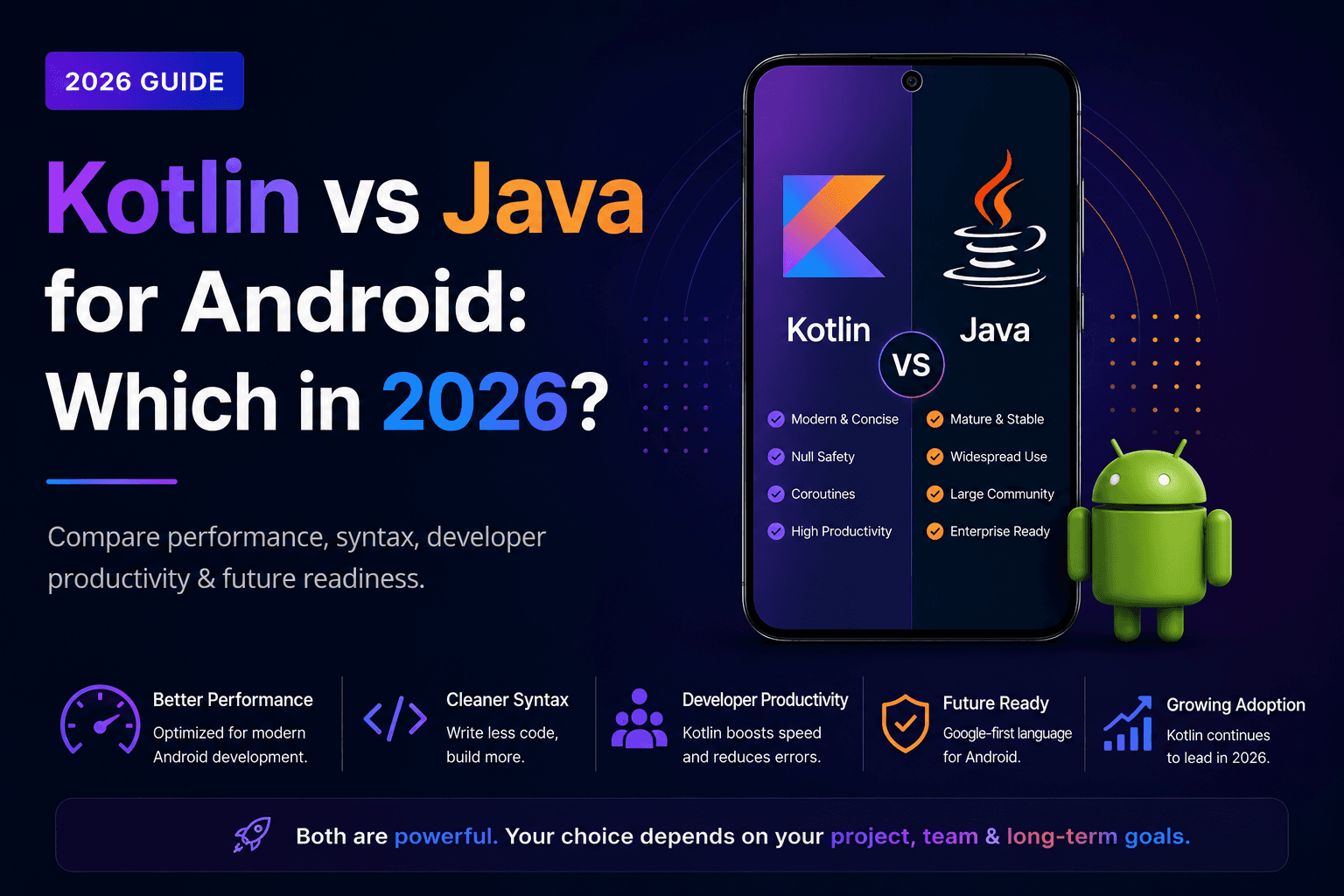
Kotlin and Java differ meaningfully in how they’re designed to prevent common programming errors.
Null Safety
Kotlin’s built-in null safety catches a large category of common Android crashes at compile time, while Java requires more manual discipline to avoid null pointer exceptions.
Code Conciseness
Kotlin generally requires significantly less boilerplate code for common Android patterns than Java, making codebases more concise and often easier to read.
Modern Language Features
Kotlin includes modern language features like coroutines for cleaner asynchronous code, while Java has historically required more verbose patterns for similar functionality, though Java has added modern features over time too.
Performance Considerations
Both languages ultimately compile to run on the same underlying Android runtime, making performance differences less significant than often assumed.
Runtime Performance
Since both Kotlin and Java compile to bytecode running on the same Android runtime, real-world performance differences between well-written code in either language are generally minimal.
Compilation & Build Times
Kotlin compilation has historically been somewhat slower than Java in some scenarios, though this gap has narrowed considerably with tooling improvements over recent years.
Ecosystem & Google’s Direction
Google’s official platform direction significantly affects long-term considerations for either language choice.
Google’s Official Recommendation
Google has officially recommended Kotlin for Android development for years, meaning new platform APIs and documentation increasingly prioritize Kotlin-first examples and support.
Interoperability Between Kotlin and Java
Kotlin offers full interoperability with Java, allowing gradual migration or mixed codebases, which reduces the risk of choosing Kotlin even for teams with existing Java code.
Hiring & Talent Considerations
Practical hiring considerations matter alongside pure technical comparison.
Kotlin Talent Availability
Kotlin has become increasingly mainstream, with a growing talent pool, though Java still has a larger overall pool of experienced Android developers in some markets.
Learning Curve for Existing Java Developers
Java developers can generally pick up Kotlin relatively quickly given the interoperability and similar underlying concepts, making a switch less disruptive than learning an entirely unrelated language.
Which Should You Choose for a New Project?
For most new Android projects in 2026, Kotlin is the generally recommended default given Google’s official direction and the language safety benefits it provides, though Java remains a viable choice, particularly for teams with deep existing Java expertise and codebases.
FAQs
Is Kotlin replacing Java for Android development entirely?
Kotlin has become the officially recommended and dominant choice for new Android development, though Java remains supported and many existing Java codebases continue to be maintained.
Can Kotlin and Java code coexist in the same Android project?
Yes, Kotlin offers full interoperability with Java, allowing both languages to coexist in the same project, which supports gradual migration rather than requiring an all-or-nothing switch.
Is Kotlin harder to learn than Java?
For developers with programming experience, Kotlin is generally considered approachable, and Java developers specifically often find the transition relatively smooth given Kotlin’s interoperability and similar underlying concepts.
Does Kotlin cost more to develop with than Java?
Development costs are generally comparable, since the language itself is a relatively small factor in overall project cost compared to feature scope and developer experience level.
Should I rewrite an existing Java Android app in Kotlin?
Not necessarily immediately; many teams migrate gradually, writing new features in Kotlin while maintaining existing Java code, rather than undertaking a complete rewrite solely for language modernization.
Which language has better long-term support from Google?
Kotlin currently receives Google’s primary strategic focus for Android development, making it the safer long-term bet for new projects, though Java remains supported for existing codebases.