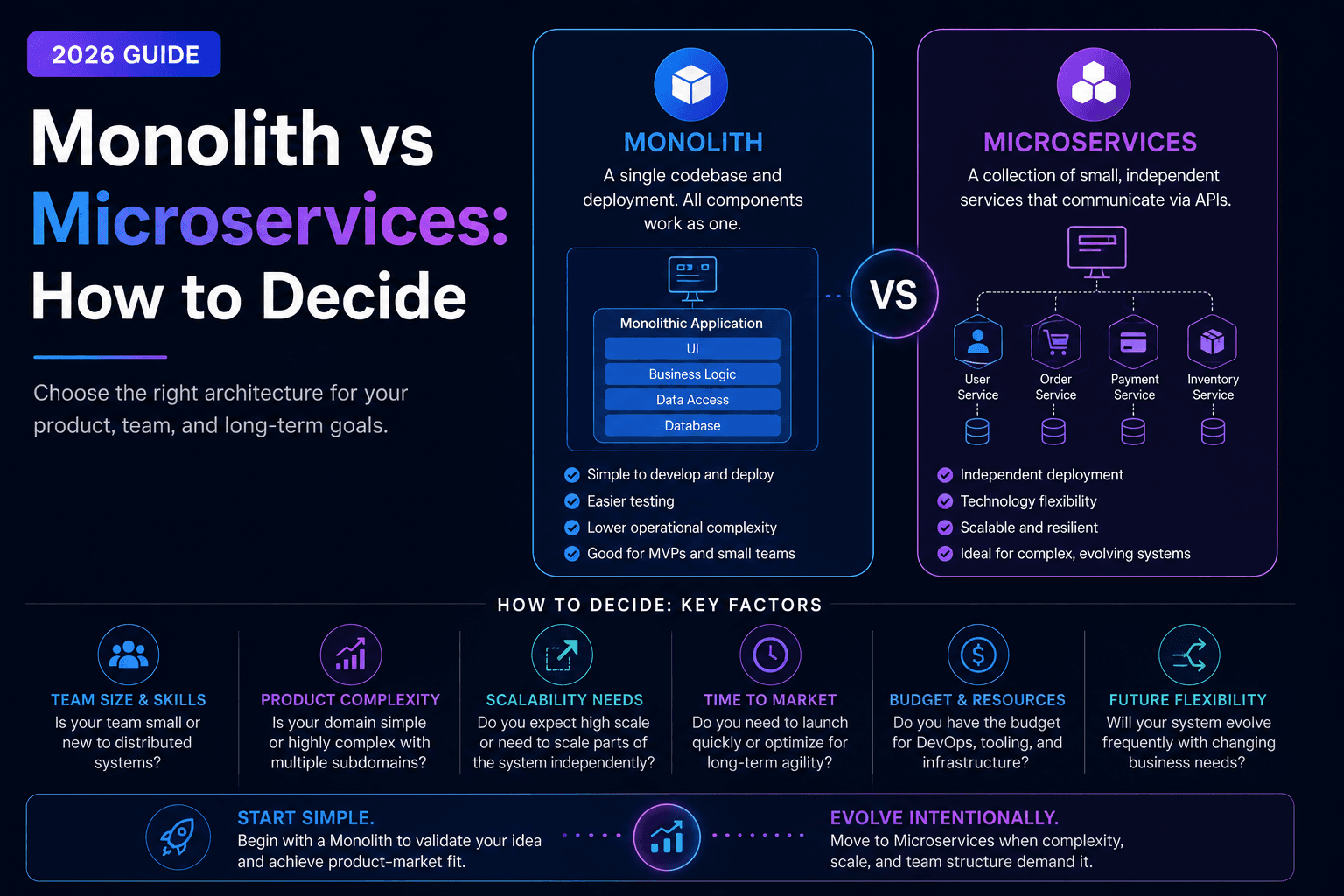
Choosing between monolith vs microservices architecture significantly affects development speed, operational complexity, and how easily your system scales, making it one of the most consequential early architecture decisions for a new application. Businesses working with our software development team often assume microservices are automatically the “modern” or “better” choice, when in reality the right answer depends heavily on your specific stage and scale. This guide compares the two approaches honestly, including when each genuinely fits better.
Development Speed & Simplicity
The two architectures differ significantly in how quickly teams can build and iterate, especially early on.
Monolith’s Simpler Initial Development
A monolithic architecture, with all functionality in one codebase, is generally simpler and faster to build initially, without the coordination overhead microservices introduce.
Microservices’ Coordination Overhead
Microservices require managing communication between separate services, adding coordination complexity that can slow down development, particularly for smaller teams or simpler applications.
Scaling Considerations
Each architecture handles scaling differently as an application grows.
Monolith Scaling Limitations
Monoliths generally scale as a single unit, meaning you scale the entire application even if only one specific component actually needs more capacity, which can become inefficient at significant scale.
Microservices’ Independent Scaling
Microservices allow scaling individual services independently based on their specific load, providing more efficient resource usage for applications with uneven load across different functions.
Operational Complexity
Running and maintaining each architecture in production involves different challenges.
Monolith’s Simpler Deployment
Deploying a monolith typically involves a single deployment unit, simplifying operational processes compared to coordinating deployments across many independent microservices.
Microservices’ Distributed System Challenges
Microservices introduce distributed system challenges like service discovery, inter-service communication reliability, and more complex monitoring across many independent components.
Team Structure Considerations
Architecture choice interacts significantly with how your engineering team is organized.
Monoliths for Smaller, Unified Teams
Smaller teams working on a single codebase often find monolithic architecture’s simplicity aligns well with their team structure, without needing to coordinate across service boundaries.
Microservices for Larger, Multi-Team Organizations
Larger organizations with multiple independent teams often benefit from microservices’ ability to let each team own and deploy their specific service independently.
When to Choose Each Approach
Making the right choice depends on being honest about your actual current stage and needs, not aspirational future scale.
Start With a Monolith for Most New Projects
Most new applications, especially startups validating product-market fit, benefit from starting with a well-structured monolith, avoiding microservices’ overhead until genuine scaling needs justify it.
Consider Microservices When Scale or Team Size Demands It
Microservices become genuinely valuable when you have clear scaling bottlenecks in specific components or a large enough engineering organization that independent team deployment matters.
FAQs
Should every application eventually move to microservices?
No, many successful applications run well as monoliths indefinitely; microservices make sense specifically when scaling or organizational needs genuinely require the independent deployment and scaling they provide.
Is it a mistake to start a new project with microservices?
For most early-stage projects, yes; the coordination overhead of microservices typically outweighs their benefits before you have genuine scale or team-size pressures that justify the added complexity.
Can a monolith be converted to microservices later?
Yes, though this migration requires careful planning and is generally easier when the monolith was built with clean internal boundaries between different functional areas from the start.
Do microservices always perform better than monoliths?
Not necessarily; microservices can introduce network latency between services that a well-optimized monolith avoids entirely, making performance comparison dependent on specific implementation details.
How do I know if my monolith has become a scaling problem?
Watch for specific components under disproportionate load compared to the rest of the application, or team coordination friction from multiple teams working in the same codebase simultaneously.
Is microservices architecture more expensive to run?
Generally yes, due to the additional infrastructure and operational overhead of running and monitoring many independent services compared to a single monolithic deployment.