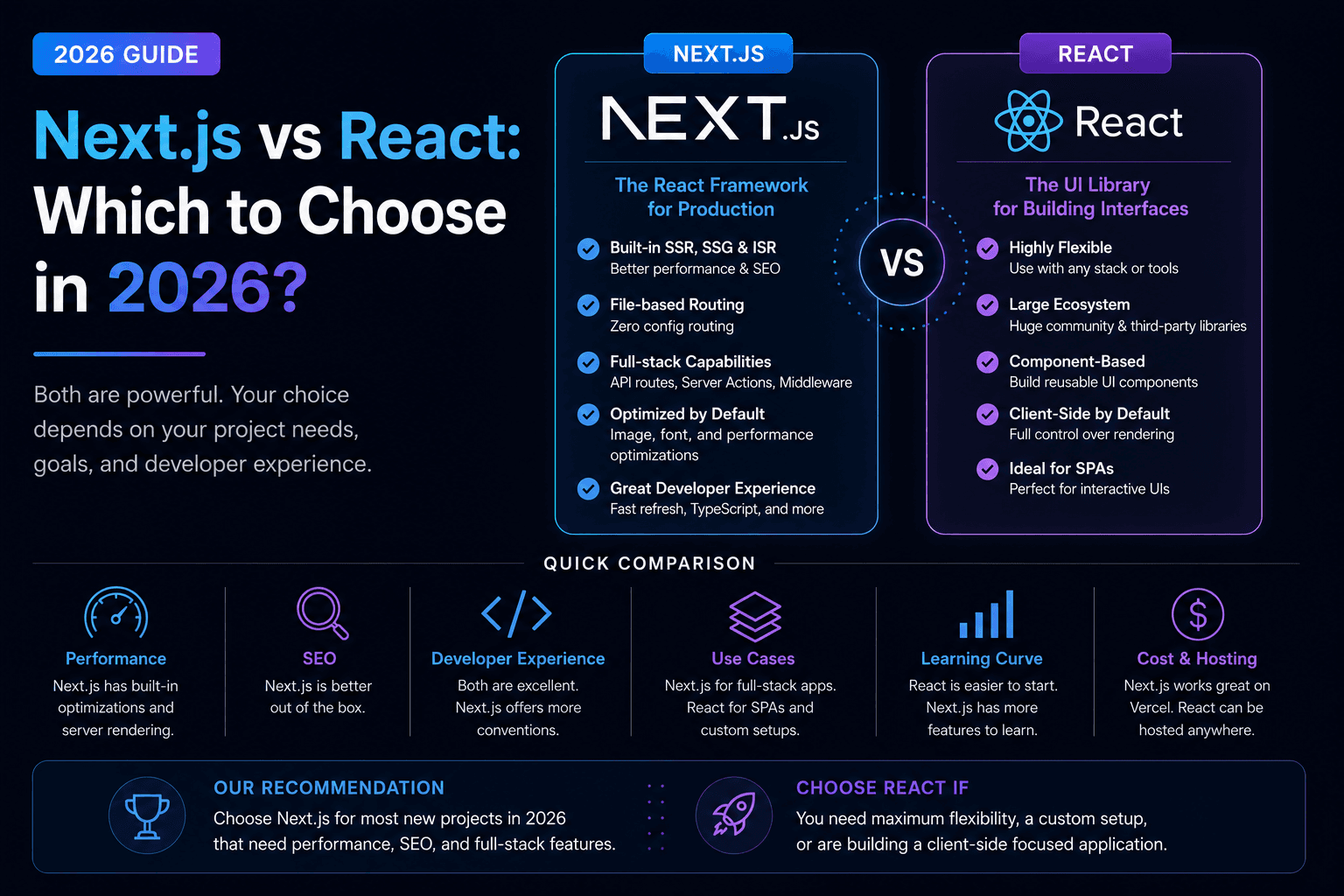
Comparing Next.js vs React requires understanding that they’re not actually direct competitors — Next.js is a framework built on top of React, adding rendering, routing, and SEO capabilities that plain React alone doesn’t provide out of the box. Businesses working with our web application development team often ask which to choose, when the real question is usually whether your project needs what Next.js adds on top of React’s core library. This guide focuses specifically on server-side rendering, routing, and SEO considerations to clarify when each approach fits best.
Understanding the Actual Relationship
Before comparing tradeoffs, it’s worth clarifying that Next.js uses React under the hood rather than being a genuine alternative to it.
React as the Underlying UI Library
React itself is a JavaScript library for building user interfaces through components, forming the foundation that Next.js and other frameworks build additional capabilities on top of.
Next.js as a Full Framework Built on React
Next.js adds server-side rendering, file-based routing, and built-in optimization features on top of React, providing a more complete framework rather than requiring you to assemble these pieces yourself.
Rendering Approach Differences
The two approaches differ significantly in how content gets rendered, which matters for both performance and SEO.
Plain React’s Client-Side Rendering Default
A standard React application typically renders entirely in the browser by default, which can create slower initial page loads and SEO challenges without additional configuration.
Next.js’s Server-Side & Static Rendering Options
Next.js provides built-in server-side rendering and static generation options, letting content render on the server before reaching the browser, improving both initial load performance and SEO.
SEO Considerations
Rendering approach directly affects how well search engines can index your content.
SEO Challenges With Client-Side-Only React
Pure client-side rendered React applications can face SEO challenges since search engine crawlers historically had more difficulty properly indexing content that renders only after JavaScript execution.
Next.js’s Built-In SEO Advantages
Next.js’s server-side rendering and static generation capabilities make content immediately available in the initial HTML response, generally providing stronger SEO performance without additional workarounds.
Routing & Project Structure
The two approaches also differ in how routing and project organization work.
React’s Flexible but Manual Routing
Plain React requires adding a separate routing library and configuring routes manually, offering flexibility but requiring more setup decisions from your team.
Next.js’s File-Based Routing
Next.js provides file-based routing built in, where your file structure automatically defines your application’s routes, reducing configuration overhead and decision fatigue.
When to Choose Plain React
Certain project types genuinely fit better with plain React without Next.js’s additional framework layer.
Highly Custom, Non-Standard Applications
Applications with very specific, unusual architecture needs that don’t fit Next.js’s conventions may benefit from React’s flexibility without an opinionated framework layer on top.
Internal Tools Without SEO Requirements
Internal dashboards or tools with no public SEO requirements may not need Next.js’s server-side rendering benefits, making plain React’s simplicity sufficient.
When to Choose Next.js
Most public-facing web applications benefit from what Next.js adds on top of React.
Public-Facing Sites Needing Strong SEO
Any public-facing application where search engine visibility matters significantly benefits from Next.js’s built-in server-side rendering and SEO-friendly architecture.
FAQs
Is Next.js a replacement for React?
No, Next.js is built on top of React and requires it as the underlying UI library; the real choice is whether to use plain React or add Next.js’s additional framework capabilities.
Does Next.js always provide better SEO than plain React?
Generally yes, due to built-in server-side rendering, though plain React can achieve good SEO with additional configuration and libraries, just requiring more manual setup work.
Is Next.js more complex to learn than plain React?
Next.js adds some framework-specific concepts on top of React, but its conventions can actually simplify certain decisions, like routing, that plain React leaves to your own configuration.
Can I migrate an existing React app to Next.js?
Yes, though migration effort depends on the existing application’s architecture, since adopting Next.js’s rendering and routing conventions typically requires some restructuring.
Does Next.js cost more to develop with than plain React?
Development cost is generally comparable, and Next.js’s built-in conventions can actually reduce time spent on decisions and configuration that plain React would otherwise require.
Which should I choose for a simple internal admin dashboard?
For internal tools without public SEO requirements, plain React is often sufficient, though Next.js’s routing conventions and performance benefits can still be valuable even for internal applications.