Choosing between REST vs GraphQL for a new API affects how efficiently your frontend fetches data and how flexible your API remains as client needs evolve over time. Businesses working with our API integration services team often ask which style fits their specific application better, since both have genuine strengths depending on your use case. This guide compares the two approaches on the factors that matter most for a real architecture decision.
Data Fetching Flexibility
The two approaches differ significantly in how clients request and receive data.
REST’s Fixed Endpoint Structure
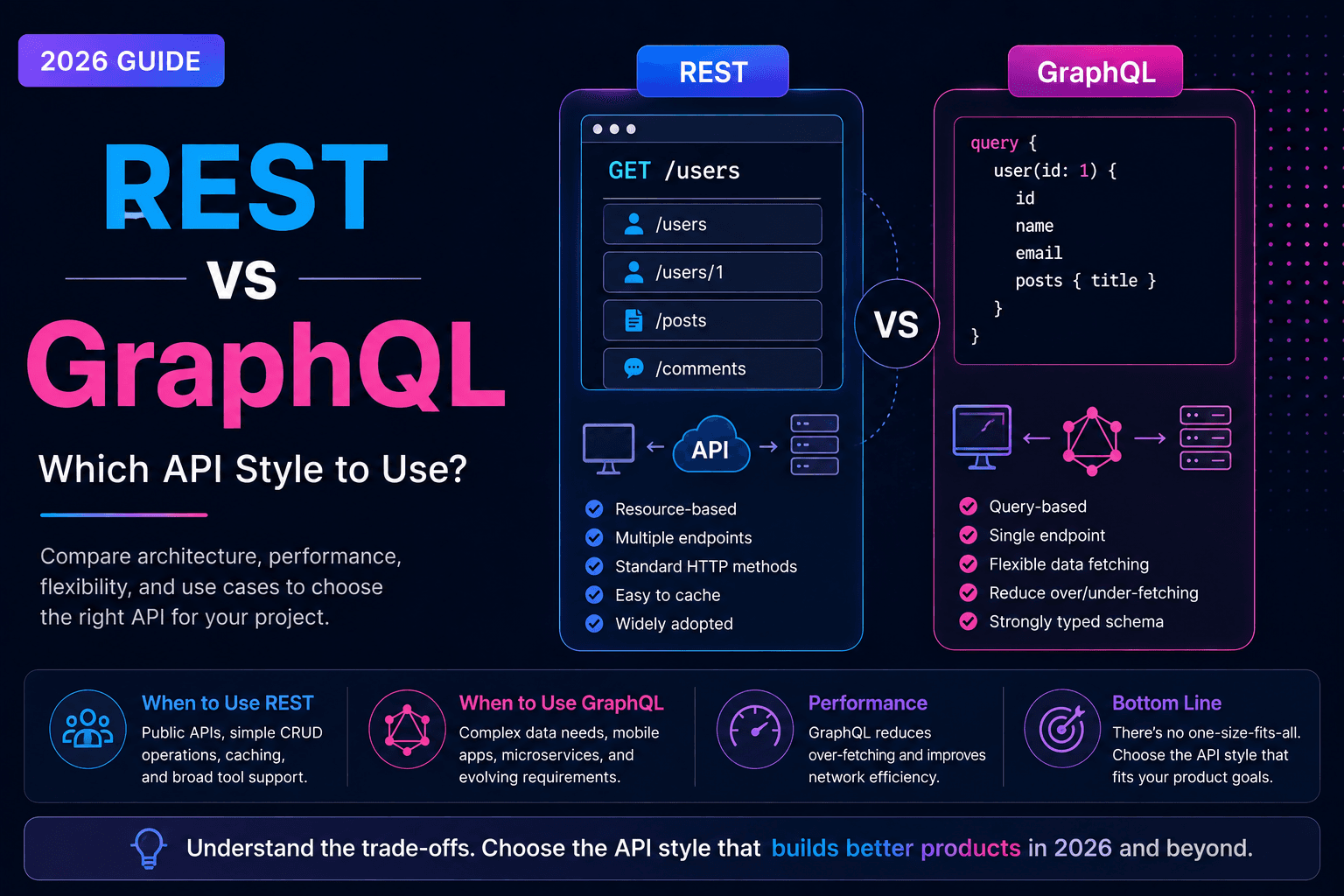
REST APIs typically expose fixed endpoints returning predetermined data structures, which can lead to over-fetching or under-fetching data relative to what a specific client screen actually needs.
GraphQL’s Query Flexibility
GraphQL lets clients specify exactly which fields they need in a single request, reducing over-fetching and letting frontend teams iterate without waiting for new backend endpoints.
Performance Considerations
Each approach has different performance characteristics depending on usage patterns.
REST Caching Simplicity
REST’s use of standard HTTP methods and URLs makes leveraging standard HTTP caching straightforward, an advantage for content that benefits from simple, well-understood caching layers.
GraphQL’s Single-Request Efficiency
GraphQL can reduce the number of round trips needed for complex data requirements by combining what would be multiple REST calls into a single query, though this requires more careful backend query optimization.
Tooling & Ecosystem Maturity
Both approaches have mature but different tooling ecosystems.
REST’s Widespread Familiarity
REST has been the dominant API style for years, meaning most developers have direct experience with it and tooling support is extremely broad and well-established.
GraphQL’s Growing but Specialized Tooling
GraphQL has strong, growing tooling including schema introspection and typed queries, though it requires learning GraphQL-specific concepts that add some onboarding overhead for teams new to the approach.
When REST Makes More Sense
Certain project characteristics favor REST’s simpler, more established approach.
Simple, Well-Defined Data Needs
Applications with straightforward, stable data requirements often don’t need GraphQL’s flexibility, making REST’s simplicity a better fit without unnecessary complexity.
Heavy Reliance on HTTP Caching
Applications that benefit significantly from standard HTTP caching layers often find REST’s alignment with HTTP conventions more straightforward to implement effectively.
When GraphQL Makes More Sense
Other project characteristics favor GraphQL’s flexibility despite its additional complexity.
Complex, Evolving Frontend Requirements
Applications with frequently changing or highly varied data needs across different client screens benefit from GraphQL’s ability to request exactly what’s needed without backend changes.
Multiple Client Types With Different Needs
Applications serving multiple client types, like web and mobile, with different data requirements benefit from GraphQL letting each client request its own specific data shape from a shared API.
FAQs
Is GraphQL always better than REST?
No, GraphQL offers genuine advantages for complex, evolving data needs, but REST’s simplicity and caching benefits make it a better fit for many straightforward use cases.
Is GraphQL harder to implement than REST?
Generally yes, GraphQL requires more upfront schema design and query optimization consideration, while REST’s simpler request-response model is often quicker to implement for straightforward APIs.
Can I use both REST and GraphQL in the same application?
Yes, some applications use GraphQL for complex, frontend-driven data needs while using REST for simpler, more standardized operations, combining both where each fits best.
Does GraphQL solve caching the same way REST does?
Not directly; GraphQL requires different caching strategies than REST’s straightforward HTTP caching, since a single GraphQL endpoint handles many different possible queries.
Which is better for a mobile app with limited bandwidth?
GraphQL’s ability to request exactly the needed fields can reduce data transfer compared to REST endpoints that return more data than a specific mobile screen needs.
Should I migrate an existing REST API to GraphQL?
Not automatically; migration makes sense when you’re experiencing genuine pain points GraphQL specifically solves, rather than switching simply because GraphQL is newer or trending.