Most articles about Salesforce alternatives are published by CRM vendors who place themselves first, which makes them difficult to use for an actual decision. This page is written from the implementation side. We migrate organisations between CRM platforms, which means we see what the switch costs, which migrations succeed, and how often the original complaint about Salesforce turns out to be an implementation problem rather than a product one. That distinction determines whether switching helps.
First, Confirm Switching Solves Your Problem
<cite index=”2-1″>The reasons organisations most commonly cite for leaving Salesforce are cost, a steep learning curve and complexity, difficulty with customisation and integration, inconsistent support, and an unintuitive interface.</cite> Several of those are fixable without changing platform, and migration is expensive enough that establishing which category you are in matters before evaluating anything.
Cost Is Sometimes a Licensing Problem
Paying for editions and add-ons that go unused is common. An audit of actual seat usage and enabled features frequently recovers significant spend without a migration.
Complexity Is Often Accumulated Configuration
Years of custom fields, workflows, and automations added by different people produce a system nobody understands. That follows you to a new platform unless the process is redesigned.
Poor Adoption Is Usually a Process Problem
If sales staff avoid the CRM, a different CRM will also be avoided. Adoption failures trace to process fit and data entry burden rather than to the platform.
When Switching Genuinely Is the Answer
When licence cost cannot be justified at your scale, when you need deployment options Salesforce does not offer, or when your requirements are far simpler than the platform assumes. Our CRM solutions work starts by establishing which applies.
The Cost Question Honestly
Pricing is the most cited reason for looking elsewhere, and it is worth being specific. <cite index=”6-1″>Salesforce Sales Cloud starts at $165 per user per month, with a small business suite at $25 per user per month that is considerably more basic, and a small business Pro tier from $100 per user per month.</cite>
Where the Cost Actually Accumulates
Add-ons, higher tiers required for one specific capability, and integration licences. The headline per-seat figure is rarely the final figure.
Compare Total Cost, Not Licence Cost
Implementation, administration, integration, and training belong in the comparison. A cheaper licence with heavier administrative burden is not cheaper.
Model Three Years, Not One
Migration cost is front-loaded and licence saving is annual. A one-year comparison makes switching look worse than it is, and a three-year comparison is the honest horizon.
Include the Migration Cost
Data extraction, field mapping, integration rebuilding, and parallel running. Our data migration practice exists because this is consistently underestimated.
The Main Alternatives by Category
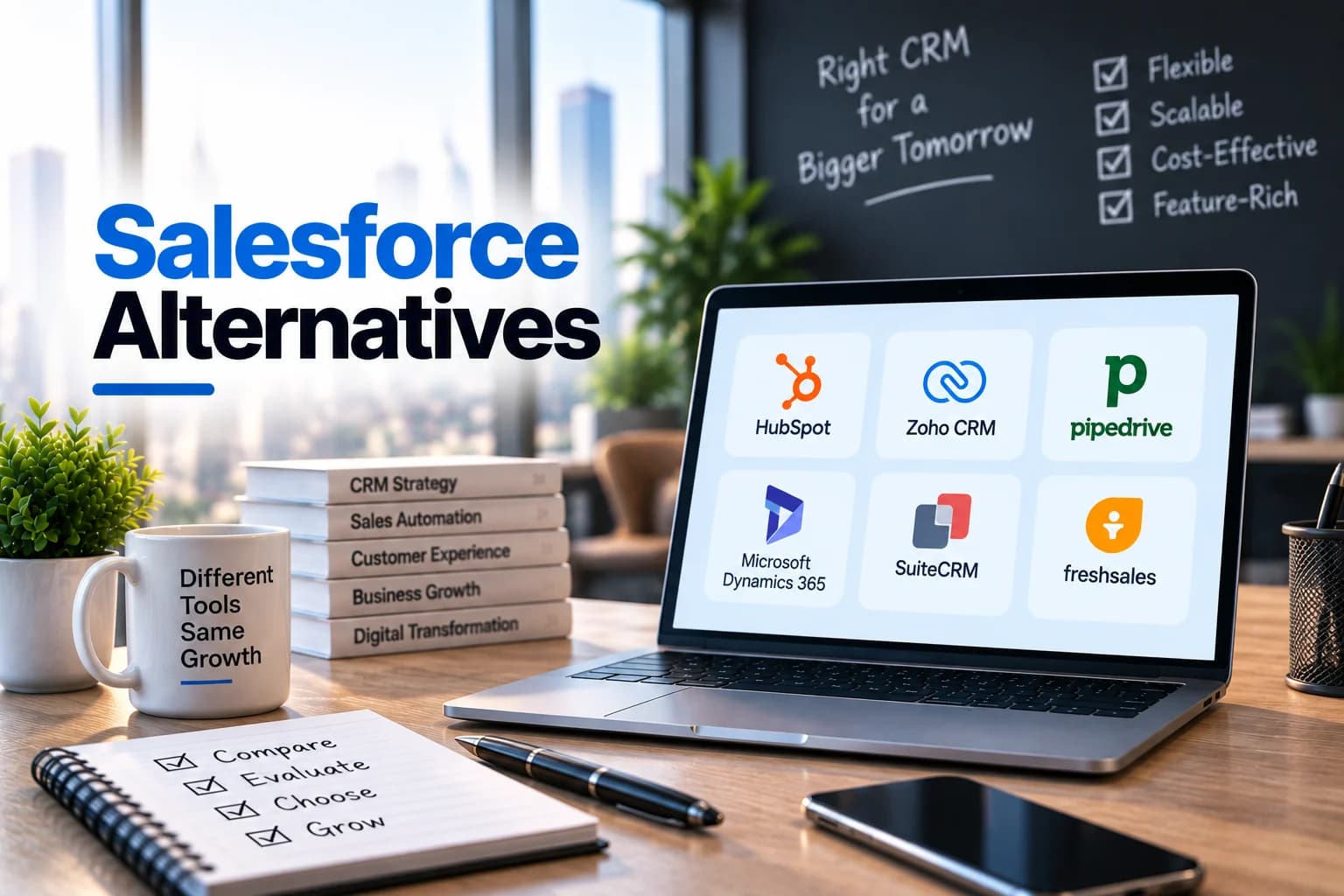
<cite index=”3-1″>The alternatives most consistently named across comparison sources are Zendesk, Microsoft Dynamics 365, Zoho, HubSpot, Pipedrive, Freshworks, Odoo, and Vtiger, and the right fit depends on the use case: Pipedrive suits visual pipeline management, Zoho and Vtiger suit teams wanting customisable tools, and Dynamics 365 suits businesses already invested in the Microsoft ecosystem.</cite> Grouping them by what they are actually for is more useful than ranking them.
Enterprise Suites
Microsoft Dynamics 365 and comparable enterprise platforms suit organisations with complex requirements and existing vendor relationships. <cite index=”4-1″>Dynamics and HubSpot suit teams needing a broader cross-department CRM, while Pipedrive and monday sales CRM suit straightforward pipeline management and faster adoption.</cite>
Mid-Market All-Rounders
HubSpot, Zoho, and Freshworks cover sales, marketing, and service adequately at considerably lower cost than enterprise suites, which fits the majority of organisations leaving Salesforce.
Pipeline-Focused Tools
Pipedrive and similar tools do sales pipeline management well and deliberately little else. Appropriate where the requirement is genuinely just pipeline visibility.
Self-Hosted and Open Source
SuiteCRM, Odoo, Vtiger, and similar platforms can be self-hosted, which changes both the cost structure and the data control position. This category is covered below because vendor-published comparisons largely omit it.
Self-Hosted and Open Source CRM
This category is systematically underrepresented in Salesforce alternative articles, for the straightforward reason that those articles are written by companies selling hosted products. It is a legitimate option with specific advantages and specific costs.
What Self-Hosting Changes
No per-seat licence, full data control, and deployment wherever your requirements dictate. Cost shifts from subscription to infrastructure and maintenance.
Where It Fits Best
Organisations with data residency requirements, large user counts where per-seat pricing becomes punitive, or unusual customisation needs that hosted platforms constrain.
What It Demands
Someone must own hosting, updates, security patching, and backups. Without that ownership, self-hosted CRM becomes an unmaintained liability rather than a saving.
Our Position, Disclosed
TechEsperto is an official SuiteCRM Professional Partner, so treat our view on this category as informed and interested. We recommend it where the requirements above hold and recommend hosted platforms where they do not.
Customisation Depth
Open platforms permit changes hosted products do not. Our api-integration-services work covers connecting them into an existing estate.
Planning the Migration Realistically
Migration is where CRM switches succeed or fail, and the failures are rarely technical. They come from moving accumulated mess into a clean system, or from underestimating what integrations and reporting will cost to rebuild.
Do Not Migrate Everything
Years of duplicate records, unused fields, and dead opportunities should not follow you. Migration is the one good opportunity to decide what matters.
Rebuild Integrations, Do Not Assume Them
Every connected system needs rebuilding against the new platform. This is frequently the largest line item and it is regularly omitted from comparisons.
Recover the Business Logic First
Workflows and automations built in Salesforce over years encode decisions nobody documented. Extracting that intent is real work and it is where migrations overrun.
Rebuild Reporting Deliberately
Reports people rely on need recreating and verifying. Our CRM reporting and analytics work treats this as a deliverable rather than an afterthought.
Run in Parallel Before Cutover
Both systems operating briefly, with reconciliation, is the safest transition for anything the sales team depends on daily.
FAQs
What are the main alternatives to Salesforce?
Microsoft Dynamics 365 for enterprises in the Microsoft ecosystem, HubSpot and Zoho as mid-market all-rounders, Pipedrive and monday CRM for pipeline-focused teams, Zendesk where service is the priority, and self-hosted options including SuiteCRM, Odoo, and Vtiger.
Why do companies leave Salesforce?
Most commonly cost, complexity and learning curve, difficulty with customisation and integration, support quality, and interface usability. Several of these are implementation problems rather than platform problems, which is worth establishing before committing to migration.
How much does Salesforce actually cost?
Sales Cloud starts at $165 per user per month, with a basic small business suite at $25 and a small business Pro tier from $100. Add-ons and higher tiers required for specific capabilities mean the headline figure is rarely the final cost.
Is open source CRM a realistic alternative?
Yes, where you have data residency requirements, large user counts making per-seat pricing punitive, or customisation needs hosted platforms constrain. It requires someone owning hosting, updates, security patching, and backups, which is a real ongoing commitment.
What does migrating off Salesforce cost?
More than the data transfer. The larger costs are rebuilding every integration against the new platform, recovering business logic encoded in years of workflows, recreating reporting, and running both systems in parallel during cutover.
Will switching CRM fix poor adoption?
Usually not. If sales staff avoid the current CRM, they will avoid the next one. Adoption failures trace to process fit and data entry burden rather than to the platform, and migrating without redesigning the process reproduces the problem.