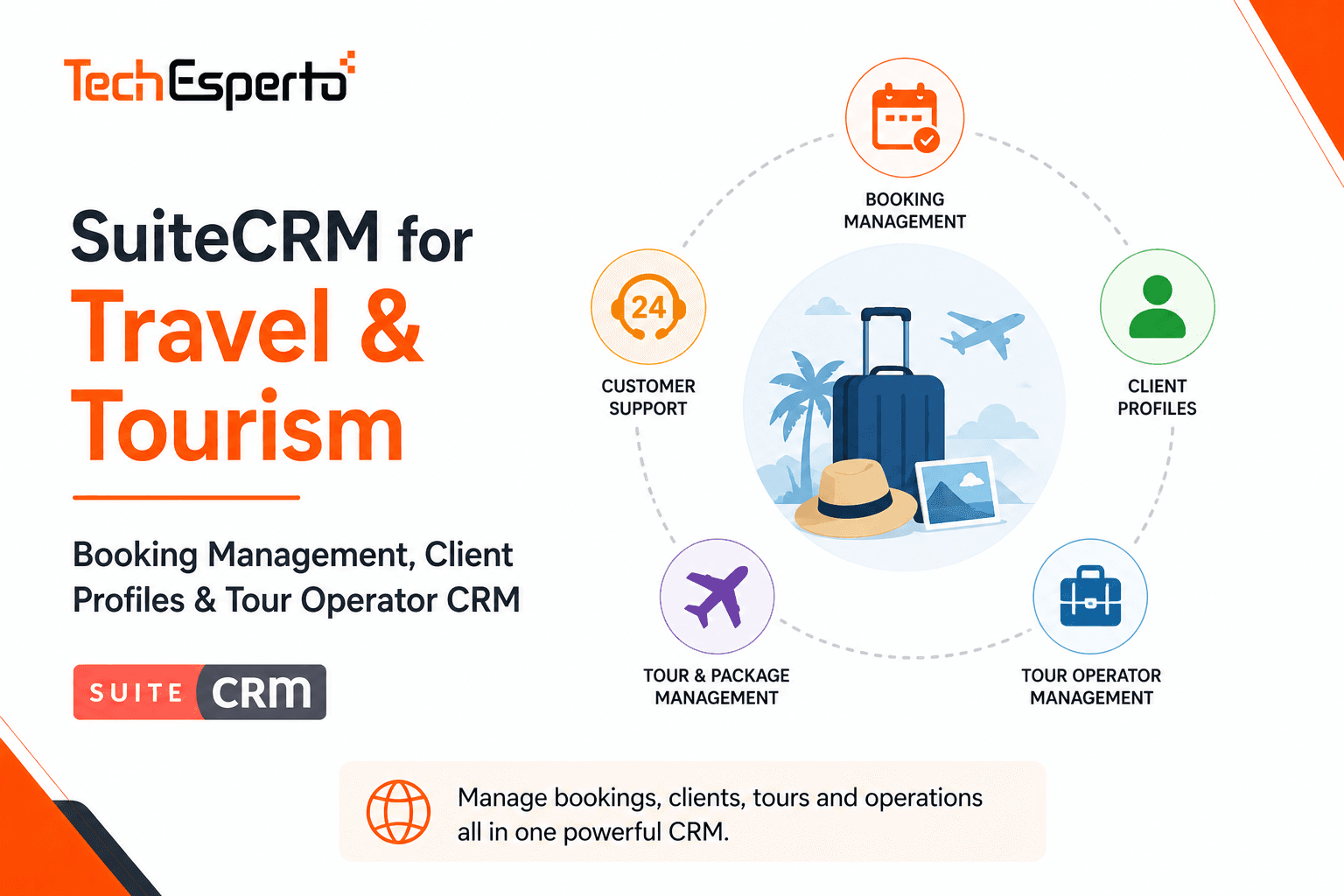
Travel and tourism businesses manage relationships that span the entire trip lifecycle — from the first inquiry months before departure through booking, pre-trip communication, the travel experience itself, post-trip follow-up, and future trip planning. Every traveler has preferences, past trip history, passport details, dietary needs, and budget expectations that should inform every interaction.
Generic CRMs treat a Bali honeymoon inquiry the same as a B2B software lead. Purpose-built travel CRMs like TravelJoy ($39–$79/user/month) and Tutterfly address travel-specific needs but limit customization and charge recurring fees. SuiteCRM provides a free, open-source foundation that can be customized into a complete travel agency or tour operator CRM — managing inquiries, bookings, itineraries, suppliers, and client relationships without per-user costs.
Why Travel & Tourism Needs a Specialized CRM
Travel businesses face challenges that generic CRMs don’t solve. A single booking involves multiple suppliers — airlines, hotels, transfer companies, activity providers, insurance — each with their own confirmation numbers, payment deadlines, and cancellation policies. Group tours multiply this complexity by the number of travelers. And the seasonality of travel means inquiry volumes spike dramatically during peak booking periods.
Without a CRM, travel agencies track bookings in spreadsheets that break when complexity grows, miss payment deadlines because supplier timelines aren’t centrally tracked, send generic marketing instead of personalized trip recommendations, lose repeat business because past traveler preferences aren’t recorded, and can’t measure which marketing channels produce the most bookings.
Building a Travel CRM with SuiteCRM
Traveler Profiles
Build comprehensive client records going far beyond standard contact fields: passport details (name as on passport, number, expiry date, nationality), travel preferences (adventure, luxury, beach, cultural, family, solo), dietary requirements and allergies, frequent flyer numbers and loyalty programs, travel insurance preferences, budget range and typical trip style, emergency contact information, past trips with dates, destinations, and satisfaction ratings, and preferred communication channel (email, WhatsApp, phone).
When a past client inquires about a new trip, the travel advisor opens their profile and sees everything — their last 5 trips, that they prefer boutique hotels over chains, that they’re vegetarian, that their passport expires in 8 months (flag for renewal before booking international travel). This level of personalization is what transforms a transactional agency into a trusted travel advisor.
Booking & Trip Pipeline
Build a custom Bookings module with travel-specific stages: Inquiry Received → Consultation Scheduled → Itinerary Proposed → Itinerary Revised → Deposit Received → Suppliers Booked → Full Payment Received → Travel Documents Sent → Trip Active → Trip Completed → Post-Trip Follow-Up.
Each booking record tracks: traveler Contact(s) — multiple travelers per booking for groups/families, destination(s), travel dates (departure and return), trip type (package, custom, group tour, corporate), total booking value and commission, deposit amount and payment schedule, suppliers involved (linked to Suppliers module), booking reference numbers per supplier, travel insurance status, visa requirements and status, and special requests and notes.
Workflow automation drives the booking lifecycle: when a deposit is received, create tasks to book each supplier within 48 hours. 30 days before departure, send travel documents and pre-trip information. 7 days before, send a final reminder with packing tips and emergency contacts. On return date + 3 days, trigger a post-trip feedback survey.
Itinerary Management
Build an Itinerary Items module linked to Bookings, tracking each component of the trip: day number and date, activity/service (flight, hotel, transfer, tour, restaurant, activity), supplier name and confirmation number, time and duration, location and address, cost (net to agency and gross to client), status (Pending → Confirmed → Cancelled → Completed), and notes and special instructions.
This gives travel advisors a day-by-day view of every client’s trip — and alerts them immediately if any supplier confirmation is missing or a component status changes.
Supplier & Partner Management
Travel agencies work with dozens or hundreds of suppliers. Build a Suppliers module (or customize Accounts with a Vendor type): company name and type (airline, hotel, transfer, tour operator, DMC, insurance), destination coverage, contact persons with roles, contract rates and commission structures, payment terms and deadlines, quality rating based on client feedback, and preferred/approved status.
Link suppliers to Itinerary Items and Bookings for complete visibility. Reports show which suppliers generate the most revenue, highest client satisfaction, and best commission rates — informing future partnership decisions.
Group Tour Management
Tour operators managing group tours need additional tracking. Build a Group Tours module: tour name and code, departure date and duration, destination, maximum capacity and current bookings, tour leader assigned, pricing tiers (early bird, standard, last minute), inclusions and exclusions, minimum numbers and cancellation thresholds, and rooming list management.
Link individual Bookings to the Group Tour. Dashboards show fill rate per departure, revenue per tour, and capacity utilization. Workflows trigger actions at capacity milestones — when a tour reaches 80% capacity, increase marketing spend. When it hits minimum numbers, confirm the departure and notify all booked travelers.
Corporate Travel Management
For agencies handling corporate accounts, use SuiteCRM’s Accounts module to track: company travel policy and budget, preferred suppliers and negotiated rates, traveler profiles for each employee, approval workflows for trip requests, and monthly/quarterly travel spend reporting.
Security Groups ensure corporate client data is visible only to assigned account managers — not the entire agency team.
Automating the Travel Lifecycle
Inquiry → Consultation → Proposal
Client submits inquiry (website form, email, phone, WhatsApp) → SuiteCRM creates a Booking record at “Inquiry” stage → assigns to available travel advisor based on destination expertise → sends immediate acknowledgment with advisor introduction → creates consultation scheduling task.
Booking Confirmed → Supplier Coordination
Deposit received → workflow creates supplier booking tasks for each itinerary component → as each supplier confirms, status updates on the itinerary item → when all components confirmed, send “Your trip is fully confirmed!” notification to traveler → payment deadline reminders auto-generated based on supplier terms.
Pre-Trip Communication
60 days before departure → send destination guide and visa requirements. 30 days → send travel documents, insurance confirmation, and packing suggestions. 7 days → send final itinerary summary, emergency contacts, and weather forecast link. 1 day → send “Have an amazing trip!” WhatsApp message.
Post-Trip → Loyalty → Rebooking
Trip completed + 3 days → satisfaction survey email. + 7 days → request online review (TripAdvisor, Google). + 30 days → send photos/memories email with “Plan your next adventure” CTA. + 6 months → seasonal destination suggestion based on past preferences. + 11 months → “This time last year you were in ” anniversary trigger with rebooking offer.
Travel Dashboards
Build custom dashboards for each role:
For Travel Advisors: Active inquiries and bookings, upcoming departures this month, payment deadlines approaching, and personal revenue month-to-date.
For Operations: Supplier confirmations pending, bookings missing components, group tour fill rates, and visa/document status across all active bookings.
For Management: Total booking revenue by month, average booking value, conversion rate (inquiry-to-booking), top destinations by revenue, advisor performance comparison, and marketing channel ROI.
SuiteCRM vs Travel CRMs
| Feature | SuiteCRM (Custom) | TravelJoy | Tutterfly |
| Licensing | $0 (unlimited users) | $39–$79/user/month | Custom pricing |
| Annual Cost (8 advisors) | ~$2,400 (hosting) | $3,744–$7,584 | Varies |
| Traveler Profiles | Fully customizable | Built-in | Built-in |
| Booking Management | Custom module (free) | Built-in | Built-in |
| Itinerary Builder | Custom module (free) | Built-in | Built-in |
| Group Tours | Custom module (free) | Limited | Limited |
| Supplier Management | Custom module (free) | Basic | Basic |
| Custom Modules | Unlimited | None | None |
| Data Ownership | Complete | Vendor cloud | Vendor cloud |
Integrations for Travel
SuiteCRM’s REST API connects to: GDS systems (Amadeus, Sabre, Travelport) for flight and hotel data, booking engines and OTAs for reservation sync, email and calendar for communication logging and appointment scheduling, SMS/WhatsApp for traveler communication at every stage, accounting software for commission and payment tracking, and your agency website for inquiry capture and trip showcase.
Implementation
A travel CRM deployment takes 10–14 weeks: core CRM, traveler profiles, booking pipeline (weeks 1–4), itinerary management, supplier modules, group tours (weeks 5–8), workflow automation, integrations, dashboards (weeks 9–11), and training for advisors, operations, and management (weeks 12–14).
As the Official SuiteCRM Professional Partner, TechEsperto builds CRM solutions for relationship-driven businesses.Contact usfor a free travel CRM consultation.