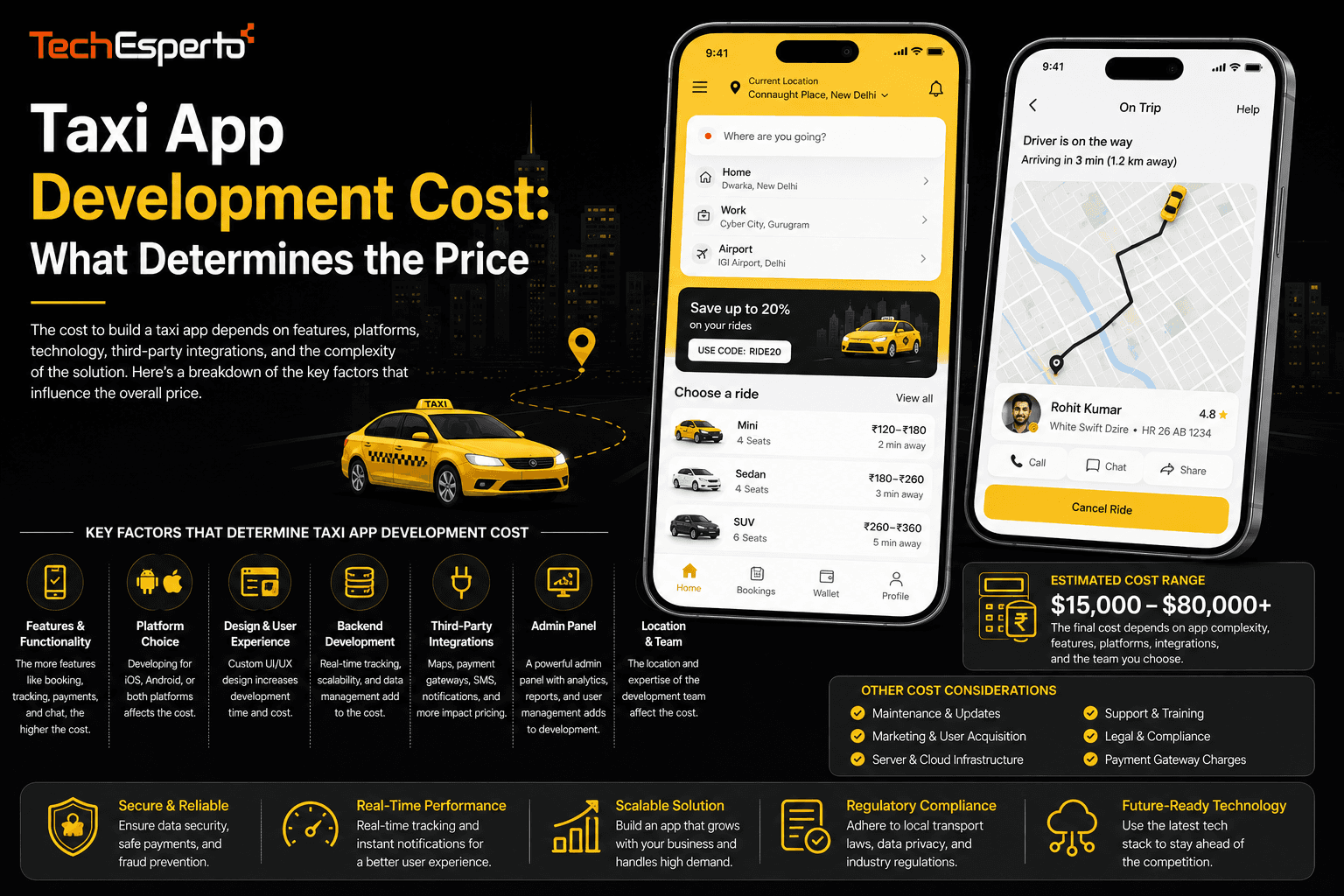
Taxi app development cost typically ranges from $40,000 to $80,000 for an MVP with core booking and dispatch features, $80,000 to $200,000 for a full platform with rider, driver, and admin apps, and $200,000 or more for enterprise-scale, multi-region fleet systems. Actual cost depends on dispatch complexity, payment integration, and the number of apps required.
Transport operators and startup founders often need a realistic cost picture before deciding to build a custom taxi or ride-hailing platform. TechEsperto Solutions builds taxi apps as part of its broader taxi app development practice, and this guide breaks down what actually drives cost up or down for this type of project.
What Determines Taxi App Development Cost
Taxi app development cost is driven primarily by how many separate apps the platform needs, how sophisticated the dispatch and matching logic is, and which third-party integrations are required for mapping, payments, and notifications. A working taxi platform typically needs a rider app, a driver app, and an admin dispatch dashboard, and each of these adds development time. Dispatch logic complexity matters significantly, since simple proximity-based matching costs less to build than a system accounting for driver ratings, surge pricing, or scheduled rides. Payment integration complexity, particularly around supporting multiple payment methods and automated driver payouts, adds cost that scales with the number of regions and payment providers involved. Real-time GPS tracking accuracy requirements also affect cost, since more precise tracking and arrival estimates require additional development investment.
Number of Separate Apps Required
Building rider, driver, and admin dispatch interfaces each adds development time and cost.
Dispatch and Matching Logic Complexity
Simple proximity matching costs less than systems accounting for ratings, surge pricing, or scheduled rides.
Payment Integration and Payout Complexity
Supporting multiple payment methods and automated driver payouts adds development scope.
Real-Time GPS Tracking Accuracy
More precise tracking and arrival time estimates require additional development investment.
Geographic and Regional Scope
Supporting multiple cities or regions adds complexity around payment methods, languages, and regulations.
Fleet Management and Multi-Tenant Requirements
Supporting franchise or multi-operator fleet structures adds admin panel complexity.
Cost by Development Approach
Taxi platforms are typically built at one of three general investment levels, and choosing the right starting point depends on how much of the business model is already validated. An MVP approach focuses on core booking, basic dispatch, and essential payment processing to test the concept in a single city. A full platform approach builds out rider, driver, and admin apps with a more complete feature set suited to an established or well-funded launch. An enterprise-scale approach supports multiple cities or regions, franchise management, and advanced analytics across a broader operational footprint. Each approach reflects a different stage of business maturity rather than simply a smaller or larger version of the same build.
MVP or Single-Module Build ($40,000 to $80,000)
An MVP focuses on core booking, basic dispatch, and essential payment processing for a single-city launch.
Full Platform Build ($80,000 to $200,000)
A full platform includes rider, driver, and admin apps with a more complete feature set for an established launch.
Enterprise-Scale Build ($200,000+)
Enterprise-scale systems support multiple cities, franchise management, and advanced analytics.
Choosing the Right Starting Point
The right approach depends on how validated the business model already is and available launch budget.
Phased Development Strategy
Many founders start with an MVP in one city and phase in additional cities and features as the platform proves demand.
Budget Allocation Across Phases
Allocating budget across an initial MVP and later expansion phases helps manage risk while building toward a fuller platform.
Cost by App Component
Within a taxi platform, different components represent different shares of overall development effort. The rider app typically receives significant design investment, since this is the interface driving booking volume and customer retention. The driver app needs reliable navigation and job management but can often launch with a more focused feature set than the rider app. The admin and dispatch backend, while less visible to end users, requires significant engineering investment since it coordinates real-time data between riders and drivers. Payment processing, handling fare calculation and driver payouts, requires investment proportional to the number of payment methods and regions supported.
Rider App Investment
The rider app typically receives significant design investment given its role in driving booking volume.
Driver App Investment
Driver apps need reliable navigation and job management but can launch with a more focused feature set initially.
Admin and Dispatch Backend Investment
The backend coordinating real-time data between riders and drivers requires significant engineering investment.
Payment Processing Layer Investment
Payment processing needs investment proportional to payment methods, fare calculation, and payout complexity.
Fare Calculation Engine Investment
Dynamic fare calculation, including surge pricing logic, adds development scope beyond fixed-rate pricing.
Analytics and Reporting Investment
Analytics and reporting tools can start basic and expand as the operator needs deeper insight into fleet performance.
Key Cost Drivers and Add-Ons
Beyond core app components, several specific features tend to meaningfully affect overall development cost for taxi platforms. Real-time GPS tracking with accurate arrival time estimates requires more development investment than basic trip status updates. Surge or dynamic pricing logic adds cost tied to demand modeling and fare calculation complexity. Support for scheduled rides, in addition to instant dispatch, adds a distinct booking flow beyond standard on-demand matching. Multi-city or franchise support, where each region or franchise operator manages its own drivers, adds admin panel complexity beyond a single-city deployment. Safety features, such as SOS buttons and trip sharing, add discrete functionality that increases overall project scope.
Real-Time GPS Tracking Accuracy
More precise tracking and arrival time estimation requires additional development investment beyond basic status updates.
Surge or Dynamic Pricing Logic
Demand-based fare calculation adds cost tied to pricing model complexity.
Scheduled Ride Booking
Supporting scheduled rides alongside instant dispatch adds a distinct booking flow beyond standard matching.
Multi-City or Franchise Support
Multi-tenant admin structures for franchise or multi-region operators add development scope.
Safety and Emergency Features
SOS buttons, trip sharing, and safety verification add discrete functionality beyond core booking features.
Third-Party Fleet Integration
Integrating with third-party or independent driver fleets as an alternative to an owned fleet adds integration cost.
Ongoing Costs After Launch
Development cost is only part of the total investment required to run a taxi platform, since ongoing costs continue after launch and need separate planning. Cloud infrastructure costs scale with trip volume and active driver count, meaning a growing platform will see rising hosting costs over time. Payment processing fees are typically charged per transaction by payment providers, representing an ongoing percentage-based cost tied to trip volume. Mapping and GPS API usage fees often scale with the number of active trips and can become a significant ongoing cost at higher volume. App maintenance, including bug fixes and OS compatibility updates, requires ongoing developer time even after the initial build is complete.
Cloud Infrastructure and Hosting Costs
Infrastructure costs scale with trip volume and active driver count, growing as the platform gains traction.
Payment Processing Transaction Fees
Payment providers typically charge a percentage-based fee per transaction, an ongoing cost tied to trip volume.
Mapping and GPS API Usage Fees
Mapping API costs often scale with active trip volume and can become significant at higher scale.
App Maintenance and Updates
Ongoing maintenance, security updates, and OS compatibility updates require continued developer time after launch.
Driver Recruitment and Onboarding Operations
Driver recruitment and verification operations represent an ongoing cost separate from technical development.
Customer Support Operations
Support staffing costs scale with rider and driver base, separate from development costs.
How to Reduce Development Costs Without Cutting Corners
Founders looking to manage taxi app development costs have several legitimate options that do not compromise platform reliability. Starting with a focused MVP in a single city, rather than building for multiple regions or every possible feature from day one, is the most effective way to control initial cost. Using established third-party mapping and payment services, rather than building this infrastructure from scratch, saves significant development time. Deferring advanced features like surge pricing or franchise management to a post-launch phase lets founders validate the core business model before investing further. Choosing cross-platform development frameworks where appropriate can also reduce cost compared to building fully separate native apps, though this tradeoff should be evaluated based on target driver and rider device preferences.
Start with a Focused Single-City MVP
Launching with one city and core features controls initial cost while validating the business model.
Use Established Third-Party Mapping and Payment Services
Leveraging existing mapping and payment providers saves significant development time compared to building from scratch.
Defer Advanced Features to Later Phases
Surge pricing, franchise management, and other advanced features can be added after the core platform proves demand.
Consider Cross-Platform Development Frameworks
Cross-platform frameworks can reduce cost compared to fully separate native builds, depending on target device preferences.
Prioritize Dispatch Reliability Over Feature Breadth
Investing in dispatch accuracy and GPS tracking matters more early on than a broad feature set.
Plan for Phased Budget Allocation
Allocating budget across an initial launch and planned expansion phases helps manage overall investment risk.
FAQs
How much does taxi app development typically cost?
Taxi app development typically costs between $40,000 and $80,000 for an MVP with core booking and dispatch features, and $80,000 to $200,000 for a full platform including rider, driver, and admin apps. Enterprise-scale, multi-region systems start at $200,000 and scale with fleet size and feature complexity.
What is the biggest cost driver in taxi app development?
The number of separate apps required, typically rider, driver, and admin dispatch interfaces, along with the complexity of real-time dispatch and payment processing, tend to be the largest cost drivers in this type of project.
Can I reduce cost by launching with fewer features?
Yes, starting with a focused MVP covering core booking and dispatch functionality in a single city is the most effective way to control initial development cost, with additional features added once the business model is validated.
Are there ongoing costs beyond initial development?
Yes, ongoing costs include cloud infrastructure that scales with trip volume, per-transaction payment processing fees, mapping API usage fees, and continued app maintenance, all separate from the initial development investment.
Does surge pricing significantly increase development cost?
Surge or dynamic pricing does add development scope, since it requires demand modeling and more complex fare calculation logic compared to fixed-rate pricing, though the specific cost impact depends on how sophisticated the pricing model needs to be.
How can TechEsperto Solutions help estimate my specific project cost?
TechEsperto Solutions provides a detailed cost estimate after a scoping call covering your target city, fleet size, and required features, since exact pricing depends on these project-specific factors rather than a one-size-fits-all number.