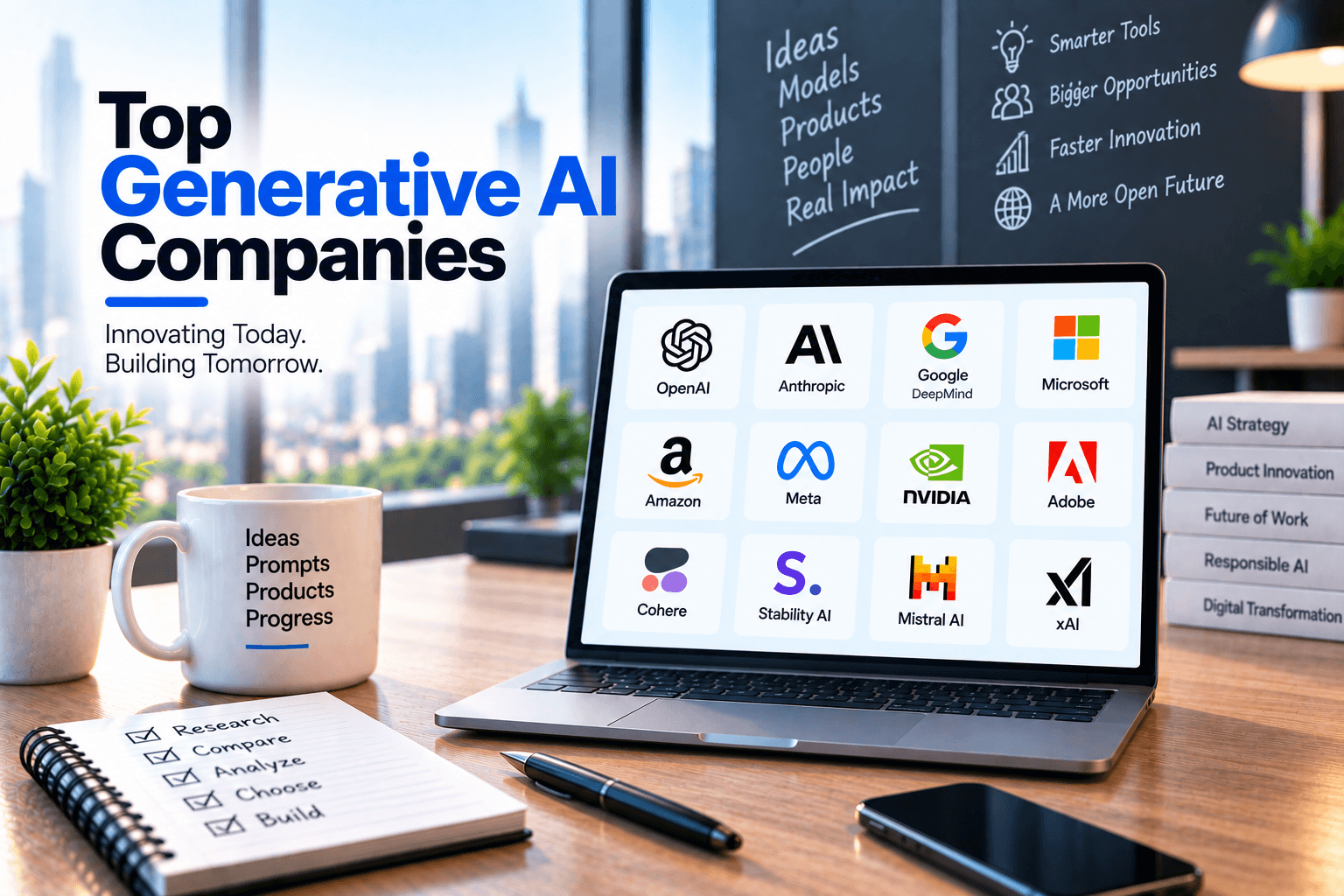
Ranking generative AI companies against each other is close to meaningless, because they occupy different layers of the same stack. A model lab, a compute supplier, and a data platform are not competitors. This page organises the field by layer, explains what each company actually provides to a team building something, and covers the licensing and jurisdiction questions that matter more to most buyers than benchmark position does.
Frontier Proprietary Model Labs
The companies training the largest models, where capability is highest and cost per token is correspondingly highest. (cite index=”35-1″>OpenAI and Anthropic together account for the large majority of total valuation in this category, reflecting the economics of frontier training where a single run costs hundreds of millions.</cite>
OpenAI
The broadest ecosystem and widest adoption, spanning text, image, video, and agent frameworks alongside enterprise products. Frequently the default first choice on breadth alone.
Anthropic
(cite index=”28-1″>Notable for strong performance on long-context tasks, coding, and document analysis, with published safety research relevant to teams deploying in regulated industries where output reliability and auditability matter.</cite>
Google DeepMind
Competitive on capability with (cite index=”33-1″>the largest context window in the market at the time of writing</cite>, and deeply integrated into the Google Cloud estate.
Microsoft
(cite index=”33-1″>Microsoft released its first own model family at Build 2026, including a mid-sized reasoning model trained from scratch rather than distilled, alongside a coding model inside GitHub Copilot.</cite> New, and it sits inside a stack many organisations already run.
How to Choose Between Them
Test against your own examples rather than benchmarks. Our generative AI development work establishes that evaluation before selecting a provider.
Open-Weight Model Providers
Where you need to self-host, control the model, or avoid per-token pricing at volume, open-weight providers are the alternative, with an important licensing caveat most coverage omits.
Mistral AI
(cite index=”28-1″>A Paris-based company founded in April 2023, developing open-weight and proprietary models with a focus on efficiency and European data sovereignty.</cite> (cite index=”35-1″>It occupies a unique position as both a frontier developer and the leading European AI company, with EU regulatory requirements potentially creating a structural advantage for European enterprises seeking data sovereignty guarantees.</cite>
Meta
Widely adopted open-weight models, with a licensing caveat below that matters for European and large organisations specifically.
DeepSeek and Alibaba
(cite index=”34-1″>Chinese labs shipping open-weight models under permissive licences, gaining ground with teams wanting to self-host or avoid per-token costs.</cite>
The Licensing Detail That Matters
(cite index=”33-1″>Meta’s Llama is frequently described as open source, but its licence restricts EU usage and adds a large-company clause, and the Open Source Initiative does not accept it as open source. For a European company the genuinely clean open-weight options are Mistral and the permissively licensed Chinese models.</cite>
Why This Belongs in a Buying Decision
Licence terms determine whether you can legally deploy the model in your jurisdiction and at your size. Our AI consulting services engagements check this before technical evaluation.
Infrastructure and Compute
The layer everything else depends on, which is easy to overlook when comparing models and impossible to ignore when planning capacity or cost.
NVIDIA
(cite index=”28-1″>Supplies the compute that nearly every other company in this space runs on</cite>, which makes it structurally central regardless of which model you choose.
Cloud Providers as Model Distributors
The major clouds increasingly resell frontier models alongside their own, which frequently simplifies procurement and data residency. Our AWS, Azure and GCP services work covers those routes.
Inference Providers
(cite index=”34-1″>Third-party providers such as Together, Fireworks, and Groq often provide comparable quality at lower cost plus open-source alternatives, while first-party providers offer the latest models first.</cite>
The Multi-Provider Argument
(cite index=”34-1″>For production workloads, consider multi-provider strategies with automatic failover</cite>, since uptime, rate limits, and service commitments vary substantially between providers.
Platform and Tooling Vendors
Between the models and your application sits the tooling layer, which is where most engineering effort actually goes and which receives far less attention than model comparisons.
Databricks
(cite index=”28-1″>The standard platform for data and AI engineering at scale, handling data pipelines and AI governance.</cite> Relevant because data readiness gates most AI projects.
Hugging Face
(cite index=”28-1″>Where most engineers start when evaluating open-weight models</cite>, functioning as the distribution and evaluation layer for the open ecosystem.
Specialist Modality Vendors
(cite index=”28-1″>ElevenLabs covers voice AI for teams building conversation or audio products</cite>, with comparable specialists in image and video generation.
Why Tooling Matters More Than It Appears
The model is one component. Our data analytics work usually precedes AI delivery because pipelines and definitions determine feasibility.
Choosing Providers Without Chasing Benchmarks
Benchmark leadership changes between releases and rarely determines project outcomes. These criteria hold regardless of which lab is currently ahead.
Test Against Your Own Cases
Benchmark scores measure general capability on tasks that are probably not yours. A small evaluation set of your real examples is more informative than any leaderboard.
Check Jurisdiction and Data Terms
Where data is processed and what the provider retains constrains selection in regulated contexts more than capability does.
Abstract the Provider
Model providers deprecate and update. Keeping model calls behind your own interface makes switching a configuration change rather than a refactor.
Price the Cheapest Adequate Option
Establish quality with a capable model, then test progressively smaller and cheaper ones until quality drops below threshold.
Expect This Page to Date
The companies are stable, the model versions are not. Our AI and automation engagements re-evaluate provider selection periodically rather than treating it as settled.
FAQs
Which companies lead in generative AI?
OpenAI and Anthropic lead on frontier proprietary models and account for the large majority of category valuation. Google DeepMind competes on capability and context length, and Microsoft has recently released its own model family.
What are the main open-weight model providers?
Mistral AI in Europe, Meta, and Chinese labs including DeepSeek and Alibaba. Licence terms differ significantly, and that difference matters more than capability for many deployment decisions.
Is Llama open source?
Not by the Open Source Initiative’s definition. Its licence restricts EU usage and includes a large-company clause. For European organisations, Mistral and the permissively licensed Chinese models are the genuinely clean open-weight options.
Should I use one model provider or several?
For production workloads, several with failover is worth considering, since uptime, rate limits, and service commitments vary. Keeping model calls behind your own interface makes that practical rather than a rebuild.
How do I choose between model providers?
Test against your own examples rather than benchmarks, check jurisdiction and data retention terms, then establish the cheapest model that meets your quality threshold. Benchmark leadership changes between releases and rarely determines outcomes.
Why does NVIDIA appear in a generative AI company list?
Because it supplies the compute nearly every other company in the space runs on, which makes it structurally central to capacity, cost, and availability regardless of which model or provider you select.