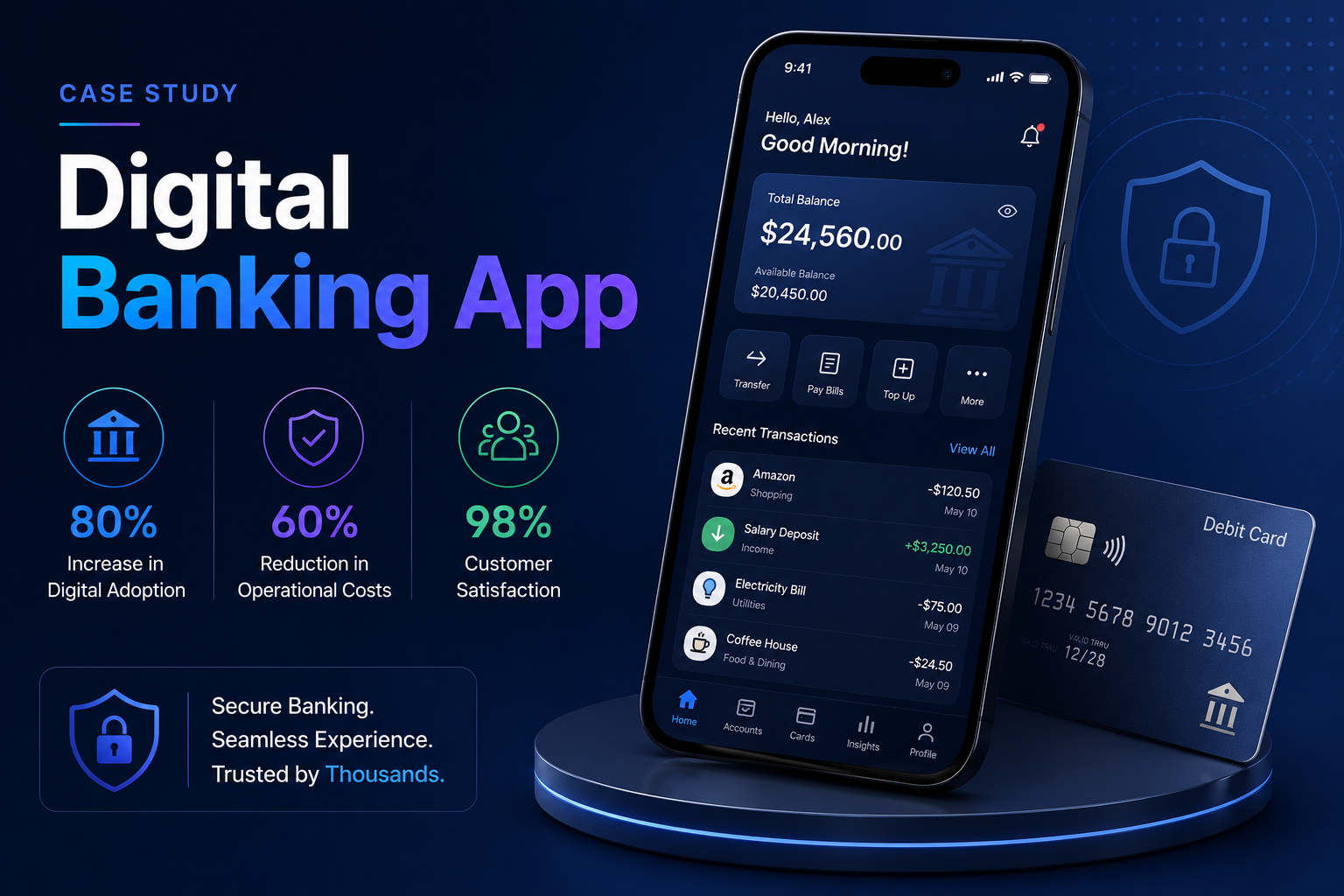
Fintech mobile app development is judged on three things a demo never shows: whether the app holds up under a security assessment, whether it settles money correctly at the edges, and whether it stays fast when transaction volume moves. TechEsperto builds wallets, banking apps, lending platforms, trading interfaces, and payment products as connected systems that reach core banking, ledger, KYC, and payment infrastructure. Our engineering background is integration, which is where most fintech builds stall. Bring us a scope, a stalled build, or a compliance deadline and we will give you a direct technical read before you commit budget.
Fintech buyers rarely arrive with a design problem. They arrive with a risk problem: a partner bank’s security questionnaire, a payment processor’s certification requirement, a regulator’s expectation about data residency, or an existing app that cannot be scaled without a rewrite. These constraints shape architecture decisions in the first sprint, and reversing them later is expensive. The pressures below are the ones that most often decide whether a fintech product ships on schedule or spends a quarter in remediation.
Partner banks, processors, and enterprise clients run their own assessments covering key storage, session handling, certificate pinning, and logging. Apps built without those controls fail review and get sent back for architectural rework.
Retries, timeouts, partial failures, and reconciliation are where payment apps break. Correct ledger design and idempotent transaction handling matter more to a fintech product than any front-end feature.
Identity verification is the highest-friction moment in any fintech app. Poorly sequenced document capture and verification waits lose users who already decided to sign up.
PCI-DSS scope, SOC 2 controls, and data residency requirements dictate where card data can touch your systems. Deciding this after development starts usually means re-architecting the payment path.
Core banking platforms, card processors, and back-office systems have their own integration timelines and sandbox access processes. A mobile app development plan that ignores those dependencies will miss its launch date.
We scope fintech builds around the money flow and the regulatory perimeter first, then design the interface around it, because the reverse order produces apps that look finished but cannot be certified. The product types below cover what banks, lenders, payment companies, and fintech startups most often ask us to build, either as a standalone product or as the customer-facing layer of a platform that already has a back office.
Stored balance, peer-to-peer transfer, card provisioning, and merchant payment flows, with an internal ledger designed for reconciliation rather than a balance field updated in place.
Account overview, transfers, statements, card controls, and alerts for banks and credit unions, integrated with the core banking platform through a controlled service layer rather than direct database access.
Application intake, document capture, decision workflow, disbursement, and repayment scheduling, with the underwriting integration designed so policy changes do not require an app release.
Real-time quote handling, order entry, portfolio views, and statement delivery, built with attention to latency, market data licensing constraints, and clear disclosure placement.
Checkout flows, settlement views, refund handling, and merchant dashboards, using tokenized card handling through certified processors as covered on our payment gateway integration service.
Quote, bind, policy servicing, and claims submission apps with document handling and status transparency, integrated with policy administration and claims systems already in place.
The features that make a fintech app credible are largely defensive. Authentication behavior, transaction integrity, fraud signals, and audit trails determine whether an assessor approves the product and whether your support team can explain what happened to a customer’s money on a specific day. We implement the capabilities below as architecture rather than as a hardening phase appended to the end of the build.
Multi-factor authentication, biometric unlock, device registration, and step-up challenges on sensitive actions, with risk signals evaluated server side rather than trusted from the client.
Every money-moving operation is idempotent and traceable, so a retried request cannot double-charge and every state change can be reconstructed from an immutable transaction log.
Rules and model-driven checks covering velocity, geolocation anomalies, device reputation, and behavioral signals, with a review queue rather than silent blocking that generates support volume.
Document capture, liveness checks, sanctions and watchlist screening, and case handling through established verification providers, sequenced to minimize abandonment during onboarding.
Freeze and unfreeze, spending limits, merchant category controls, and push notifications delivered in seconds, since notification latency is a leading driver of fraud-related support calls.
Immutable access and transaction logs with retention aligned to your obligations, structured so reporting extracts do not require engineering intervention each cycle.
Fintech compliance is an architecture outcome. What an assessor examines is where card data travels, how keys are stored, who can reach production, and whether you can evidence all of it after the fact. We design against PCI-DSS scope reduction, SOC 2 control expectations, and the data protection rules applying to your markets, then document each decision so your compliance lead is not reverse-engineering the system during an audit window.
We keep raw card data out of your application entirely by using processor tokenization and hosted fields, which reduces assessment scope and removes the most expensive category of remediation.
Change management, access reviews, environment separation, and logging implemented as enforced process rather than documented intent, which is the distinction auditors test.
Data encrypted in transit and at rest, keys held in a managed key service with rotation policy, and no secrets embedded in application binaries where they can be extracted.
Certificate pinning, jailbreak and root detection, tamper checks, secure local storage, and obfuscation, addressing the mobile-specific findings that dominate fintech penetration test reports.
Independent testing before release with findings triaged against a documented severity policy, plus support during your partner’s or regulator’s own assessment process.
Fintech projects need the unknowns resolved early, because the schedule risks are integration access, certification timelines, and compliance decisions rather than screen design. Each stage below produces a named deliverable, and you work directly with the engineers building the product. Sprint demos show working transaction flows in a sandbox rather than static screens, so stakeholders review real behavior against real edge cases.
We document every movement of funds and data, including failure paths, and identify which systems own truth at each step before a single screen is designed.
Scope decisions on card data, residency, retention, and access control are made upfront, so the build carries no unresolved regulatory dependency into development.
Clickable prototypes focused on onboarding, verification, and first transaction, because those flows determine activation rates more than any feature added later.
Two-week sprints working against processor and core system sandboxes from the start, so integration problems surface in week three rather than during launch preparation.
Static analysis, dependency scanning, penetration testing, and support through processor or partner certification, followed by App Store and Google Play submission.
Transaction monitoring, incident response, OS compatibility updates, and continued releases, with alerting configured for settlement and authorization anomalies rather than only server errors.
digital banking app case study shows how we handle authentication, transaction flows, and security requirements in a live financial product.
Fintech app cost is driven by the number of external systems in scope, the depth of compliance work, and whether certification or independent assessment is required before launch. A wallet using a single processor is a different commercial conversation than a banking app integrating a core platform, a KYC provider, and two payment rails. We issue an itemized estimate after discovery, and you can review how we structure figures on our app development cost page.
Appropriate for defined scopes such as an MVP wallet or a specific module, with milestones, acceptance criteria, and a change process agreed before development starts.
A named team assigned to your roadmap and billed monthly, which fits multi-phase fintech platforms where scope evolves as compliance and partner requirements clarify.
Specific engineers embedded in your team for a platform, an integration, or a certification push, working inside your existing process, tooling, and security controls.
Post-launch monitoring, security patching, OS compatibility work, and incremental releases, scoped monthly so maintenance and incident response are planned capacity rather than emergencies.
Our work and story have been picked up by news outlets and databases worldwide.
As featured on
Cost tracks integration count, compliance scope, and whether certification is required. A wallet MVP on a single processor sits well below a banking app touching a core platform, KYC provider, and multiple payment rails. We issue an itemized estimate after discovery instead of a headline number.
A focused MVP typically launches in a few months. Timelines extend when core banking integration, processor certification, or independent security assessment is involved, largely because of external dependencies such as sandbox access and review queues. We name those risks during discovery.
We keep raw card data out of your application by using processor tokenization and hosted fields, which reduces assessment scope significantly. Alongside that we implement encryption, managed key storage, mobile hardening, and audit logging, then support you through third-party penetration testing.
Swift and Kotlin for native builds where hardware-backed security features matter, Flutter or React Native for cross-platform products, and cloud infrastructure on AWS, Azure, or Google Cloud with environment separation and infrastructure as code.
Yes. We build interfaces to core banking platforms, card processors, ACH and real-time payment rails, KYC providers, and reporting systems, validating each in sandbox before production connection. Integration scope is assessed and priced during discovery.
Yes. Maintenance engagements cover transaction and settlement monitoring, incident response, security patching, OS compatibility updates, and continued feature releases. Fintech products need sustained support because processor requirements and platform security rules change regularly.
Tell us what you are building, which systems it must reach, and what your compliance perimeter looks like. We will respond within one business day with a technical read on the scope, the integration and certification risks we see, and a clear next step. Book a free consultation with our team.
Tell us what you’re building. Our team will get back to you within one business day with a clear, no-obligation plan.