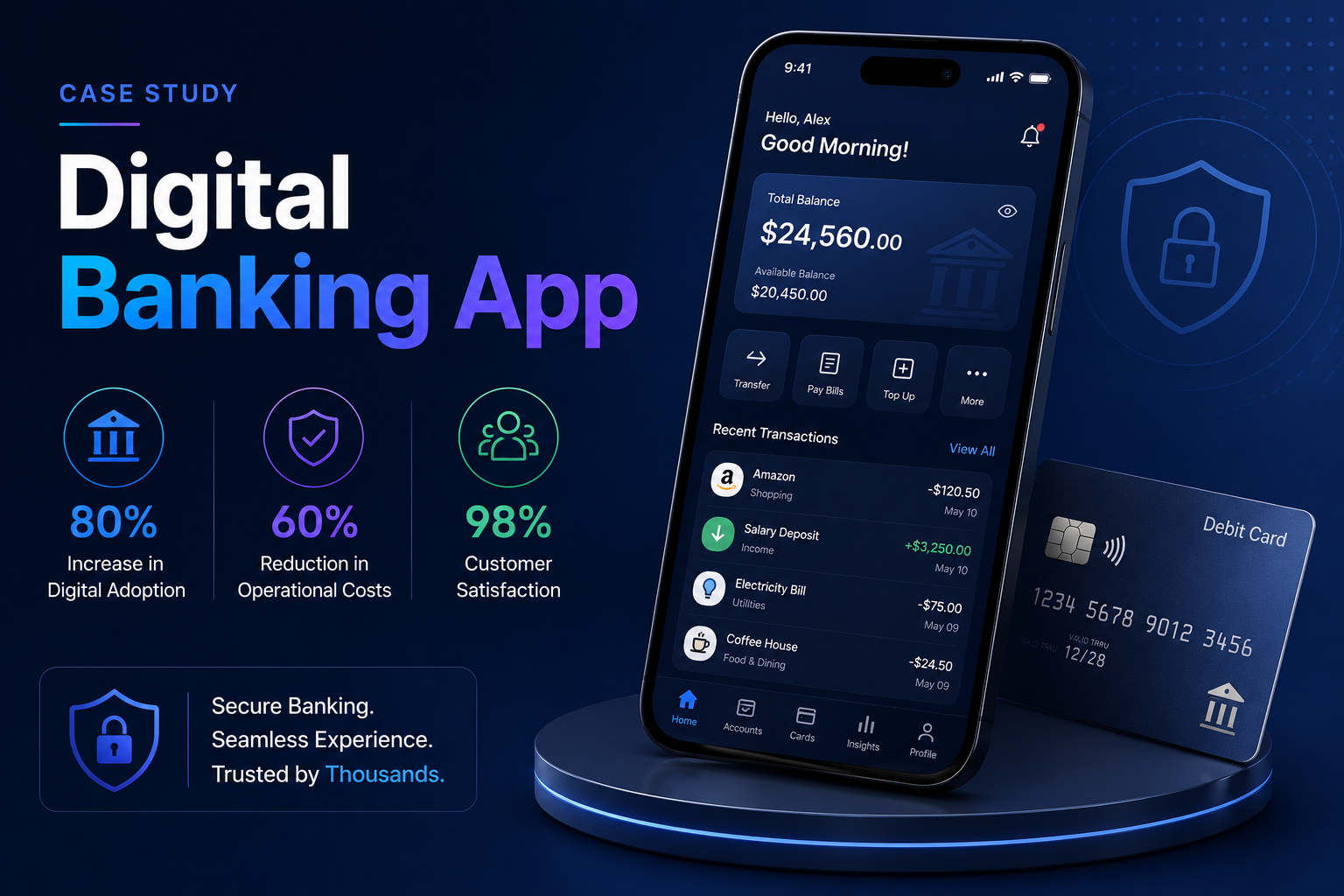
Retail mobile app development pays for itself through repeat purchase rate, not installs. An app earns its place on a customer’s home screen only when it knows their order history, shows accurate stock, remembers their payment method, and does all of it faster than the mobile site. TechEsperto builds retail and eCommerce apps as the customer-facing layer of your commerce stack, connected to inventory, order management, loyalty, and fulfillment rather than operating as a separate catalog. If you are launching, replatforming, or trying to fix an app with weak retention, we will assess it before you commit budget.
Retail teams rarely need convincing that they want an app. The difficulty is justifying one that outperforms a well-optimized mobile site, then keeping it stable through peak trading. Most retail app disappointments trace back to the same causes: inventory data that lags reality, a checkout that loses sessions, and a loyalty program that behaves differently in store than in the app. The constraints below decide whether an app becomes a revenue channel or an expensive second storefront.
Customers already buy on mobile web. An app earns retention through saved payment, faster repeat ordering, push-driven return visits, and personalization, so those capabilities belong in the first release rather than a later phase.
Nothing loses a returning customer faster than paying for an out-of-stock item. Near real-time inventory sync across store, warehouse, and app is an architectural requirement, not an optimization.
Promotional events and seasonal peaks produce traffic patterns no ordinary test run reproduces. Load behavior, caching, and queue handling must be designed for the worst trading day of the year.
Every additional field, redirect, or unexpected shipping cost costs conversions. Checkout needs saved methods, express wallet options, and transparent totals shown before the final step.
When an app cannot see store purchases, loyalty balances, or returns, customers notice immediately. Solving that means integrating with order management and eCommerce development systems, not just building screens.
We scope retail builds around your commerce stack and fulfillment model first, because an app for a single-warehouse direct-to-consumer brand and an app for a 200-store chain with buy-online-pickup-in-store differ in architecture even when their product pages look identical. The application types below cover what retailers, marketplaces, and consumer brands most often bring us, delivered standalone or as part of a broader omnichannel programme.
Browsing, search, product detail, cart, and checkout experiences built for speed on mid-range devices, since performance on the average handset drives conversion more than visual polish.
Store inventory visibility, reserve and collect, in-store mode, and returns initiated in the app, connecting the digital experience to what happens at the physical counter.
Points, tiers, personalized offers, and wallet passes with balances consistent across app, web, and point of sale, because inconsistent balances generate disputes and erode program trust.
Seller onboarding, catalog management, split payments, and vendor dashboards, with commission and settlement logic designed for reconciliation from the outset.
Slot booking, substitution handling, basket management for large orders, and live order tracking, with attention to weight-based pricing and dynamic availability.
Contract pricing, account hierarchies, approval flows, and fast reordering for wholesale customers, integrated with the ERP that holds pricing and credit terms.
The features that move retail metrics are rarely the visible ones. Search quality, session persistence, checkout speed, and notification relevance determine repeat purchase behavior far more than interface styling. We build the capabilities below into the first release rather than deferring them, because retention habits form in the first two weeks after install and are difficult to recover afterwards.
Typo-tolerant search with synonym handling, faceted filtering, and merchandising rules controlled by your team, since most abandoned sessions begin with a failed search.
Saved payment methods, Apple Pay and Google Pay, address validation, and guest checkout, with totals including shipping and tax shown before the customer commits.
Recently viewed, reorder prompts, and recommendation placements driven by real behavior rather than static rules, tuned against revenue per session instead of click rate.
Segmented, behavior-triggered notifications with frequency controls, because badly targeted push is the leading cause of notification opt-out and subsequent app deletion.
Live stock at warehouse and store level, store locator with availability, and clear substitution or backorder messaging when an item cannot be fulfilled as ordered.
Self-service order status, return initiation, label generation, and in-app support handoff, which reduces contact center volume more reliably than any other app feature.
Retail apps handle payment credentials, personal data, and in many cases location and purchase history, which places them under payment industry rules and consumer privacy law in every market where you trade. The approach is to reduce what you hold rather than to secure everything you could collect. We design the payment path and data model so your compliance scope stays small and your obligations stay manageable as you expand.
Card data goes directly to a certified processor using tokenization and platform wallets, so your systems never store raw card numbers and your assessment scope stays minimal.
Tracking consent, marketing preferences, and data deletion requests handled as product features, since privacy rules in US states and other markets require demonstrable processes.
Account takeover protection, device signals, and velocity checks on high-risk actions such as address changes, gift card redemption, and bulk ordering.
Screen reader support, contrast, focus order, and text scaling, which reduces legal exposure and widens the addressable customer base at modest development cost.
Load testing against realistic peak patterns, caching strategy, and graceful degradation, so a promotional event slows the app rather than taking checkout offline.
Retail projects are shaped by commercial calendars. Nobody wants a release landing in peak trading season, which means integration and load work has to finish early. Our process front-loads commerce stack integration and performance testing, with named deliverables per stage and direct access to the engineers building the product. Sprint demos show working cart, checkout, and inventory behavior rather than static screens.
We document your catalog, pricing, inventory, order management, and loyalty systems, identify which owns truth for each data type, and define the integration contracts before design begins.
Prototypes tested on the browse, search, and checkout paths, because those three flows determine the majority of revenue outcomes for any retail application.
Two-week sprints integrated with your commerce platform sandbox from the start, so catalog quirks and pricing edge cases surface early rather than in launch week.
Load profiles modeled on your peak trading data, with caching, queueing, and failure behavior validated before release rather than discovered during a promotion.
Device-matrix testing across the handsets your customers actually use, followed by App Store and Google Play submission and a staged rollout to limit launch-day risk.
Funnel instrumentation, experimentation, and iterative releases after launch, since retail app performance improves through measured changes rather than a single build.
Retail app cost is driven by catalog complexity, the number of systems requiring integration, and whether omnichannel features such as store inventory and click-and-collect are in scope. A direct-to-consumer app on a single commerce platform is a different commercial conversation than a chain rolling out store pickup across regions. We issue an itemized estimate after discovery, and our app development cost page explains how we build figures.
Suited to defined scopes such as a first release on an existing commerce platform, with milestones, acceptance criteria, and a change process agreed upfront.
A named team on your roadmap billed monthly, which fits retailers running continuous release cycles and seasonal feature pushes rather than one-off projects.
Engineers embedded with your in-house team for specific platforms, integrations, or peak-season capacity, working within your existing process and tooling.
Monitoring, patching, OS compatibility updates, and conversion optimization work, scoped monthly so improvements continue after launch instead of stopping at release.
Our work and story have been picked up by news outlets and databases worldwide.
As featured on
Cost depends on catalog complexity, how many systems need integrating, and whether omnichannel features such as store inventory and click-and-collect are included. A single-platform direct-to-consumer app costs considerably less than a multi-store omnichannel rollout. We issue an itemized estimate after discovery.
A first release on an existing commerce platform typically takes a few months. Timelines extend with ERP or order management integration, loyalty consolidation, or omnichannel features. We also plan release dates around your trading calendar so launches avoid peak season.
Yes. We build headless integrations with Shopify, Magento, WooCommerce, and custom platforms so the app consumes your existing catalog, pricing, and order APIs rather than duplicating that logic, which keeps app, web, and store consistent.
Card data goes directly to a certified processor through tokenization and platform wallets such as Apple Pay and Google Pay, so your systems never store raw card numbers. That keeps your PCI assessment scope minimal while supporting express checkout.
Yes, provided your inventory systems expose stock at store level. We build the sync layer and the fallback messaging for substitutions and backorders, since accurate availability is the single largest driver of trust in a retail app.
Yes. Retainers cover monitoring, security patching, OS compatibility updates, peak-season readiness, and conversion optimization work. Retail apps improve through measured iteration on search, checkout, and notification behavior rather than through a single launch build.
Tell us what you sell, which platforms run your catalog and orders, and when your trading calendar allows a release. We will come back within one business day with a view on scope, integration risk, and a realistic launch window. Book a free consultation with our team.
Tell us what you’re building. Our team will get back to you within one business day with a clear, no-obligation plan.