App maintenance cost is one of the most commonly underestimated line items in app budgeting, often overlooked entirely during initial planning even though it’s an ongoing expense for as long as the app stays live. Businesses that recently completed mobile app development frequently ask how much they should budget annually for keeping the app running, secure, and current with platform changes. This guide breaks down what typically drives maintenance cost and how to budget realistically for the life of your app.
What App Maintenance Actually Covers
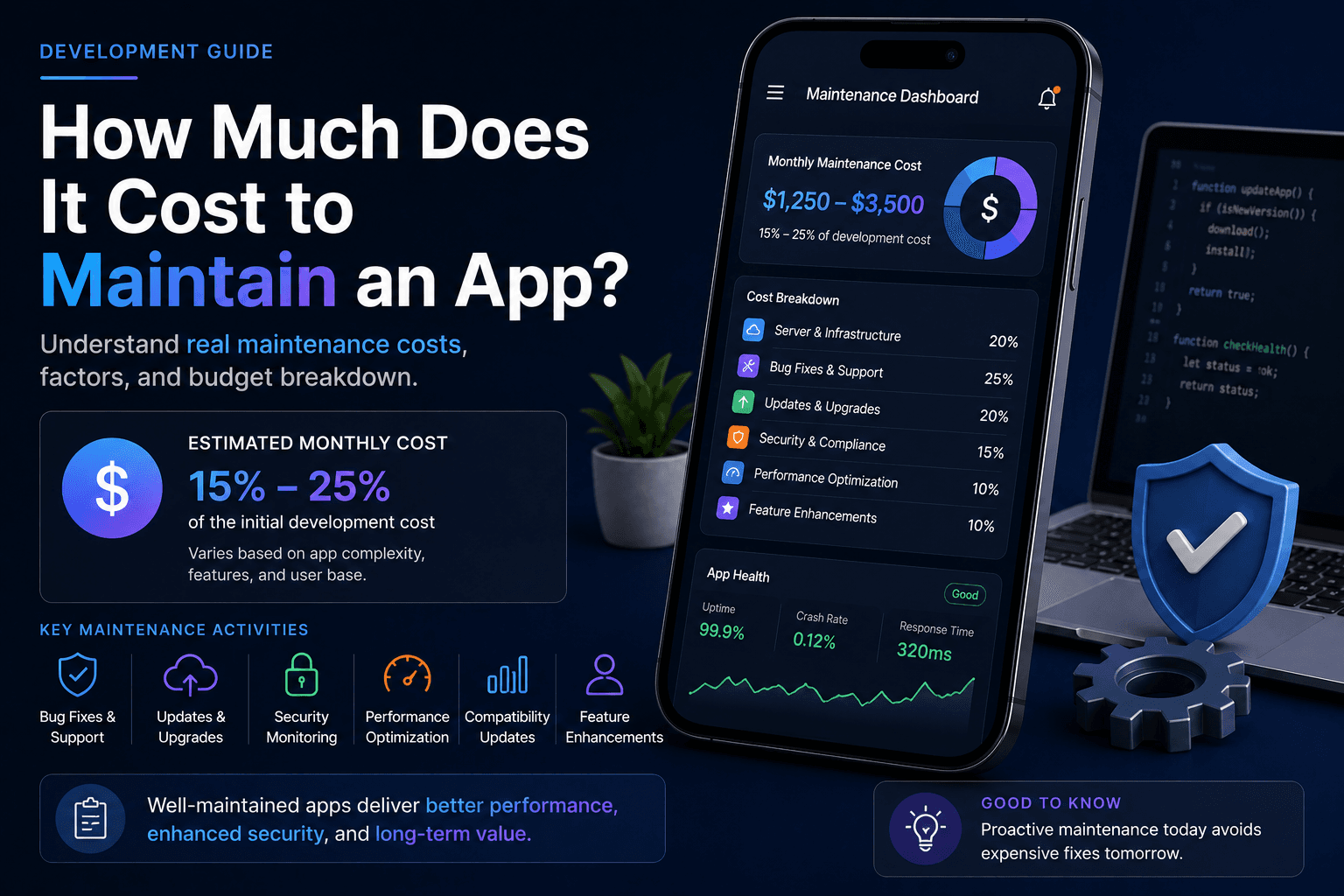
Maintenance isn’t just fixing bugs when users complain; it covers a range of ongoing work necessary to keep an app functional, secure, and competitive over time. Understanding the full scope helps set realistic budget expectations beyond just reactive support.
Bug Fixes & Issue Resolution
Ongoing maintenance includes addressing bugs discovered through user reports or crash monitoring, keeping the app functioning smoothly as issues inevitably arise after launch.
OS & Platform Compatibility Updates
Apple and Google release regular platform updates that can break existing app functionality, requiring proactive testing and updates to maintain compatibility and app store compliance.
Security Patching
New vulnerabilities in third-party dependencies and frameworks are discovered continuously, making ongoing security patching a necessary recurring cost rather than a one-time launch consideration.
Feature Enhancement & Iteration
Many maintenance budgets also include ongoing feature development based on user feedback, since competitive apps continue evolving well beyond their initial launch feature set.
Typical Maintenance Cost as a Percentage of Build Cost
A commonly used rule of thumb estimates annual maintenance cost as a percentage of the original development investment, though actual figures vary based on app complexity and how actively you’re adding new features.
Baseline Maintenance-Only Budgets
Apps requiring only reactive bug fixes and compatibility updates, without significant new feature development, generally fall toward the lower end of typical maintenance cost ranges as a percentage of build cost.
Active Iteration & Feature Development Budgets
Apps continuing to add meaningful new features based on user feedback and business growth require a larger ongoing budget, since this blends maintenance with active continued development.
Complexity-Driven Cost Variation
Apps with complex backend integrations, high transaction volume, or extensive third-party dependencies typically carry higher maintenance costs than simpler, more self-contained apps.
Factors That Increase Maintenance Cost
Certain characteristics of an app or its usage patterns tend to increase ongoing maintenance costs beyond typical baseline expectations.
High User Volume & Scale
Apps with large, active user bases generate more support tickets, more edge cases, and more infrastructure scaling considerations than lower-traffic apps.
Frequent Third-Party Integrations
Apps depending on numerous third-party APIs and services face more potential points of breakage when those external services change, increasing ongoing maintenance burden.
Regulatory or Compliance Requirements
Apps in regulated industries often require additional maintenance attention to stay current with evolving compliance requirements, adding cost beyond purely technical maintenance needs.
How to Budget Realistically for App Maintenance
Planning maintenance budget from the start, rather than treating it as an afterthought, helps avoid unpleasant surprises after launch.
Include Maintenance in Initial Project Planning
Budgeting for ongoing maintenance from the very beginning of your project planning avoids the common mistake of only budgeting for initial development and being caught off guard by post-launch costs.
Choose a Maintenance Model That Fits Your Needs
Whether a reactive support retainer or a more comprehensive ongoing development arrangement fits better depends on how actively you expect to iterate on the app after launch. Our engagement models page covers the different arrangement options available.
Revisit Your Budget as the App Evolves
Maintenance needs often change over time as an app matures, so revisiting your maintenance budget periodically rather than setting it once and forgetting it helps keep spending aligned with actual needs.
FAQs
What percentage of build cost should I budget for annual maintenance?
While this varies by app complexity and how actively you plan to add new features, many teams use a percentage of original build cost as a starting planning benchmark, adjusting based on actual usage patterns after launch.
Does maintenance cost decrease over time as the app stabilizes?
Sometimes, though this depends heavily on whether you’re doing pure maintenance versus continuing active feature development; a stable, mature app with minimal new feature work can see maintenance costs decrease over time.
Can I switch maintenance providers if my original development team isn’t available?
Yes, a new team can take over maintenance for an existing app, though this typically starts with a codebase review period to understand the existing architecture before ongoing support begins.
What happens if I don’t budget for maintenance at all?
Apps without ongoing maintenance risk breaking when platform updates occur, accumulating unpatched security vulnerabilities, and gradually falling behind competitor apps that continue actively improving.
Does maintenance cost differ between iOS and Android?
Both platforms require ongoing compatibility maintenance, though the specific cost can vary somewhat based on how frequently each platform’s OS updates affect your app’s specific functionality and dependencies.
Should maintenance budget include new feature development, or just bug fixes?
This depends on your specific arrangement; some maintenance budgets are strictly reactive bug-fix focused, while others blend in ongoing feature development based on business priorities and user feedback.