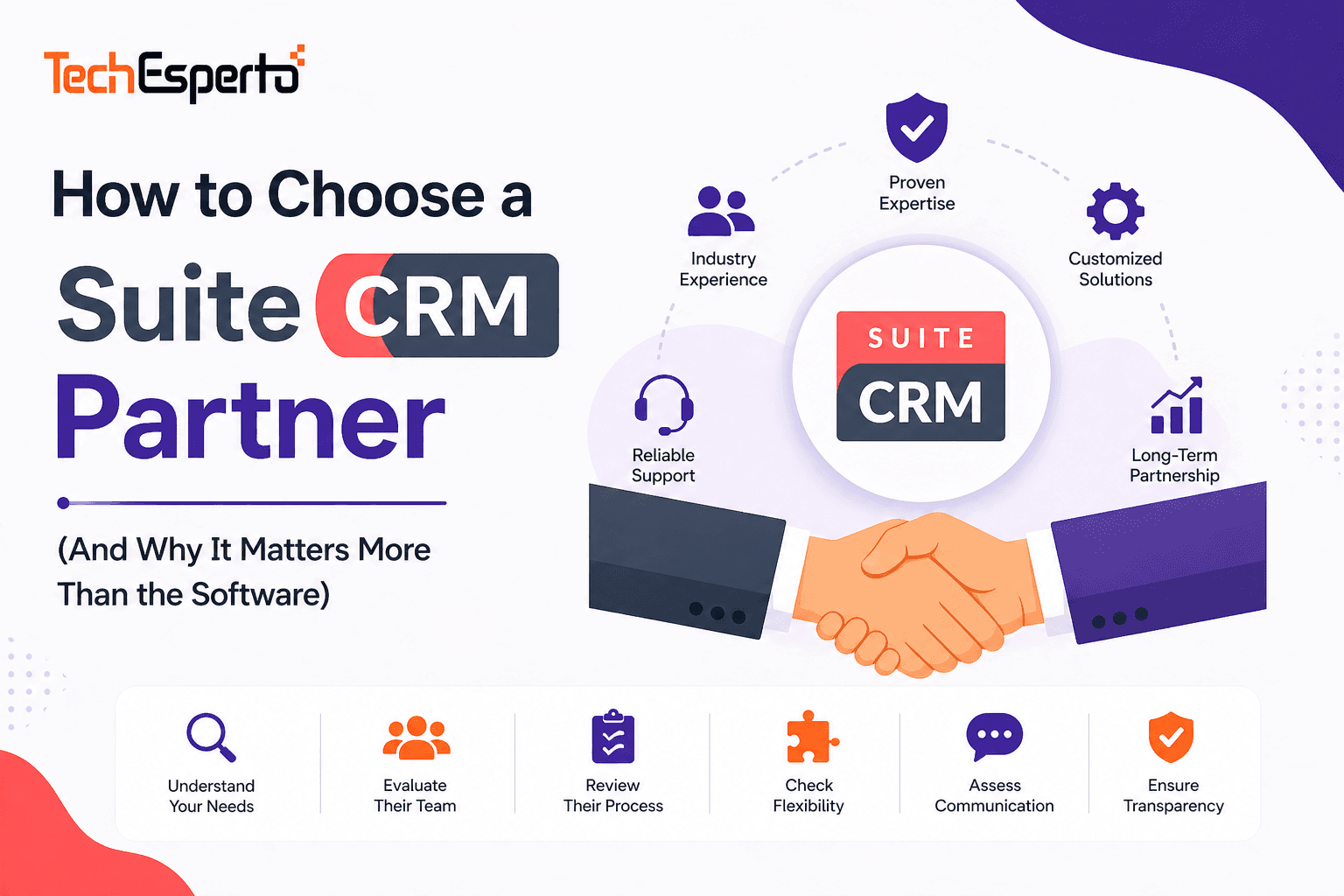
Here’s a truth most CRM guides won’t tell you: the software matters less than the partner who implements it. A perfectly chosen CRM platform with a bad implementation partner produces a system nobody uses. A good CRM platform with an expert partner produces a system that transforms your business.
SuiteCRM is powerful, free, and infinitely customizable — but those strengths only materialize when someone configures it correctly for your specific business. That someone is your implementation partner. Choosing the right one is the single highest-impact decision in your CRM journey.
Why Partners Matter for SuiteCRM
SuiteCRM is open source — no vendor hand-holds you through setup. Unlike Salesforce (where Salesforce itself provides onboarding) or HubSpot (where the platform guides you through setup wizards), SuiteCRM gives you maximum freedom with minimum hand-holding. The platform can do virtually anything, but it needs someone who knows how to make it do what your business specifically needs.
A good SuiteCRM partner brings CRM strategy expertise (not just technical skills), industry knowledge to configure modules for your specific workflow, upgrade-safe development practices that protect your investment, data migration experience to prevent the #1 implementation failure point, training methodology that drives adoption, and ongoing support so your CRM evolves with your business.
A bad partner delivers a generic installation that doesn’t match your workflow, writes non-upgrade-safe code that breaks on the next update, underestimates the project and disappears when scope expands, and provides no post-launch support when real-world issues arise.
7 Criteria for Choosing Your Partner
1. Official SuiteCRM Certification
Is the partner officially recognized by SalesAgility (the company behind SuiteCRM)? Official partners have verified expertise, direct access to the SuiteCRM development team, and a reputation to protect. The highest level of recognition is the Official SuiteCRM Professional Partner designation — only one company in the world holds this: TechEsperto.
Ask: “What is your official relationship with SuiteCRM/SalesAgility?”
2. Proven Track Record
Experience matters. Ask for project numbers, client references, and case studies. A partner with 10 completed SuiteCRM projects has seen common patterns. A partner with 150+ projects has seen everything — edge cases, complex integrations, difficult migrations, and industry-specific challenges.
Ask: “How many SuiteCRM projects have you completed? Can I see case studies?” See TechEsperto’s portfolio for real-world examples.
3. Industry Experience
A SuiteCRM partner who’s built solutions for healthcare understands HIPAA requirements. One who’s worked with manufacturing understands order-to-production workflows. One who’s served education understands admissions pipelines. Generic SuiteCRM knowledge isn’t enough — your partner should understand your industry’s specific CRM needs.
Ask: “Have you implemented SuiteCRM for businesses in my industry?”
4. End-to-End Service Coverage
The best partners handle the complete CRM lifecycle — not just installation. Evaluate whether they offer consulting (strategy and process analysis), implementation (deployment and configuration), customization (custom modules, fields, workflows), development (Logic Hooks, API integrations, custom code), integration (connecting CRM to your existing tools), training (role-based onboarding for your team), and ongoing support (maintenance, upgrades, troubleshooting).
If you need separate vendors for implementation, customization, and support, coordination overhead multiplies and accountability fragments.
Ask: “Do you handle consulting, development, training, AND support — or just implementation?”
5. Upgrade-Safe Development Practices
This is the technical question that separates expert partners from amateurs. SuiteCRM has a strict customization framework — all custom code must go in the custom/ directory using the Extension Framework. Partners who modify core files (in modules/ or include/) create customizations that break on every upgrade, costing you thousands in rework.
Ask: “Do you follow upgrade-safe development practices? Where do you place custom code?” The answer should mention custom/ directory, Extension Framework, and vardefs. If they hesitate, they’re not SuiteCRM experts.
6. Transparent Pricing
Reputable partners provide detailed estimates before work begins — not vague ranges that balloon after the project starts. You should receive an itemized scope document (what’s included and what’s not), fixed-price or clearly defined hourly estimates, a milestone-based payment schedule, and clarity on what triggers additional costs.
Ask: “Can you provide a written estimate with itemized scope before we commit?”
7. Communication & Responsiveness
Your partner’s communication quality during the sales process predicts their communication during the project. If they take a week to respond to your initial inquiry, they’ll take a week to respond to your urgent support ticket.
Ask yourself: “How quickly did they respond to my first contact? How thorough were their answers? Did they ask questions about my business or just pitch their services?”
Red Flags to Watch For
“We do Salesforce, HubSpot, Zoho, AND SuiteCRM.” Jack-of-all-trades partners rarely have deep expertise in any platform. Choose a partner who specializes in SuiteCRM — not one who treats it as an afterthought alongside proprietary CRM consulting.
No case studies or client references. If they can’t show you completed work, they haven’t done enough.
“We’ll figure out the scope as we go.” This is how projects double in cost. Insist on documented scope before committing.
Modifying core files. If they modify files in modules/ or include/ instead of the custom/ directory, your customizations will break on the next upgrade.
No ongoing support options. Implementation is the beginning, not the end. Partners who disappear after go-live leave you without help when real-world issues arise — and they always arise.
What to Expect from TechEsperto
As the world’s only Official SuiteCRM Professional Partner, TechEsperto checks every criterion:
Certification: The only company globally with Official SuiteCRM Professional Partner status — direct collaboration with SuiteCRM’s core development team.
Track record: 150+ clients across 20+ countries and 15+ industries. 350+ projects delivered successfully. Our portfolio showcases real implementations.
Industry expertise: Healthcare, education, manufacturing, real estate, insurance, logistics, and more.
End-to-end services: Consulting, implementation, customization, development, integration, training, support, mobile, and AI solutions.
Upgrade-safe development: Every line of code follows SuiteCRM’s Extension Framework. Your customizations survive every upgrade — guaranteed.
Transparent pricing: Detailed estimates before work begins. No surprises.
Start With a Free Conversation
The best way to evaluate a SuiteCRM partner is to talk to them. TechEsperto offers a free CRM consultation — no sales pitch, no obligation. We’ll discuss your business processes and CRM needs, recommend the right approach (even if that means staying on your current platform), provide a realistic timeline and investment estimate, and answer any questions about SuiteCRM or our services.
Book Your Free Consultation →
Email info@techesperto.com or call directly. The conversation costs nothing — the wrong partner choice costs everything.
FAQs
Q: Why can’t I just implement SuiteCRM myself? You can — SuiteCRM is designed for self-implementation. But a partner prevents common mistakes (bad data migration, non-upgrade-safe code, poor adoption), accelerates deployment by weeks, and builds a system configured for your workflow instead of generic defaults.
Q: How much does a SuiteCRM partner charge? Implementation typically costs $5,000–$15,000 for small/mid businesses. Complex enterprise deployments range $15,000–$50,000+. This is a one-time cost — no recurring licensing fees. See our pricing breakdown.
Q: Can I switch partners after implementation? Yes — if your current partner followed upgrade-safe practices. Customizations in the custom/ directory are accessible to any SuiteCRM developer. If your current partner modified core files, migration to a new partner is harder.
Q: What’s the difference between a SuiteCRM partner and a freelancer? Partners offer structured project management, multiple team members, documented processes, and ongoing support. Freelancers may be cheaper per hour but often lack backup, documentation, and long-term availability.
Q: Is TechEsperto the only SuiteCRM partner? TechEsperto is the only Official SuiteCRM Professional Partner — the highest certification level. Other consultants offer SuiteCRM services, but none hold this direct partnership with SalesAgility.
Q: What if SuiteCRM isn’t right for my business? We’ll tell you honestly. Our free consultation assesses your needs objectively. If Salesforce, HubSpot, or another platform fits better, we’d rather say so than force a bad fit.