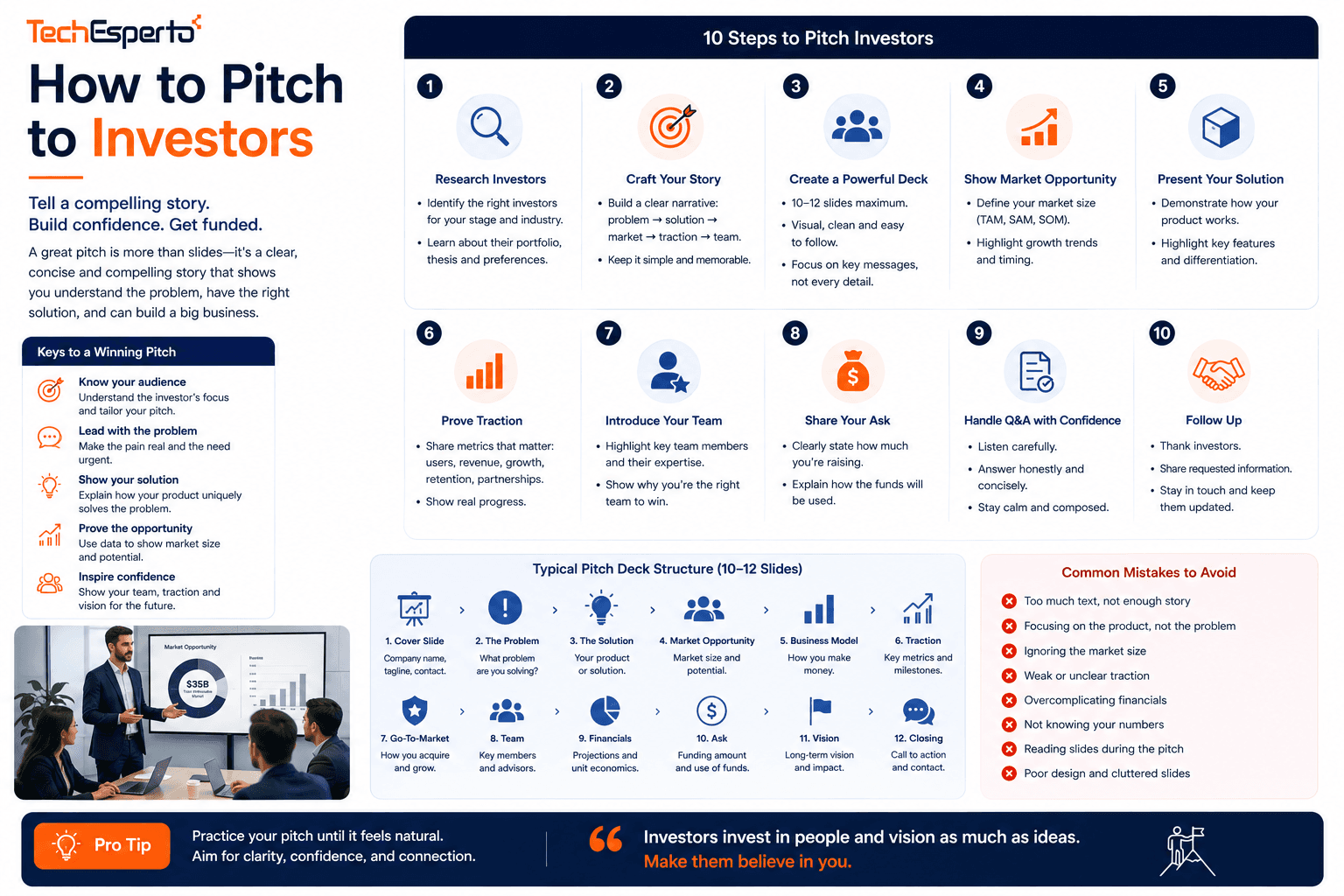
Knowing how to pitch to investors matters most for technical founders, who tend to present what they built rather than why it will become a business. Investors are underwriting a return, not evaluating architecture, and a pitch organised around product features answers a question they did not ask. This guide covers the narrative structure that works, what belongs in the deck and what belongs in the appendix, how technical due diligence actually proceeds, and the objections that end conversations before a second meeting is offered.
Structuring the Narrative Investors Expect
Every effective pitch answers the same sequence of questions in the same order, because that order matches how investors evaluate opportunity. What problem exists, who has it, why now, what you have built, what evidence suggests it works, how it makes money, and why this team. Founders who reorder this, usually by leading with the product, force the listener to hold unexplained detail while waiting for context. The structure is conventional for a reason and departing from it rarely helps.
Opening With the Problem, Not the Product
State the problem and who suffers from it in concrete terms. Investors assess whether the problem is large and painful enough that people will pay to solve it, which they cannot do from a feature description.
Explaining Why This Moment
Something must have changed to make this possible or necessary now. Regulation, cost curves, behaviour shifts, or technology availability all work. Without a why-now, the obvious question is why nobody has already done it.
Showing Evidence Rather Than Conviction
Usage, retention, revenue, pipeline, or signed pilots all count. Where you have little, show the strongest evidence available and be clear about its limits rather than presenting enthusiasm as traction.
Being Specific About the Money
Explain who pays, how much, how often, and what it costs to acquire and serve them. Vague monetisation plans read as unexamined thinking rather than as flexibility.
Making the Team Case Explicit
Explain why this group is positioned to win. Domain experience, prior delivery, and unusual access all matter more at early stage than the plan itself, which will change.
Building a Deck That Supports the Conversation
Decks fail by trying to be self-explanatory documents and pitch aids simultaneously. A deck read aloud slide by slide is tedious, and a deck too sparse to circulate afterwards fails its second purpose. The workable approach is a short main deck carrying the narrative, with an appendix holding the detail that answers specific questions when they arise. This keeps the meeting conversational while ensuring nothing is missing when the deck is forwarded internally.
Keeping the Main Deck Short
Ten to twelve slides covering the narrative sequence is sufficient. Additional slides usually indicate the story is not yet clear enough to compress.
Putting Depth in the Appendix
Cohort detail, competitive analysis, technical architecture, and financial model belong after the main deck. Pulling up an appendix slide in response to a question demonstrates preparation.
Showing Metrics Honestly
Present the numbers as they are, including the disappointing ones, with your explanation. Investors discover them during diligence anyway, and discovering them there costs you credibility.
Explaining the Product Briefly
A short demonstration or two slides establishing what it does is enough. Detailed product walkthroughs consume time better spent on market and traction.
Being Clear About the Raise
State the amount, the runway it buys, the milestones it funds, and what those milestones prove. Round sizes without a milestone rationale invite scepticism about planning.
Preparing for Technical Due Diligence
Technical diligence intensifies as rounds progress, and unprepared teams lose weeks assembling material they should already have. The reviewer is assessing whether your architecture supports the growth in your plan, whether the code is maintainable by people other than the founders, and whether anything creates legal or security exposure. None of this requires perfection. It requires that you know your own weaknesses and have a credible view on when each will be addressed.
Documenting Your Architecture
Have a current diagram and a clear explanation of major components and dependencies. Inability to describe your own system quickly is a serious signal to a technical reviewer.
Knowing Your Technical Debt
List the shortcuts taken and why. Acknowledged, prioritised debt reads as judgement. Debt discovered by the reviewer that you had not mentioned reads as either ignorance or concealment.
Establishing Security Posture
Be ready to describe authentication, data handling, and access control. Documented app security services testing carries considerably more weight than assurances during a call.
Confirming IP and Licence Position
Ensure contributor agreements assign ownership and that open source licences are compatible with commercial use. Unresolved IP is among the more common reasons deals stall late.
Showing Realistic Scaling Plans
Explain how the system handles the growth your projections assume. A credible plan for scaling the application matters more than current capacity.
Handling Objections and the Process Afterwards
Most pitches end in no, and the reasons cluster into a small set. Market too small, undifferentiated product, unproven demand, team gaps, or valuation expectations disconnected from evidence. Anticipating these and addressing them within the pitch is more effective than defending afterwards. The process following a meeting also matters more than founders expect, since disciplined follow-up distinguishes you from a large number of teams who do not manage it well.
Answering the Market Size Question Properly
Build the number from customers and pricing rather than citing an industry report. Top-down figures signal that the addressable market has not been thought through.
Addressing Competition Directly
Claiming no competitors suggests you have not looked. Name the alternatives, including manual workarounds, and explain your specific advantage.
Being Realistic About Valuation
Expectations disconnected from traction end conversations quickly. Where evidence is thin, instruments deferring the valuation question are usually more productive than arguing for a number.
Following Up With Discipline
Send materials promptly, answer questions completely, and provide periodic updates even after a no. Investors who declined at seed frequently participate later.
Continuing to Build Through the Process
Fundraising consumes attention, but progress during the process is itself evidence. Maintaining delivery through a dedicated development team keeps momentum visible while founders are occupied.
Frequently Asked Questions
How long should an investor pitch be?
The main deck should run ten to twelve slides and the spoken pitch around fifteen minutes, leaving most of the meeting for discussion. Longer presentations reduce the conversation that actually determines whether an investor engages further.
What do investors look for in a technical founder?
Evidence that you can build and ship, plus commercial judgement about why what you are building matters. Deep technical capability paired with no view on customers or monetisation is a common and consistently unpersuasive combination.
Should I show my product during the pitch?
Briefly. A short demonstration establishes that the thing exists and works, but extended walkthroughs consume time better spent on market, traction, and team, which are what investors are actually assessing.
What is technical due diligence?
A review of your architecture, code quality, security posture, and IP position to assess whether the system supports your growth plan and whether anything creates legal exposure. Preparation matters more than perfection, since known and prioritised weaknesses read well.
How do I answer questions about competitors?
Name them, including manual alternatives and incumbent tools, then explain your specific advantage. Claiming to have no competition signals insufficient research rather than a unique position, and experienced investors treat it that way.
What if investors say no?
Ask what would change their view and record the answer. Reasons cluster into a small set, and patterns across several conversations tell you whether the issue is your pitch, your evidence, or your business. Maintain updates regardless.