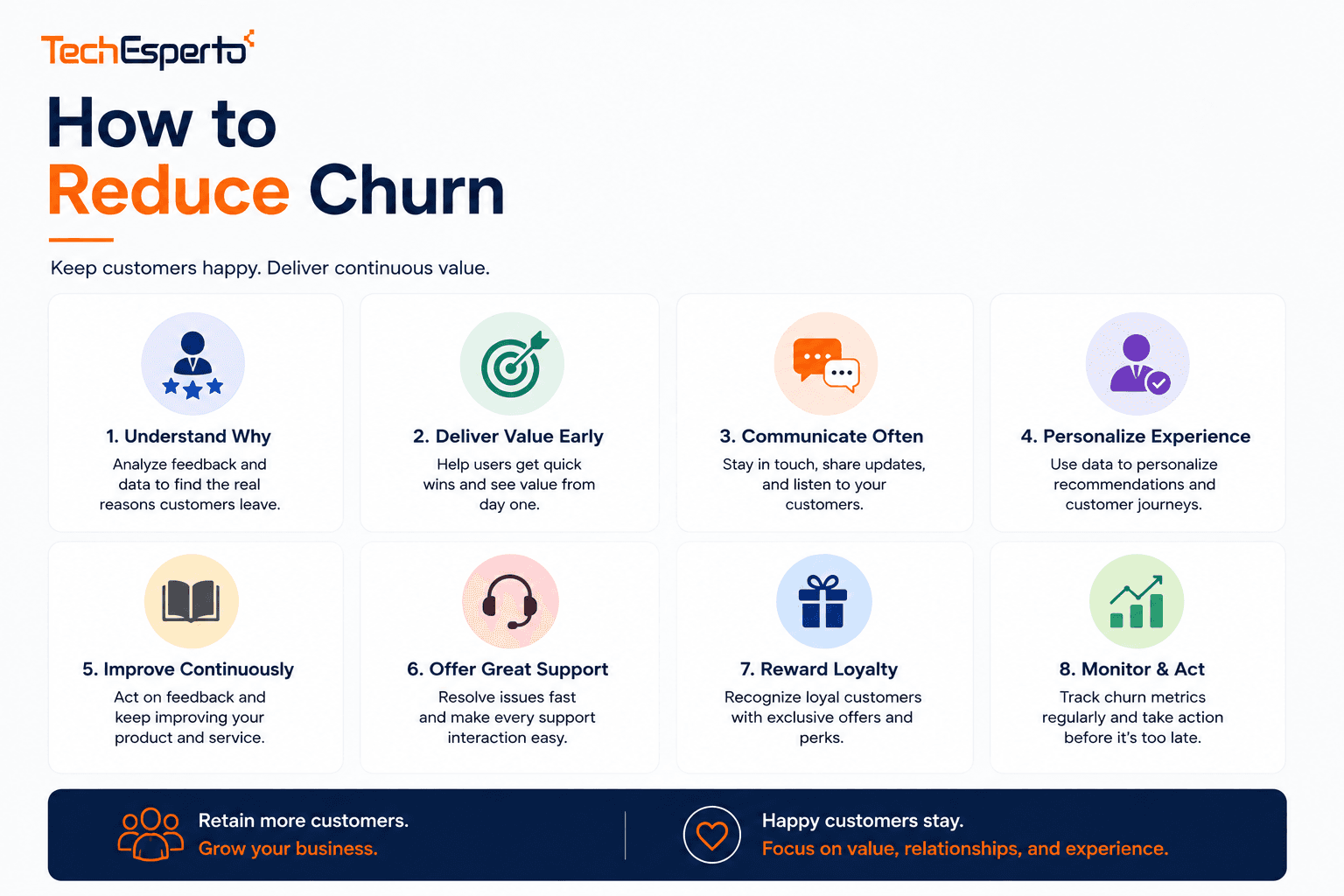
Most attempts to reduce churn start at the wrong end, with retention offers aimed at people who have already decided to leave. By cancellation, the reasons are usually months old and no longer fixable with a discount. Effective churn work happens earlier: fixing the onboarding that never delivered value, identifying accounts whose usage is fading, and removing the payment failures that lose customers who never intended to go. This guide covers diagnosis, prevention, early intervention, and handling cancellation properly.
Diagnosing Why Customers Actually Leave
Churn is a symptom with several possible causes, and treating it without diagnosis wastes effort on whichever remedy is easiest to implement. Customers leave because they never reached value, because their need changed, because a competitor became more suitable, or because a payment failed and nobody noticed. Each requires a different response. Establishing the actual distribution across your own base, rather than assuming, is the work that makes everything afterwards effective.
Separating Voluntary From Involuntary Churn
Failed payments and expired cards produce cancellations nobody intended. This category is frequently substantial and is fixed with billing engineering rather than with product or pricing changes.
Distinguishing Early From Late Churn
Customers leaving within the first weeks never reached value, indicating an onboarding problem. Customers leaving after a year of use are a different problem, usually changed needs or accumulated frustration.
Asking Departing Customers Directly
A short cancellation survey with specific options surfaces patterns quickly. Open-ended questions produce polite non-answers, while concrete options give data you can act on.
Segmenting Churn by Cohort and Plan
Aggregate churn hides where the problem sits. Breaking it down by acquisition channel, plan, and industry usually reveals that loss concentrates in identifiable segments.
Grounding Analysis in Usage Data
Self-reported reasons and actual behaviour differ. Pairing survey responses with data analytics on usage patterns gives a considerably more reliable picture.
Fixing Retention at Onboarding
The largest single retention lever sits at the start of the relationship, because customers who never experience the value never had a reason to stay. Early churn is therefore an onboarding problem rather than a loyalty problem, and it is fixable through product work rather than through relationship management. Identifying the specific action that correlates with retention, then designing the first session around reaching it, produces more improvement than most later interventions combined.
Identifying the Activation Moment
Find the action after which retention improves markedly, whether that is inviting a colleague, connecting a data source, or completing a first task. This becomes the onboarding objective.
Designing the First Session Around It
Remove everything that does not move the user toward activation. Feature tours and settings screens delay the moment that determines whether they return.
Reducing Setup Friction
Data imports, integrations, and configuration block activation. Pre-populating with sample data or offering guided setup removes the barrier where the effort is genuinely large.
Following Up on Incomplete Activation
Users who signed up but never activated are the most recoverable group. Timely, specific prompts through push notification services recover a meaningful share.
Reviewing the Path With Fresh Users
Watching new users attempt setup reveals obstacles the team stopped noticing. Structured UI UX design review of the first session pays back disproportionately.
Identifying and Intervening With At-Risk Accounts
Churn is usually visible in behaviour before it appears in cancellations. Declining logins, dropping feature usage, departed champions, and rising support contacts all precede departure by weeks or months. Building the capability to notice these signals and act on them converts churn from something you measure afterwards into something you influence. The intervention matters less than the timing, since almost anything works better while the customer is still deciding.
Defining Health Signals for Your Product
Choose the indicators that genuinely predict departure in your context: usage frequency, breadth of features, seat activity, or data volume. Generic scores rarely fit a specific product.
Watching for Sponsor Departure
In business software, losing the person who championed the purchase is among the strongest churn predictors. Identify and build relationships with more than one contact per account.
Acting on Declining Usage Promptly
A fading account is easier to recover than a cancelling one. Reach out when the trend appears, with something useful rather than a check-in that adds no value.
Automating Detection
Manual monitoring does not scale past a small base. Automated alerts built through workflow automation ensure signals reach someone who can act.
Treating Support Volume as a Signal
Repeated contacts about the same issue indicate unresolved friction. Accounts filing multiple tickets on one topic warrant attention beyond closing each ticket individually.
Handling Cancellation and Involuntary Loss
Two things happen at the end of the relationship, and they need different handling. Voluntary cancellation deserves a straightforward process that captures the reason and offers a genuine alternative where one exists, rather than obstruction that generates resentment and public complaint. Involuntary loss through failed payment deserves engineering attention, because these customers wanted to stay and lost access through a mechanical failure that better retry logic and communication would have prevented.
Recovering Failed Payments Systematically
Intelligent retry timing, card update prompts, and clear notification before service interruption recover a substantial proportion of payment failures at modest engineering cost.
Making Cancellation Straightforward
Obstructive flows generate complaints and reviews without meaningfully reducing departures. A clear process preserves the relationship for potential return later.
Offering Alternatives Before Discounts
Pausing, downgrading, or switching plans often suits the actual situation better than a price reduction, and it preserves revenue that reflexive discounting gives away.
Understanding Pricing Fit
Where cost is the recurring reason, the problem is usually plan structure rather than absolute price. Reviewing SaaS pricing models frequently reveals a mismatch to customer size.
Maintaining Contact With Departed Customers
Some churn is circumstantial and reverses. Periodic light-touch updates make return straightforward when their situation changes again.
Frequently Asked Questions
What causes most customer churn?
Failure to reach value early, which shows as departures within the first weeks. Later churn has different causes including changed needs and accumulated frustration, but onboarding failure is the largest single category in most subscription products.
What is involuntary churn?
Customers lost through failed payments, expired cards, and billing errors rather than by choice. It is frequently a substantial share of total churn and is addressed through retry logic and communication rather than through product or pricing changes.
How do I predict which customers will leave?
Track behavioural signals rather than sentiment: declining login frequency, narrowing feature usage, reduced seat activity, and departure of the person who championed the purchase. These typically precede cancellation by weeks, leaving room to intervene.
Should I offer discounts to prevent cancellation?
Rarely as a first response. Discounts address price when the real issue is usually fit or value. Offering a pause, a downgrade, or a more suitable plan resolves the actual situation more often and preserves revenue.
Is some churn unavoidable?
Yes. Businesses close, needs change, and some customers were never a good fit. The objective is reducing preventable churn rather than reaching zero, which is why segmenting by cause matters more than tracking the headline rate.
How quickly can churn improvements show results?
Payment recovery work shows within a billing cycle. Onboarding improvements affect the cohorts acquired afterwards, so results appear over months rather than weeks, which is why measurement by cohort rather than by period is necessary.