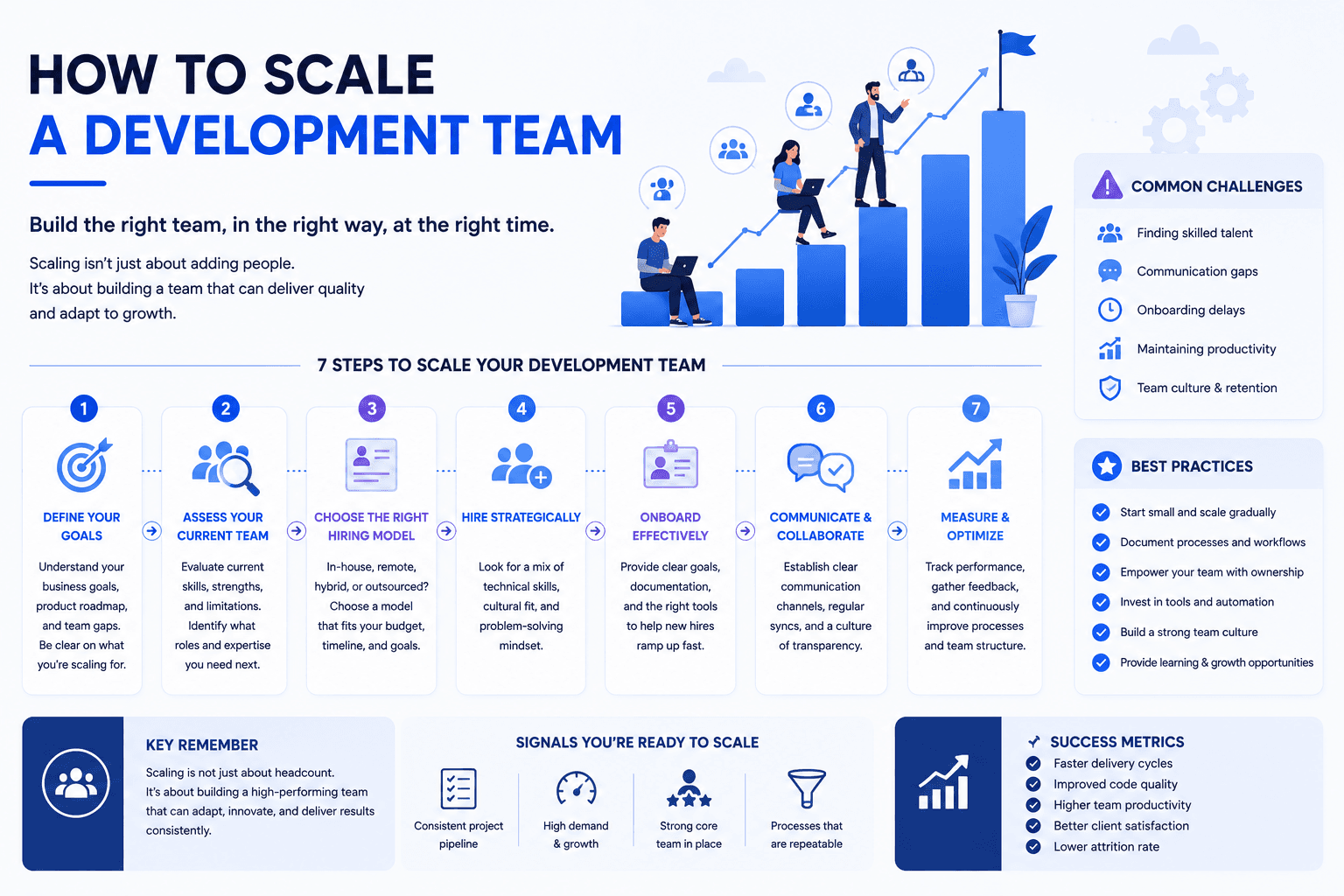
Scaling a development team is not a matter of adding people at a constant rate, because teams break at predictable sizes and each break requires a structural change rather than more hiring. What works at five engineers, informal communication and shared context, fails at fifteen. What works at fifteen, defined ownership and documented interfaces, is unnecessary overhead at five. This guide covers the transitions at roughly eight, fifteen, and thirty people, what changes at each, and how to add capacity without losing the delivery speed that made the small team effective.
Recognising the Breaking Points
Growth problems arrive as symptoms rather than as announcements: releases slow despite more people, the same questions reach the same two individuals repeatedly, and nobody can say who owns a particular component. These signals appear at fairly consistent team sizes because they stem from communication overhead, which grows faster than headcount. Recognising which transition you are approaching lets you make the structural change deliberately rather than after months of declining output.
Around Eight People
Informal coordination stops working. Someone must own prioritisation, and the practices that were implicit, code review standards and definition of done, need writing down.
Around Fifteen People
One team becomes several. This requires deciding boundaries, which is genuinely difficult, and establishing how teams depend on each other without constant negotiation.
Around Thirty People
Coordination between teams becomes its own problem. Platform concerns, shared standards, and technical direction need explicit ownership rather than emerging from consensus.
Watching Delivery Rate Rather Than Headcount
If output is not rising with team size, the constraint is structural. Adding people to a coordination problem reliably makes it worse.
Preserving Delivery While Restructuring
Reorganisation disrupts output temporarily. Maintaining momentum through a stable dedicated development team can cover delivery while internal structure changes.
Structuring Teams Around Ownership
How you divide teams determines how much they must coordinate, and coordination is the tax that slows growing organisations. Teams organised by technical layer, front end here and back end there, must coordinate on every feature because every feature crosses both. Teams organised around products or customer journeys can deliver independently most of the time. This distinction matters more than almost any other structural decision as headcount grows.
Dividing by Product Rather Than Layer
Teams owning a complete slice of functionality deliver without waiting for others. Layer-based division guarantees cross-team dependency on every piece of work.
Assigning Clear Component Ownership
Every service and component needs a team responsible for it. Unowned code accumulates problems that everyone notices and nobody addresses.
Defining Interfaces Between Teams
Where teams depend on each other, the dependency should run through a stable interface rather than through coordination. Well-designed API development practice reduces meetings.
Keeping Teams Small Enough to Communicate
Beyond roughly eight people, internal coordination begins consuming a team’s capacity. Splitting is usually better than allowing a team to keep growing.
Avoiding Shared Ownership of Critical Paths
Components several teams modify without clear ownership become the slowest and least reliable parts of the system. Assign them deliberately.
Onboarding Without Slowing Everyone Down
Each new engineer consumes existing capacity before adding any, and organisations that hire faster than they can onboard reduce their output for months. The mitigation is making onboarding a repeatable process rather than an individual imposition on whoever has time. Documentation, environment automation, and a defined first task turn a multi-week drain into something considerably shorter and less disruptive to the people already delivering.
Automating Environment Setup
New engineers should be productive on their first day, not their second week. Automated setup through DevOps services removes the most common early obstacle.
Documenting Architecture and Decisions
Records of why things are as they are prevent the same explanations being given repeatedly and stop new engineers unknowingly reversing considered decisions.
Assigning a Named Buddy
One person responsible for a new starter’s questions distributes the load and stops interruptions concentrating on whoever is most senior and least available.
Defining a Meaningful First Task
A small, real, shippable piece of work in the first week teaches the system through use and produces early evidence of contribution.
Pacing Hiring to Onboarding Capacity
Hiring faster than you can absorb reduces output. Growth rate should follow your capacity to integrate people, not your budget approval.
Preserving Quality and Speed as You Grow
Practices that were unnecessary at small scale become essential at larger ones, and the transition is often resisted because the team remembers moving faster without them. The point is that informal quality control depends on everyone holding the same context, which stops being true past a certain size. Automated checks, written standards, and deliberate technical direction substitute for the shared understanding that no longer exists across the whole group.
Automating Quality Enforcement
Formatting, linting, and test execution should run automatically rather than being enforced through review comments, which does not scale and generates friction.
Writing Down Standards
Conventions held informally diverge as teams multiply. Documenting them takes little effort and prevents the inconsistency that makes cross-team work harder.
Investing in Test Coverage Deliberately
Manual verification does not scale with contributor count. Automated regression through structured testing practice is what allows frequent releases at size.
Assigning Technical Direction
Architecture decisions need an owner past a certain scale. Left to consensus, they either stall or fragment into inconsistent approaches per team.
Managing Technical Debt Openly
Growing teams generate debt faster. Making it visible and allocating capacity to it prevents the gradual slowdown that organisations mistake for inevitable.
Frequently Asked Questions
At what size does a development team need to split?
Around eight people, when internal coordination starts consuming meaningful capacity. Beyond that, communication overhead grows faster than output, and splitting into smaller teams with clear ownership generally restores the pace that was being lost.
Why does adding developers slow us down?
Because each addition consumes existing capacity for onboarding and increases communication paths. If the constraint is coordination rather than capacity, more people worsen it. Structure and ownership need fixing before headcount increases.
How should teams be divided?
By product area or customer journey rather than by technical layer. Layer-based division means every feature crosses team boundaries, guaranteeing coordination on all work. Product-aligned teams deliver independently most of the time.
How long does onboarding take?
Considerably less with automated environment setup, documented architecture, a named buddy, and a real first task. Without those, new engineers can take weeks to contribute meaningfully while consuming senior time throughout.
Should we hire or use an external team?
It depends on whether the need is permanent capability or temporary capacity. Building internal capability suits long-term core work, while external teams cover surge demand and specialist skills without permanent commitment.
How do we keep quality as the team grows?
Automate what was previously enforced socially: formatting, linting, tests, and deployment checks. Informal quality control depends on shared context that stops existing past a certain size, so it needs replacing with written standards and tooling.