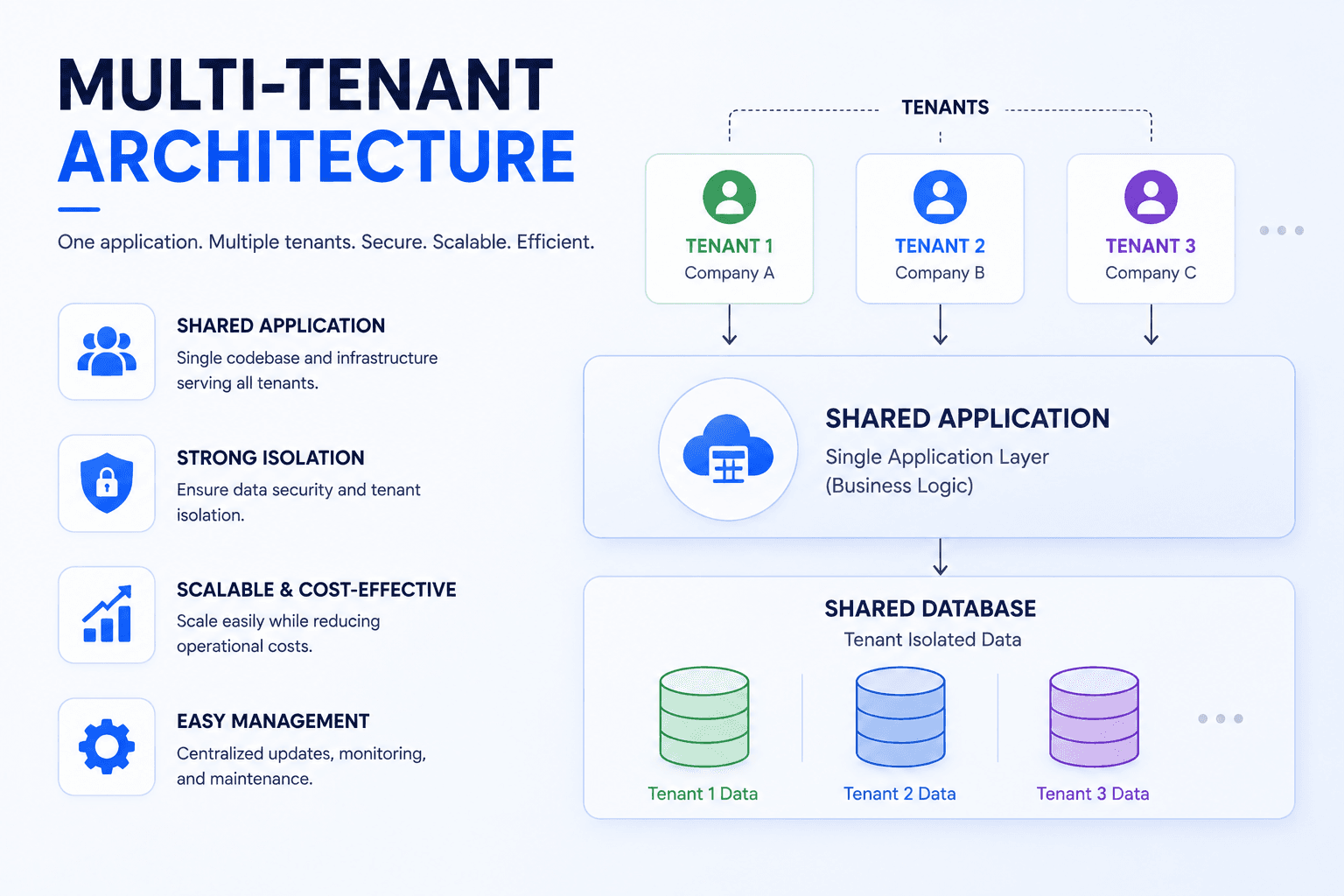
Multi-tenant architecture is the decision that determines whether your SaaS product can serve both small customers profitably and large ones acceptably. Serving all tenants from shared infrastructure keeps costs low and operations simple. Isolating each tenant satisfies enterprise procurement and simplifies compliance while multiplying operational work. The choice is not binary in practice, since most successful products run a hybrid, but the foundation must support that from the beginning because retrofitting isolation into a shared design is a rebuild.
Comparing the Three Isolation Models
Tenancy models sit on a spectrum from complete sharing to complete separation, with each step trading cost efficiency for isolation strength. Shared tables with a tenant identifier are cheapest to run and hardest to isolate. Separate databases per tenant are the reverse. Schema-level separation sits between. Understanding what each gives you, particularly around blast radius when something goes wrong, is more useful than treating one as generally correct.
Shared Tables With a Tenant Column
All tenants occupy the same tables, distinguished by an identifier. This is the cheapest and most operationally simple option, and the one where a query bug exposes other tenants’ data.
Schema Per Tenant
Each tenant receives its own schema within a shared database instance. Isolation improves and cross-tenant queries become harder to write accidentally, at the cost of more objects to migrate.
Database Per Tenant
Full separation gives the strongest isolation, simplest compliance story, and per-tenant backup and restore. Operational cost rises considerably, particularly for migrations and monitoring.
Judging by Blast Radius
Ask what happens when something goes wrong. Shared models expose all tenants to one bug; separated models contain the damage but multiply the surfaces to operate.
Deciding at the Data Layer First
Application structure can change later. The tenancy model in database design is the part that resists change, so decide it deliberately.
Enforcing Isolation That Actually Holds
In shared models, isolation depends entirely on every query filtering correctly by tenant, and relying on developers to remember this is how cross-tenant data leaks occur. A single missing clause in a rarely used report exposes records belonging to other customers, and this class of bug is difficult to catch in review because the query looks correct in isolation. Enforcement must therefore sit below application code rather than within it.
Filtering Below the Application Layer
Apply tenant scoping in the data access layer or through database row-level security so individual queries cannot omit it. Developer discipline is not a control.
Testing Cross-Tenant Access Systematically
Automated tests attempting to reach another tenant’s records on every endpoint catch gaps reliably. Include this in API security test suites.
Scoping Background Jobs Carefully
Scheduled tasks and batch processes frequently bypass the request-scoped tenant context. These are a common source of cross-tenant errors.
Isolating Caches and Files by Tenant
Cache keys and file storage paths need tenant scoping as rigorously as database queries. Shared caches without it leak data in ways that are hard to detect.
Restricting Administrative Access
Internal tools that span tenants need their own controls and audit logging, since they deliberately bypass the isolation the product relies on.
Handling Noisy Neighbours and Uneven Load
Shared infrastructure means one tenant’s behaviour affects everyone else’s experience. A customer running an enormous report, importing a large dataset, or generating unusual traffic can degrade performance for every other tenant on the same resources. This is not a hypothetical concern; it is the most common operational complaint in shared multi-tenancy, and it needs addressing through deliberate design rather than through hoping tenants behave moderately.
Applying Per-Tenant Limits
Rate limits and quotas per tenant prevent one customer consuming disproportionate capacity. Without them, fairness depends on customer restraint.
Separating Heavy Workloads
Reporting, exports, and bulk operations should run on separate capacity from interactive requests, so long-running work cannot block the responsive path.
Monitoring Consumption Per Tenant
Attribute resource usage by tenant so you can identify the source when performance degrades and price larger consumers appropriately.
Moving Large Tenants to Dedicated Resources
Customers whose load genuinely disrupts others are candidates for isolated infrastructure, which is usually also a commercially reasonable arrangement.
Provisioning for Aggregate Peaks
Tenant peaks cluster around business hours and month ends. Elastic capacity through cloud consulting review handles these patterns better than fixed provisioning.
Supporting Enterprise Requirements Without Rebuilding
Enterprise customers ask for things shared multi-tenancy does not naturally provide: data residency in a specific region, dedicated infrastructure, their own encryption keys, and evidence of isolation for their auditors. These requests arrive with the largest contracts, and being unable to meet them costs deals. Designing so that dedicated deployment is possible for some tenants, even if most remain shared, preserves that option without abandoning the economics of sharing.
Designing for a Hybrid Model
Build so most tenants share while specific ones can be deployed separately. Retrofitting this after committing entirely to shared infrastructure is a rebuild.
Supporting Regional Data Residency
Some customers require data to remain in a jurisdiction. This affects architecture, deployment, and operations, and it is common enough to anticipate.
Enabling Per-Tenant Encryption Keys
Customer-managed keys appear regularly in enterprise procurement. Supporting them requires the key management design to accommodate it from the start.
Providing Per-Tenant Audit Logs
Enterprise buyers want records of access to their data specifically. Generating these is straightforward when planned and awkward when retrofitted.
Automating Per-Tenant Deployment
Running separate instances is only viable with automated provisioning. Mature DevOps services practice is what makes a hybrid model operationally sustainable.
Frequently Asked Questions
What is multi-tenant architecture?
An approach where one application instance serves multiple customer organisations, with their data separated logically or physically. It reduces infrastructure and operational cost compared with running a separate deployment for every customer.
Which isolation model should I choose?
Shared tables suit high-volume, lower-value customers where cost efficiency matters most. Database per tenant suits enterprise buyers requiring strong isolation. Most successful products run a hybrid, which requires designing for that possibility early.
How do cross-tenant data leaks happen?
Usually through a query missing its tenant filter, most often in reports, background jobs, or rarely used endpoints. This is why isolation must be enforced in the data access layer rather than depending on every query being written correctly.
What is the noisy neighbour problem?
One tenant consuming disproportionate resources and degrading performance for others sharing the same infrastructure. It is addressed through per-tenant rate limits and quotas, separating heavy workloads, and moving disruptive tenants to dedicated capacity.
Can I move from shared to isolated later?
Only with substantial rework if the original design assumed sharing throughout. Building so that dedicated deployment is possible for selected tenants, even while most remain shared, preserves the option at modest additional cost.
What do enterprise customers usually require?
Data residency in specific regions, evidence of isolation for their auditors, per-tenant audit logs, and frequently customer-managed encryption keys. These arrive with the largest contracts, so anticipating them protects significant revenue.