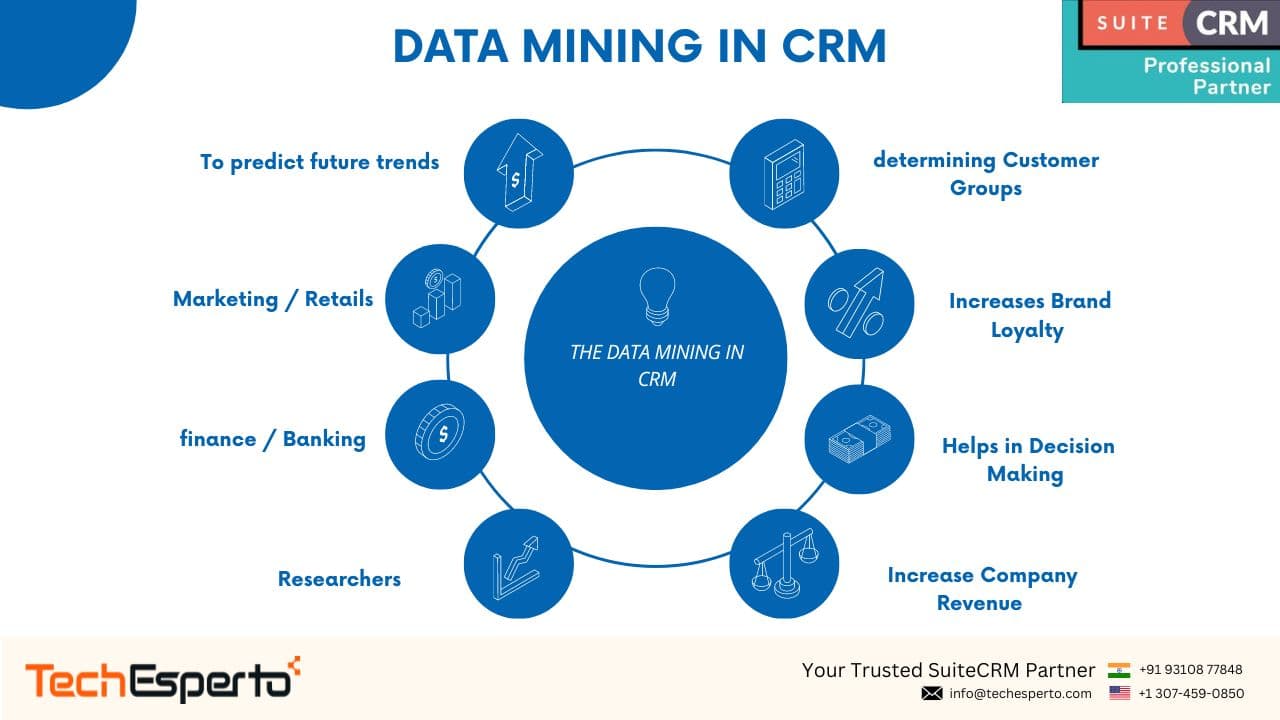
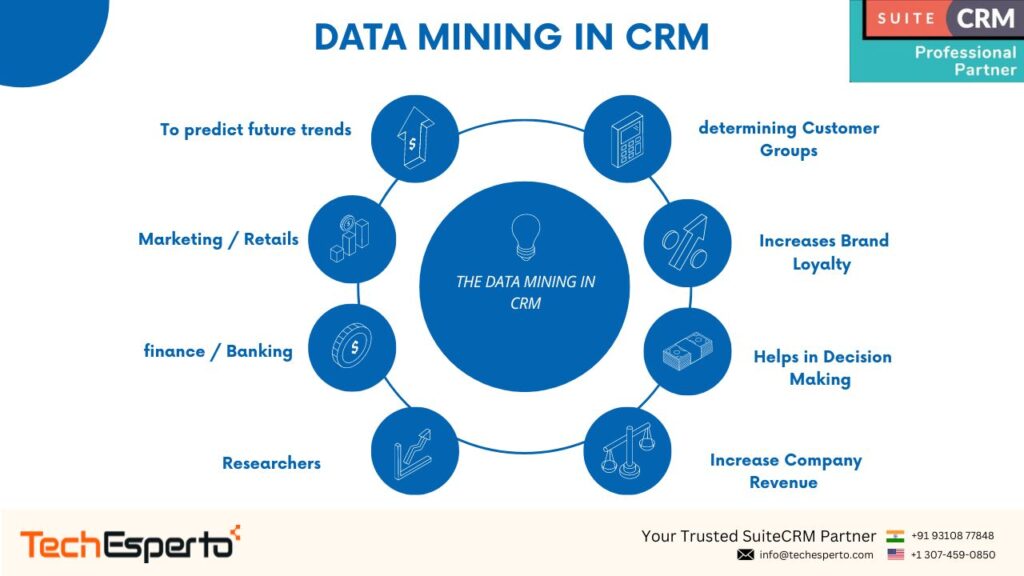
Data mining in CRM (Customer Relationship Management) is the technique of extracting valuable, actionable insights from large volumes of customer data. By analyzing patterns, trends, and behaviors hidden inside your CRM, data mining helps businesses make better decisions, optimize customer interactions, and improve retention and revenue.
In this guide, we’ll explain what data mining in CRM is, the core techniques, the business benefits, real-world use cases — and how modern AI turns CRM data mining from a quarterly analyst project into a continuous, automated advantage inside platforms like SuiteCRM.
Quick answer: Data mining in CRM uses techniques like clustering, classification, association, and regression to segment customers, predict behavior (including churn), and personalize marketing — turning raw CRM data into revenue. With AI, these techniques now run automatically and continuously.
👉 Book a free AI CRM & analytics consultation
What Is Data Mining in CRM?
Data mining is the process of analyzing large datasets to discover meaningful patterns, trends, and relationships that deliver business insight. In CRM, data mining sifts through your contacts, deals, activities, support tickets, and purchase history to surface information you can act on — for decision-making, sharper marketing, and personalized customer experiences.
Common data mining techniques in CRM include clustering, classification, association, and regression, which let businesses segment customers, predict behaviors, and optimize marketing. The richer and cleaner your CRM data, the more powerful the results — which is why a well-structured, well-integrated CRM is the foundation. (See our guide on creating custom dashboards and reports in SuiteCRM.)
Benefits of Data Mining in CRM
1. Improved Customer Segmentation
Data mining groups customers into distinct segments based on shared behaviors, preferences, and demographics — enabling targeted campaigns with personalized messages and offers. Better segmentation means higher engagement and satisfaction.
2. Predicting Customer Behavior
By analyzing historical data, data mining predicts future behaviors — purchasing patterns, product preferences, and churn likelihood. Predictive modeling lets you proactively address needs and design personalized offers, improving retention and sales. (This is the foundation of AI lead scoring.)
3. Personalized Marketing
Understanding individual preferences lets you deliver relevant product recommendations, targeted email campaigns, and customized promotions — dramatically improving marketing effectiveness. Pair it with SuiteCRM marketing automation to act on the insights automatically.
4. Optimizing Sales & Marketing Strategy
Data mining identifies the most effective channels, sales tactics, and customer touchpoints. By analyzing customer journeys, you can adjust strategy to maximize ROI, allocate resources better, and focus on high-value leads.
5. Enhancing Customer Retention
Data mining surfaces early warning signs of dissatisfaction or churn. Recognizing those patterns early lets you intervene with personalized retention efforts and reduce churn — boosting long-term loyalty and lifetime value. (See customer lifetime value.)
Core Data Mining Techniques in CRM
Clustering
Groups customers with similar characteristics into segments — frequent buyers, budget-conscious shoppers, high-spenders — enabling targeted strategies for each group.
Classification
Categorizes customers by predefined criteria (customer value, purchase history, engagement level) to personalize marketing and prioritize interactions.
Association
Finds relationships between variables — such as products frequently bought together — to drive cross-sell and upsell recommendations that lift revenue per customer.
Regression
Predicts the likelihood of future behaviors from historical data — for example, how likely a customer is to buy after an email campaign — so you can fine-tune communications.
How AI Has Changed CRM Data Mining
Traditional data mining was a periodic project: export data, run analysis, deliver a report that’s stale by the time anyone reads it. AI changes that. Inside a modern CRM, machine-learning models run continuously and automatically:
- AI lead scoring ranks every lead in real time by conversion probability. See our AI lead scoring guide.
- AI churn prediction flags at-risk customers before they leave, triggering retention workflows automatically.
- AI segmentation re-clusters your base dynamically as behavior changes — no quarterly analyst run required.
- AI next-best-action recommends the right offer or outreach for each customer.
This is exactly what we build for clients on top of SuiteCRM using OpenAI, Anthropic, or private open-weights models — your data, your control. See our AI for CRM 2026 guide and our AI CRM automation service.
How to Do Data Mining in SuiteCRM
SuiteCRM is an ideal foundation for CRM data mining because you fully own the data and the platform:
- Full data access. SuiteCRM runs on a standard MySQL/MariaDB database — your analysts and AI models can query it directly, no API throttling, no vendor gatekeeping.
- Built-in reporting + BI. Native reports and dashboards, plus the open-source SuiteCRM BI module for ETL and warehouse-style analytics. (See the SuiteCRM Store.)
- Custom fields & modules. Capture the exact data points you want to mine via SuiteCRM customization.
- Integrations. Pipe CRM data into Power BI, Tableau, or a data warehouse with SuiteCRM integration services.
- AI layer. Add predictive models for scoring, churn, and segmentation with AI CRM automation.
Unlike SaaS CRMs that lock your data behind paid analytics tiers, SuiteCRM gives you the raw material and the freedom to mine it however you want — at no license cost. (See why in SuiteCRM vs Salesforce.)
Conclusion
Data mining in CRM is essential for any business that wants to unlock the full value of its customer data. By applying clustering, classification, association, and regression — and increasingly, AI — companies gain sharper segmentation, accurate behavior prediction, personalized experiences, and stronger retention.
As customer data keeps growing, data mining (powered by AI) is becoming a decisive competitive advantage. The businesses that win are the ones that own their data, mine it continuously, and act on it automatically — which is exactly what an open-source, AI-ready CRM like SuiteCRM enables.
👉 Book a free AI CRM & analytics consultation with TechEsperto — we’ll show you how to turn your CRM data into predictions, automations, and revenue.
Frequently Asked Questions
What is data mining in CRM?
Data mining in CRM is the process of analyzing large volumes of customer data inside your CRM to discover patterns, trends, and relationships — using techniques like clustering, classification, association, and regression — to improve segmentation, predict behavior, personalize marketing, and reduce churn.
What are the main data mining techniques used in CRM?
The four core techniques are clustering (grouping similar customers), classification (categorizing by criteria), association (finding related behaviors for cross-sell/upsell), and regression (predicting future behavior). Modern AI adds continuous, automated versions of all four.
How does data mining improve customer retention?
By analyzing historical behavior, data mining identifies early warning signs of churn — declining engagement, support complaints, payment issues — letting you intervene with personalized retention efforts before the customer leaves. AI churn prediction automates this entirely.
Can SuiteCRM do data mining and predictive analytics?
Yes. SuiteCRM gives you full database access, native reporting, the SuiteCRM BI module, and the ability to add AI/ML models for scoring, churn prediction, and segmentation. Because it’s open-source, there’s no paywall on your own analytics. See our AI CRM automation service.
What’s the difference between traditional data mining and AI in CRM?
Traditional data mining is periodic and manual — export, analyze, report. AI runs continuously and automatically inside the CRM, scoring leads, predicting churn, and re-segmenting customers in real time as behavior changes.
Do I need a data scientist to do CRM data mining?
Not necessarily. Built-in CRM reporting and AI tools handle most use cases. For advanced predictive modeling, TechEsperto builds and deploys the models for you on top of SuiteCRM — no in-house data science team required.