Your sales team treats every lead the same. A CEO from a 500-person company who downloaded your pricing guide gets the same priority as a student writing a research paper. Both sit in the same queue. Both get the same follow-up timeline. Both consume the same rep time.
One will generate $50,000 in revenue. The other will generate $0. Your reps can’t tell which is which until they’ve spent hours qualifying both.
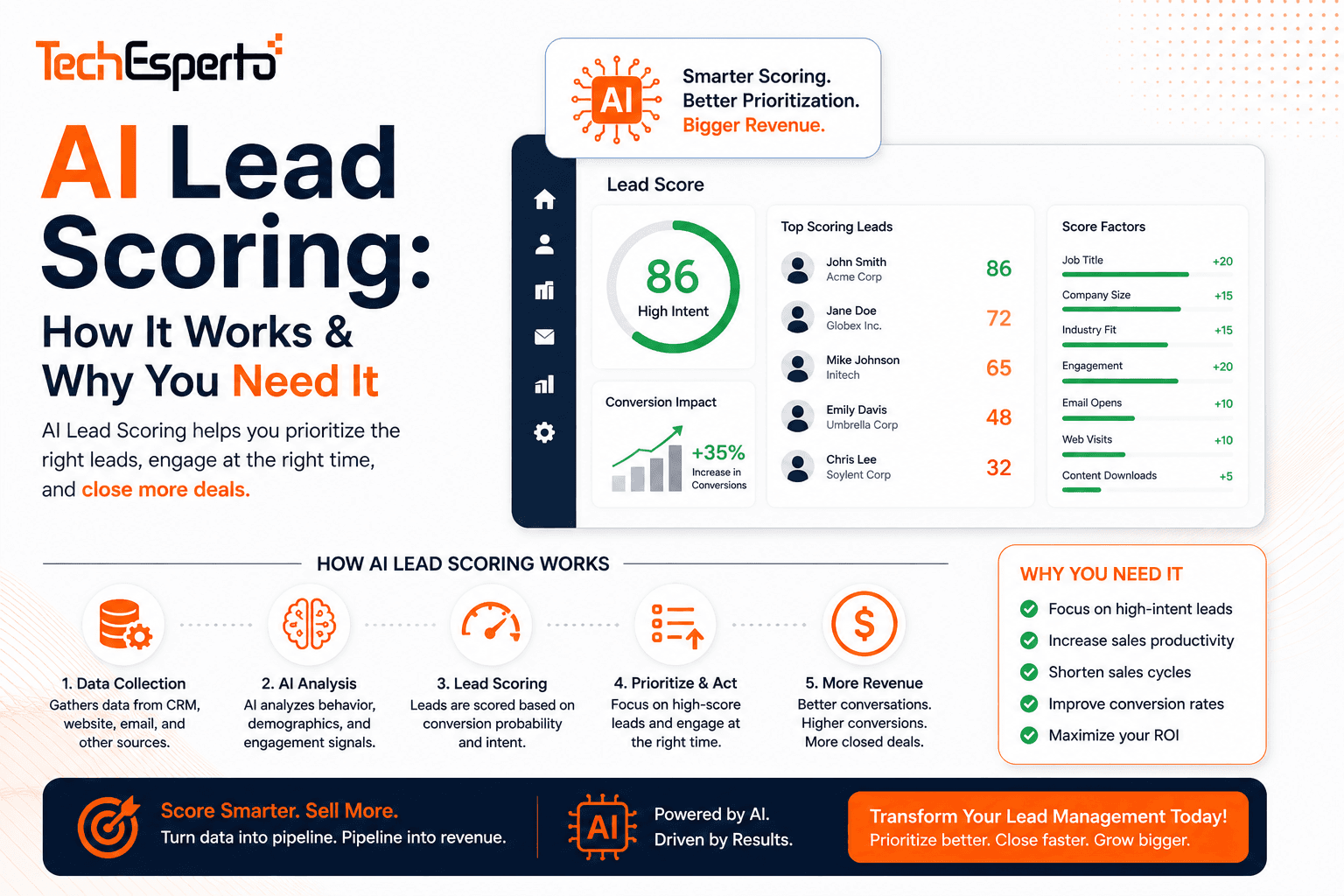
AI lead scoring fixes this. Every lead gets a conversion probability score (0–100) the moment it enters your CRM. High scores get fast-tracked. Low scores get nurtured automatically. Your reps spend 80% of their time on the 20% most likely to buy.
The result: 40–60% improvement in conversion rates. Not theory — measurable, repeatable results.
How Traditional Lead Scoring Works (And Why It Fails)
Traditional lead scoring uses static rules you define manually:
Job title = CEO → +20 points. Company size > 100 → +15 points. Downloaded pricing page → +10 points. Industry = healthcare → +10 points. Opened 3+ emails → +5 points.
Why it fails:
Rules are guesses. You assign point values based on what you THINK matters. But do CEOs actually convert better than VPs at your company? Does company size really correlate with deal size in your pipeline? You don’t know — you’re guessing.
Rules don’t adapt. Your market changes. Your product changes. Your buyer profile shifts. But your scoring rules stay frozen until someone manually updates them — which nobody does.
Rules miss patterns. The combination of “attended webinar + visited pricing page + from manufacturing industry + 50–200 employees + East Coast” might be your perfect buyer profile. No human creates a rule for that specific combination. AI finds it automatically.
How AI Lead Scoring Works
AI lead scoring uses machine learning — not static rules — to predict conversion probability.
Step 1: Train on Your Historical Data
The AI model analyzes your CRM’s historical leads — every lead that converted into a deal and every lead that didn’t. It examines hundreds of signals per lead: demographic data (job title, company size, industry, location), behavioral data (pages visited, emails opened, content downloaded, forms filled), source data (how the lead found you — webinar, Google, referral, cold outreach), timing data (day of week, time of day, speed of engagement), and engagement patterns (single visit vs multiple visits, content consumption depth).
Step 2: Identify Conversion Patterns
The model discovers patterns humans can’t see. Examples from real deployments:
“Leads from manufacturing companies with 50–200 employees who visit the pricing page within 48 hours of first website visit convert at 11x the average rate.”
“Leads from healthcare who attend a webinar AND download a case study within the same week close 3x faster than those who only do one.”
“Leads referred by existing customers convert at 8x the rate of cold outbound, regardless of company size or industry.”
No human would create rules this specific. AI finds these patterns by analyzing thousands of historical data points simultaneously.
Step 3: Score Every New Lead Automatically
When a new lead enters SuiteCRM, a Logic Hook fires — sending the lead’s attributes to the AI model. The model returns a score (0–100) that’s stored as a calculated field on the Lead record.
The score updates as the lead engages — opens an email (+3), visits pricing page (+12), attends a demo (+25). Real-time scoring via webhook events and Scheduler batch updates.
Step 4: Automate Actions Based on Score
Workflow automation routes leads based on AI score:
Score 80–100 (Hot): Assign to senior closer immediately. Create urgent follow-up task (call within 1 hour). Send personalized email from assigned rep. Alert sales manager.
Score 50–79 (Warm): Assign to standard rep pool. Create follow-up task (call within 24 hours). Add to active nurture campaign.
Score 20–49 (Cool): Add to automated email nurture sequence. No rep assignment — marketing handles until score rises. Re-score weekly.
Score 0–19 (Cold): Add to long-term drip campaign. No rep time invested. Archive after 90 days if no engagement.
Step 5: Learn and Improve
The model retrains monthly on new conversion data. As your business evolves — new products, new markets, new buyer profiles — the AI adapts automatically. Static rules can’t do this.
AI Scoring vs Rule-Based Scoring
| Factor | Rule-Based Scoring | AI Scoring |
| Setup | You define rules manually | AI learns from your data |
| Accuracy | Based on your guesses | Based on actual patterns |
| Adaptation | Manual updates (never happens) | Auto-retrains monthly |
| Complexity | Simple rules (5–10 factors) | Hundreds of factors analyzed |
| Hidden patterns | Misses combinations | Finds patterns humans can’t see |
| Time to value | Immediate but inaccurate | 2–4 weeks training, then highly accurate |
| Maintenance | Needs regular manual review | Self-improving |
What AI Lead Scoring Costs
Option A: Salesforce Einstein Lead Scoring
Requires Enterprise tier ($165/user/month minimum). For 20 sales reps: $165 × 20 = $39,600/year — and that’s just to GET the feature. Einstein scoring is a checkbox inside a $39,600 annual commitment. See all Salesforce hidden costs →
Option B: HubSpot Predictive Lead Scoring
Requires Professional tier ($90/user/month) or Enterprise ($150/user). For 20 users on Professional: $21,600/year. Full comparison →
Option C: SuiteCRM + TechEsperto AI Scoring
SuiteCRM licensing: $0. AI lead scoring integration: $5,000–$8,000 one-time. Ongoing AI API costs: $50–$200/month. Hosting: $100–$200/month.
Year 1 total: $7,000–$11,000. Year 2+: $2,000–$5,000/year.
| Platform | Year 1 | 3-Year Total |
| Salesforce Einstein | $39,600 | $118,800 |
| HubSpot Predictive | $21,600 | $64,800 |
| SuiteCRM + AI | $7,000–$11,000 | $11,000–$21,000 |
Savings vs Salesforce: $97,800–$107,800 over 3 years. On a single feature.
ROI: The Math That Sells Itself
Your current numbers (example): 100 leads/month × 10% conversion rate = 10 deals/month × $15,000 average deal = $150,000/month revenue.
With AI lead scoring (+40% conversion): 100 leads/month × 14% conversion rate = 14 deals/month × $15,000 = $210,000/month revenue.
Additional revenue: $60,000/month = $720,000/year.
AI scoring cost: $5,000–$8,000 one-time. Payback period: under 2 weeks.
Even at conservative 20% improvement: $360,000/year additional revenue. Payback: under 1 month.
Your numbers will differ.Contact us for a custom ROI projection using your actual pipeline data.
Industry-Specific AI Scoring
AI scoring works for every industry — but the signals differ:
Healthcare: Score provider leads by practice size, specialty, patient volume, and EHR system. HIPAA-compliant with self-hosted AI.
Insurance: Score by policy type, premium potential, number of policies, and renewal timing.
Construction: Score by project size, bid frequency, subcontractor volume, and geographic coverage.
Recruitment: Score client leads by hiring volume, industry, fee potential, and engagement frequency.
Automotive: Score by purchase timeline, trade-in status, financing preference, and vehicle interest.
Accounting: Score by entity type, revenue size, service complexity, and referral source.
Real estate: Score by budget range, pre-approval status, timeline urgency, and property type preference.
How TechEsperto Builds It
Week 1–2: Data Analysis
We audit your SuiteCRM data — lead volume, conversion history, field completeness, and data quality. Minimum requirements: 500+ historical leads with known outcomes (converted vs didn’t). More data = more accurate model.
Week 2–3: Model Training
Custom ML model trained on YOUR conversion patterns. We test multiple algorithms, validate accuracy against holdout data, and select the highest-performing model.
Week 3–4: Integration
Model connected to SuiteCRM via Logic Hooks (real-time scoring on lead creation/update) and Scheduler (batch rescoring). Score field added to Lead records via Studio. Workflows configured for score-based routing. Dashboard widgets showing score distribution and conversion by score band.
Week 4: Training & Go-Live
Train sales reps on using AI scores in daily workflow. Train managers on score-based reporting. Go live. Monitor accuracy for 30 days and fine-tune.
Total timeline: 4 weeks. Total cost: $5,000–$8,000.
Data Privacy: Your Scoring, Your Servers
Unlike Salesforce Einstein and SugarAI which process your lead data through vendor cloud AI, TechEsperto offers self-hosted AI scoring. The ML model runs on YOUR infrastructure. Lead data never leaves your servers. Critical for HIPAA healthcare, legal firms, financial services, and any business with GDPR requirements.
No SaaS CRM offers self-hosted AI. SuiteCRM with TechEsperto does. Read more about our AI solutions.
Get AI Lead Scoring in 4 Weeks
Step 1: Free AI assessment (15 minutes). We evaluate your lead volume, data quality, and expected ROI. No cost, no commitment.
Step 2: We build it. Model training, SuiteCRM integration, workflow configuration, and dashboard setup. 4 weeks, $5,000–$8,000.
Step 3: You sell more. Reps call the right leads first. Conversion improves 40–60%. AI pays for itself in weeks.
Book your free AI assessment →
FAQs
Q: How much data do I need for AI scoring? Minimum 500 historical leads with outcomes. 2,000+ leads produces more accurate models. If you have less, we start with enhanced rule-based scoring and transition to ML as data accumulates.
Q: How accurate is AI lead scoring? Typical accuracy: 75–85% for predicting which leads will convert. Improves over time as the model retrains on new data. Far more accurate than gut feeling or static rules.
Q: Does AI replace my sales reps? No. AI tells reps WHO to call. Reps still make the call, build the relationship, and close the deal. AI eliminates wasted time on low-probability leads.
Q: Can AI scoring work with my existing SuiteCRM? Yes. Integrates via Logic Hooks in the custom/ directory — upgrade-safe and non-destructive to your existing configuration.
Q: What if AI scores a lead wrong? It will sometimes — no model is 100% accurate. But AI is right 75–85% of the time vs gut feeling at 50% or less. Over hundreds of leads, the improvement is massive.
Q: Is my lead data safe? With self-hosted AI: completely safe on your servers. With cloud AI APIs: we configure data minimization — only essential fields sent for scoring, not full records.
Q: Can I start with just scoring and add more AI later? Absolutely. Most clients start with lead scoring, validate ROI in 30 days, then add deal prediction, email AI, or chatbot incrementally.
Q: What’s the first step?Contact usfor a free 15-minute AI assessment. We’ll tell you if your data supports AI scoring and project your specific ROI.