Customer Lifetime Value is one of the most useful metrics in business and one of the most consistently calculated wrong. The number gets quoted in board decks, used to justify customer acquisition spend, and referenced in retention discussions — often based on calculations that overstate value, ignore key costs, or use averages in ways that hide important variation.
A CRM that captures CLV correctly transforms how a business thinks about customers, segments markets, and prioritizes investment. A CRM that captures CLV incorrectly produces confident decisions based on misleading numbers — which is worse than not tracking it at all.
This article walks through what Customer Lifetime Value actually is, how to calculate it correctly, common mistakes that produce misleading numbers, how to use it operationally, and what your CRM should do to support honest CLV measurement. Written for marketing and revenue leaders, finance teams, and operations leaders who use CLV in actual business decisions.
What CLV Actually Means
Customer Lifetime Value is the total profit a customer generates over the entire duration of their relationship with your business, accounting for the cost of serving them and the time value of money.
Three components matter:
1. Revenue from the customer. Initial purchase plus all subsequent purchases, renewals, upsells, expansions over the customer’s tenure.
2. Cost of serving the customer. Customer service costs, account management costs, infrastructure costs, payment processing costs, and (controversially) marketing costs to retain them.
3. Time value of money. A dollar earned this year is worth more than a dollar earned in year 5. Properly calculated CLV discounts future cash flows to present value.
What CLV is NOT:
- It’s not just revenue. Revenue minus costs is what matters.
- It’s not just gross margin. Gross margin per transaction doesn’t capture retention behavior.
- It’s not a fixed number. CLV is probabilistic — different customers have different lifetimes, different expansion rates, different retention probabilities.
- It’s not the same as Average Revenue Per User (ARPU). ARPU is a snapshot; CLV is a projection over time.
The proper formal definition: CLV is the expected present value of all future cash flows from a customer relationship.
For broader CRM measurement context, see our glossary covering related metrics like the lead glossary entry, sales pipeline glossary entry, and lead scoring glossary entry.
The Three Calculation Approaches
Three approaches exist for calculating CLV. Each has tradeoffs.
Approach 1: Simple Historic Average
CLV = (Average Order Value × Purchase Frequency × Customer Lifespan) − Acquisition Cost
Pros: Easy to calculate. Uses data you already have. Good enough for high-level planning.
Cons: Treats all customers as average. Ignores variation. Backward-looking (uses past behavior to predict future). Doesn’t account for time value of money.
When it’s useful: Initial CLV measurement when you’re starting from zero. Quick approximations. Cohort-level analysis.
When it’s misleading: When customer behavior varies meaningfully (it always does). When customers are segmenting into “fast churners” and “long stayers” — the average obscures both.
Approach 2: Cohort-Based Calculation
Group customers by acquisition month or year, track each cohort’s behavior over time, calculate retention curves and expansion rates per cohort. Project CLV based on cohort patterns.
Pros: Captures real variation between cohorts. Reflects changes in product, pricing, or market conditions over time. Standard in SaaS and subscription businesses.
Cons: Requires meaningful historical data (typically 18+ months). More complex to calculate. Requires consistent cohort definitions.
When it’s useful: SaaS, subscription businesses, any business with recurring revenue. Tracking impact of product changes on customer economics.
When it’s misleading: When cohorts are too small for statistical significance. When the business model has changed significantly between cohorts.
Approach 3: Predictive CLV (Machine Learning)
Train a model on historical customer data to predict CLV for each individual customer based on early behavioral signals (first 90 days of engagement patterns, support ticket frequency, feature usage, payment patterns).
Pros: Most accurate. Captures individual customer variation. Enables operational use cases (high-CLV customer identification at signup).
Cons: Requires substantial historical data. Requires ML capability. Risk of overfitting to historical patterns that don’t hold in future.
When it’s useful: Mature businesses with rich behavioral data. Operational use cases where per-customer prediction matters more than population averages.
When it’s misleading: When training data isn’t representative of future customers. When model isn’t regularly retrained.
For AI/ML approaches specifically, see our Complete Guide to AI for CRM in 2026, AI Lead Scoring Guide, AI in CRM 10x Sales Revenue, and our AI for SuiteCRM service.
Five Common CLV Mistakes
Five errors that produce misleading CLV numbers. We see all of them regularly.
Mistake 1: Using Gross Revenue Instead of Contribution Margin
CLV calculated on revenue alone overstates value by 40–70% in most businesses. Customer service costs, payment processing fees, infrastructure costs, and account management time are real costs of serving customers and need to come out before you have “customer value.”
Fix: Use contribution margin (revenue minus variable cost of service) rather than revenue.
Mistake 2: Ignoring Retention Variation
A business with 90% annual retention and a business with 70% annual retention have wildly different CLV at the same revenue per customer. Using overall company retention as the input misses meaningful segment-level variation.
Fix: Calculate retention separately by segment, plan, or cohort. Combine into weighted CLV.
Mistake 3: Using Mean Instead of Median
CLV distributions are usually long-tailed. A few high-value customers pull the mean up dramatically while most customers are below it. Mean CLV overstates “typical customer” value.
Fix: Use median CLV for planning, mean CLV for revenue projection. Both numbers tell different parts of the story.
Mistake 4: Not Discounting Future Cash Flows
A customer projected to generate $50,000 over 7 years isn’t worth $50,000 today. Standard discount rates (8–12% for most businesses) reduce that to $30,000–$35,000 present value. Ignoring this overstates CLV.
Fix: Apply appropriate discount rate. Use higher rates for higher-risk customer segments.
Mistake 5: Confusing Average Lifespan With Expected Lifespan
These are different. Average lifespan (mean of customers who have churned) is backward-looking and biased toward early churners. Expected lifespan (probabilistic projection based on retention curves) is forward-looking and more accurate.
Fix: Use cohort retention curves to calculate expected lifespan, not just past churn data.
For CRM data quality patterns that affect CLV measurement reliability, see our CRM Audit Checklist, Signs Your CRM Is Costing You Money, and CRM Not Working Fixes.
How to Use CLV Operationally
CLV is most useful when it drives operational decisions, not just board slides. Five use cases that genuinely matter.
Use Case 1: Customer Acquisition Cost (CAC) Targets
CLV / CAC ratio is the standard benchmark for marketing efficiency. Healthy businesses target CLV:CAC of 3:1 or higher. Below that, acquisition spend is consuming customer value. Above 5:1, you may be underinvesting in growth.
CLV gives you the upper bound for justified CAC spending. Per-segment CLV gives you per-segment CAC targets.
For broader marketing/sales alignment context, see marketing automation glossary entry, SuiteCRM Marketing Automation page, and CRM Automations Every Business.
Use Case 2: Customer Segmentation Investment
Different customer segments have dramatically different CLV. Knowing this allows differentiated investment — high-CLV segments get dedicated success management, lower-CLV segments get scaled self-service.
The mistake is treating all customers equally when CLV varies 10x between segments. The discipline is matching investment to expected return.
Use Case 3: Retention Investment Decisions
When a customer shows churn signals, how much should you spend trying to save them? CLV gives you the answer — spend up to (but not exceeding) the present value of saving them, weighted by probability of success.
Without CLV, retention investments are arbitrary. With CLV, they’re rational.
For broader retention/customer success context, see SuiteCRM for Customer Support and SuiteCRM Customer Portal Setup.
Use Case 4: Pricing Strategy
CLV reveals which pricing structures produce best long-term value. A higher-priced plan with lower retention may have lower CLV than a moderately-priced plan with higher retention. Without CLV measurement, this isn’t visible.
Use Case 5: Sales Compensation Design
Commission structures based on closed revenue often reward acquiring poorly-fit customers who churn quickly. Compensation based on CLV-aligned signals (12-month retention bonus, expansion bonus) aligns sales behavior with business value.
For sales compensation operationalization, this requires CLV data flowing back into the CRM. See SuiteCRM Workflow Automation Complete Guide for 2026 and SuiteCRM Custom Workflow Automation.
What Your CRM Should Do for CLV
Five CRM capabilities that support honest CLV measurement and operational use.
Capability 1: Granular Transaction History
CLV calculation requires accurate transaction history per customer. Initial sale, renewals, expansions, downgrades, refunds, churn — all with accurate dates and amounts. CRM that captures this cleanly is foundational; CRM that loses transaction history forces CLV calculation in spreadsheets.
Capability 2: Customer Cost Attribution
Beyond revenue, CRM needs to capture (or integrate with systems that capture) customer service costs, account management time, support ticket volume per customer. These feed the cost side of CLV.
Capability 3: Cohort and Segment Tagging
Customers tagged by acquisition cohort, segment, plan tier, vertical — whatever segmentation your business uses. Without this, cohort-based CLV analysis isn’t possible.
Capability 4: Custom Field for CLV Tracking
Per-customer CLV value (whether calculated or imported from BI tools) needs to live on the customer record. Customer success managers, sales teams, and operations teams reference it in daily work.
For CRM customization to support this, see SuiteCRM Custom Fields Guide, SuiteCRM Customization service, and SuiteCRM Calculated Fields and Formulas.
Capability 5: Reporting and Dashboards With CLV Cuts
CLV by segment, CLV by cohort, CLV by plan, CLV trends over time. Executive dashboards need these views. Operational dashboards need per-customer CLV for daily decisions.
For reporting approaches, see How to Create Custom Dashboards and Reports in SuiteCRM and SuiteCRM Workflows Themes Customization Guide.
CLV Variation by Industry
CLV economics look meaningfully different across industries.
B2B SaaS: CLV typically 3–10x annual contract value (ACV) for healthy businesses. Net revenue retention above 100% can push CLV substantially higher. See SaaS CRM solutions, Build vs Buy CRM for SaaS, SuiteCRM vs Salesforce for Small Business, and Self-Hosted vs Cloud CRM.
Healthcare: CLV calculation more complex due to patient lifecycle (decades), insurance reimbursement variation, and treatment-cycle economics. Specialty clinics often have specific procedural CLV plus relationship CLV. See Healthcare CRM solutions and healthcare CRM guide.
FinTech / Financial Services: CLV often dominated by lifetime financial relationship value — initial product plus cross-sells plus retention over decades. Compliance considerations affect CLV-driven targeting. See FinTech CRM solutions, Finance CRM solutions, and FinTech CRM guide.
Manufacturing: Distributor-level CLV plus end-customer CLV. Distributor CLV often more important operationally because the distributor relationship drives multi-year purchase patterns. See Manufacturing CRM solutions and manufacturing CRM guide.
E-commerce / D2C: CLV variation is enormous (one-time vs. subscription vs. high-frequency repeat). Segmentation matters more here than in any other vertical. See Ecommerce CRM solutions and SuiteCRM for Retail.
Real Estate: Transactional CLV (commission per transaction) plus relationship CLV (referrals from past clients over time). See Real Estate CRM solutions and SuiteCRM for Real Estate.
Insurance: Multi-product CLV (auto + home + life over decades). Renewal economics dominate. See Insurance CRM solutions and SuiteCRM for Insurance.
How to Start Measuring CLV
Five steps in order, executable in 4–6 weeks.
Step 1: Define What “Customer” Means
Sounds obvious but isn’t. A SaaS company might define a customer as the account, the contract, or the buying group. An e-commerce business might define a customer as an email address, a household, or a purchase identity. Definition affects everything downstream.
Step 2: Audit Your Transaction Data Quality
Pull 18+ months of transaction data. Verify completeness, accuracy, and consistency. CLV built on incomplete or inconsistent data is unreliable. Cleaning data is often 20–40% of the total CLV measurement effort.
Step 3: Choose Your Calculation Approach
Match approach to data availability. New businesses use simple historic average. Established businesses with cohort data use cohort-based. Mature businesses with rich behavioral data use predictive.
Step 4: Build the Calculation in Your BI Tool
Spreadsheet for initial validation. Production CLV calculation in a BI tool (Looker, Tableau, Power BI, Metabase) connected to your data warehouse. Output flows back into CRM custom fields for operational use.
Step 5: Operationalize CLV in CRM
Per-customer CLV visible on customer records. Segment-level CLV in dashboards. Workflow rules using CLV (high-CLV customer routing, retention investment thresholds). Sales and customer success teams trained on CLV usage.
A free 30-minute CRM strategy call covers how to operationalize CLV in your specific CRM setup. No pitch, no commitment.
How accurate does CLV need to be?
Depends on use case. High-level planning works fine with ±20% accuracy. Operational decisions (which customers to invest in) benefit from ±10% accuracy. Individual customer predictions need higher accuracy. Don’t pursue accuracy beyond what your decisions require.
What if our business is too new to have meaningful retention data?
Use industry benchmarks for retention curves initially. Adjust as your own data accumulates. Even 6 months of retention data is enough to start; 18+ months gives much more confident projections.
Should we track LTV or CLV?
Same thing, different acronyms. “Lifetime Value” and “Customer Lifetime Value” are used interchangeably. LTV is more common in SaaS; CLV more common in marketing literature. Don’t get stuck on terminology.
How does CLV relate to MRR/ARR?
MRR/ARR are snapshots; CLV is a projection over time. A customer at $1,000/month MRR could have CLV of $20,000 (low retention) or $150,000 (high retention). MRR/ARR measure current state; CLV measures expected long-term value.
Should CLV calculation include acquisition cost?
Two views. CLV excluding CAC measures customer value to the business. CLV including CAC (sometimes called “Net CLV”) measures profitability per customer including the cost to acquire them. Use both for different decisions — CLV alone for retention thresholds, Net CLV for unit economics evaluation.
How does AI improve CLV measurement?
AI enables predictive CLV at the individual customer level. Rather than assuming all customers in a segment have segment-average CLV, AI models can predict per-customer CLV based on early behavioral signals. Useful when customer variation within segments is high.
For broader AI applications in CRM, see Complete Guide to AI for CRM in 2026, AI CRM Cost analysis, AI CRM Cost ROI, and AI Chatbots for CRM Lead Capture.
What’s the role of customer success in CLV?
Substantial. Customer success teams are responsible for retention and expansion — the two dominant drivers of CLV beyond initial sale. CLV measurement is how you justify customer success investment and prioritize where customer success focuses its effort.
Can CRM alone calculate CLV?
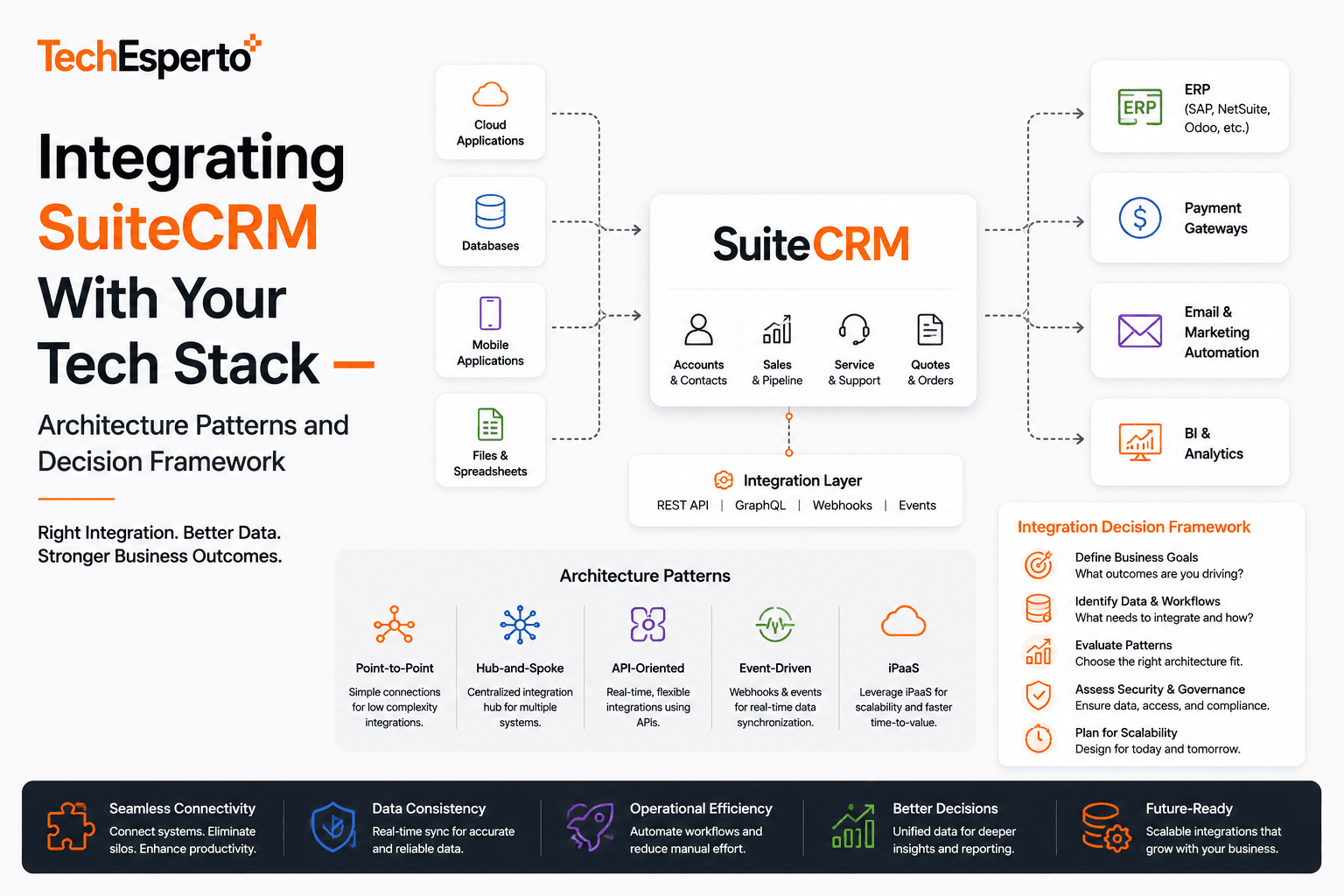
Not really. CRM holds the data inputs but proper CLV calculation usually involves a BI tool or data warehouse. CRM is where CLV gets surfaced operationally; calculation happens elsewhere. The integration between CRM and BI/warehouse is the architectural piece that makes operational CLV work. See SuiteCRM Integration service, CRM Integration Guide, and SuiteCRM REST API Guide.
How does CLV affect CRM platform choice?
Indirectly but meaningfully. CRM platforms that constrain customization, reporting, or integration depth constrain CLV operationalization. Open-source CRM platforms with full customization access give more flexibility for CLV-driven workflows. See Build vs Buy CRM framework, Best Open Source CRM Software, SuiteCRM vs Salesforce comparison, and Salesforce Hidden Costs analysis.
How do we get started with CLV measurement?
Book a free 30-minute CRM strategy call — we’ll walk through your specific situation (current CRM, data quality, segmentation needs) and give you a candid roadmap for getting CLV operational in your CRM. No pitch, no commitment.
For broader context: Ultimate CRM Buying Guide for 2026, CRM for Small Business Guide, Is Your Business Ready for CRM, 5 Signs You Need a CRM Partner, TCO glossary entry, SaaS glossary entry, and CRM glossary entry.
Frequently Asked Questions
Depends on use case. High-level planning works fine with ±20% accuracy. Operational decisions (which customers to invest in) benefit from ±10% accuracy. Individual customer predictions need higher accuracy. Don’t pursue accuracy beyond what your decisions require.
Use industry benchmarks for retention curves initially. Adjust as your own data accumulates. Even 6 months of retention data is enough to start; 18+ months gives much more confident projections.
Same thing, different acronyms. “Lifetime Value” and “Customer Lifetime Value” are used interchangeably. LTV is more common in SaaS; CLV more common in marketing literature. Don’t get stuck on terminology.
MRR/ARR are snapshots; CLV is a projection over time. A customer at $1,000/month MRR could have CLV of $20,000 (low retention) or $150,000 (high retention). MRR/ARR measure current state; CLV measures expected long-term value.
Two views. CLV excluding CAC measures customer value to the business. CLV including CAC (sometimes called “Net CLV”) measures profitability per customer including the cost to acquire them. Use both for different decisions — CLV alone for retention thresholds, Net CLV for unit economics evaluation.
AI enables predictive CLV at the individual customer level. Rather than assuming all customers in a segment have segment-average CLV, AI models can predict per-customer CLV based on early behavioral signals. Useful when customer variation within segments is high.
For broader AI applications in CRM, see Complete Guide to AI for CRM in 2026, AI CRM Cost analysis, AI CRM Cost ROI, and AI Chatbots for CRM Lead Capture.
Substantial. Customer success teams are responsible for retention and expansion — the two dominant drivers of CLV beyond initial sale. CLV measurement is how you justify customer success investment and prioritize where customer success focuses its effort.
Not really. CRM holds the data inputs but proper CLV calculation usually involves a BI tool or data warehouse. CRM is where CLV gets surfaced operationally; calculation happens elsewhere. The integration between CRM and BI/warehouse is the architectural piece that makes operational CLV work. See SuiteCRM Integration service, CRM Integration Guide, and SuiteCRM REST API Guide.
Indirectly but meaningfully. CRM platforms that constrain customization, reporting, or integration depth constrain CLV operationalization. Open-source CRM platforms with full customization access give more flexibility for CLV-driven workflows. See Build vs Buy CRM framework, Best Open Source CRM Software, SuiteCRM vs Salesforce comparison, and Salesforce Hidden Costs analysis.
Book a free 30-minute CRM strategy call — we’ll walk through your specific situation (current CRM, data quality, segmentation needs) and give you a candid roadmap for getting CLV operational in your CRM. No pitch, no commitment.
For broader context: Ultimate CRM Buying Guide for 2026, CRM for Small Business Guide, Is Your Business Ready for CRM, 5 Signs You Need a CRM Partner, TCO glossary entry, SaaS glossary entry, and CRM glossary entry.