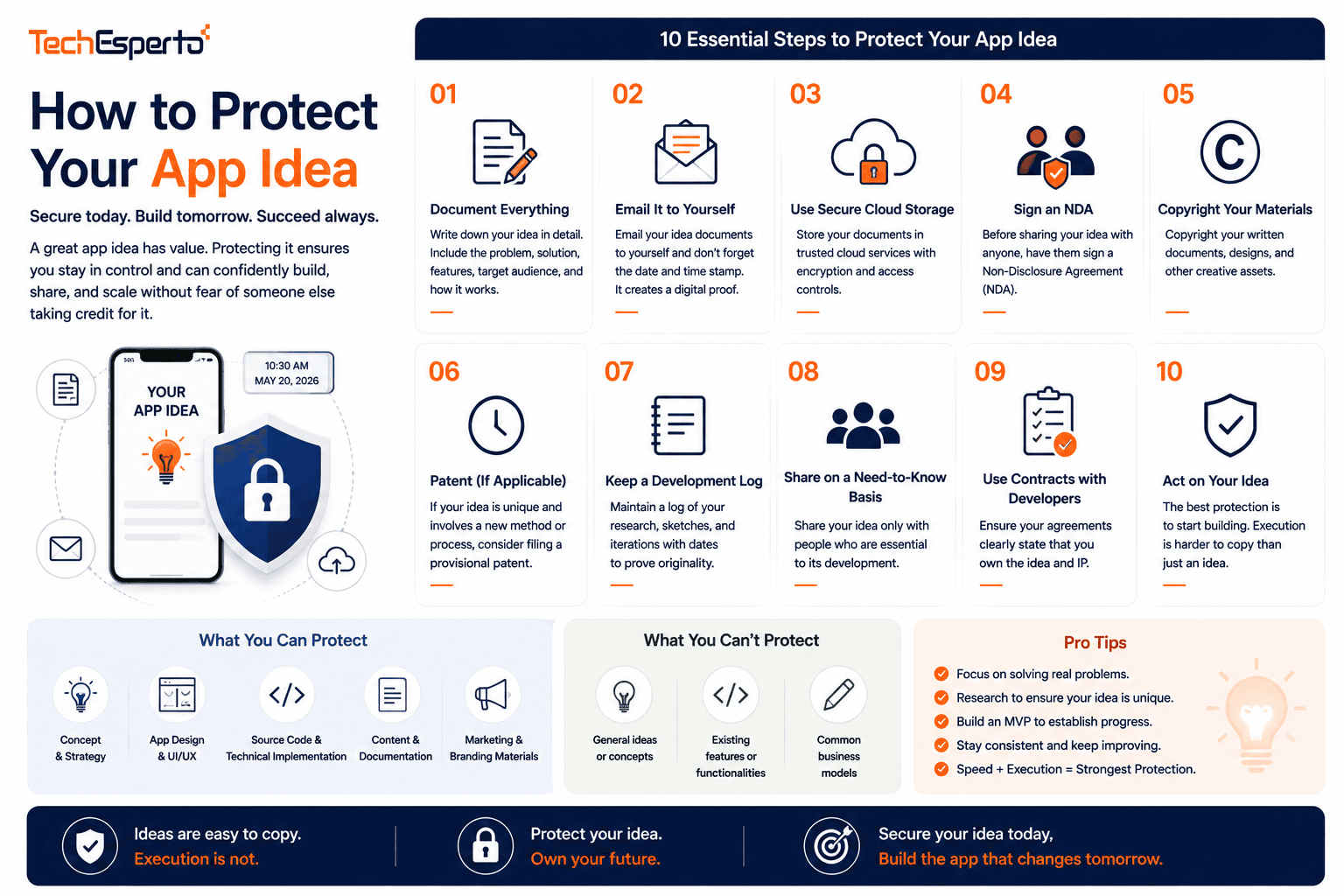
Founders asking how to protect their app idea usually worry about the wrong risk. Ideas are rarely stolen, because executing one is far harder than having it, and the parties best placed to steal are the ones least motivated to. The genuine exposure is different and more mundane: not owning the code you paid for, losing your brand name to someone who registered it first, or signing a development contract that leaves ownership ambiguous. This guide covers the protections that actually matter.
Understanding What Can and Cannot Be Protected
Legal protection attaches to expression and identity rather than to concepts. You cannot own the idea of a delivery app, but you can own the code that implements yours, the brand under which you sell it, and in narrow cases a novel technical method. Understanding this distinction prevents both wasted effort protecting what cannot be protected and neglect of the things that genuinely can be. It also explains why secrecy is a weak strategy compared with building and registering.
Ideas Themselves Are Not Protectable
Concepts, business models, and app categories fall outside intellectual property protection. Someone can build a competing product in your category lawfully, provided they write their own code and use their own branding.
Code Is Protected by Copyright
Source code is protected as a literary work from creation. This prevents copying your implementation, though it does not prevent someone independently building similar functionality.
Brand Identity Is Protected by Trademark
Your name, logo, and distinctive branding can be registered. This is frequently the most valuable protection available, since it prevents confusion in the market where customers actually make choices.
Novel Methods May Be Patentable
Genuinely new technical processes can sometimes be patented, though software patents are expensive, slow, and narrower than founders expect. Most applications do not contain anything qualifying.
Confidential Information Is Protected by Contract
Business plans, customer data, and technical specifics can be protected through agreements. This is contractual rather than proprietary protection, and it depends entirely on the terms you sign.
Getting Ownership Right With Your Development Partner
This is where founders most often discover a problem, sometimes years later during due diligence. In many jurisdictions, code written by a contractor belongs to the contractor by default unless the agreement assigns it otherwise. Founders assume that paying for work means owning it, which is true for employees in most cases and frequently not true for external developers. Confirming assignment before work begins is straightforward. Fixing it afterwards depends on the other party’s cooperation.
Requiring Explicit IP Assignment
The contract must state that all work product transfers to you on creation or payment. Silence on ownership is not neutral; it usually favours the party who wrote the code.
Covering Contractors and Subcontractors
Assignment must flow through everyone who touched the code, including subcontractors your partner engaged. Gaps here surface during investor diligence and are difficult to close retroactively.
Securing Access to Repositories and Accounts
Ownership means nothing without possession. Ensure you hold administrative access to source control, hosting, and store accounts rather than relying on your partner’s goodwill.
Clarifying Reusable Components
Development partners legitimately reuse internal libraries. Understand what is assigned to you and what is licensed, and confirm the licence permits everything you plan to do commercially.
Choosing Partners With Clear Terms
Engagement structures should state ownership plainly. Reviewing available engagement models before contracting avoids ambiguity that only becomes expensive later.
Using NDAs Sensibly
Non-disclosure agreements have a place, but founders overestimate both their protective value and how readily others will sign them. Most established development firms will sign one routinely. Most investors will not, because reviewing many similar businesses makes blanket confidentiality obligations impractical for them. Understanding where an NDA genuinely helps, and where insisting on one simply signals inexperience, saves time and preserves relationships you need.
Using NDAs With Development Partners
Vendors receiving your specifications, data, and technical detail should sign. This is standard practice and refusal from a development firm would be unusual.
Not Expecting Investors to Sign
Early-stage investors generally decline NDAs for structural reasons. Share what is needed to evaluate the opportunity and hold back genuinely sensitive operational detail.
Keeping Terms Reasonable
Overly broad agreements covering all information indefinitely are less likely to be signed and less likely to be enforced. Define the confidential information and set a sensible duration.
Recognising Enforcement Limits
An NDA gives you a claim, not prevention. Enforcement requires proving disclosure and quantifying harm, both of which are expensive. Treat it as deterrence rather than as a barrier.
Protecting Data Alongside Ideas
Where partners handle user data, confidentiality overlaps with regulatory obligation. Data protection terms matter more than concept secrecy in most software development arrangements.
Prioritising Execution Over Secrecy
The practical protection for most products is being further along than anyone considering copying you. Users, data, integrations, and brand recognition accumulate into an advantage that a competitor starting from your idea cannot quickly replicate. Founders who delay building to perfect legal protection frequently arrive at a well-protected concept that someone else has already commercialised. The sensible sequence is to secure ownership and brand, then move.
Registering Your Brand Early
Trademark registration is comparatively cheap and prevents the genuinely damaging outcome of losing your name after building recognition around it. Do this before launch rather than after.
Building the Advantage That Compounds
Users, data, and integrations create switching costs that no legal instrument provides. Reaching market through MVP development builds this faster than protection work does.
Documenting Your Development History
Keep records of when work was created and by whom. Version control history serves this purpose and is useful evidence should ownership ever be disputed.
Securing Domains and Handles Immediately
These cost little and are difficult to recover once taken. Register them as soon as you settle on a name, before any public discussion of the product.
Taking Advice Proportionate to Stakes
An hour with a qualified attorney reviewing your development contract costs far less than resolving an ownership dispute during a funding round or acquisition.
Frequently Asked Questions
Can someone steal my app idea?
They can build something similar lawfully, since ideas are not protected. What they cannot do is copy your code or use your brand. In practice, execution advantage protects most products more effectively than secrecy, because building well is harder than conceiving.
Do I own the code if I pay a developer to write it?
Not automatically in many jurisdictions. Contractor-written code frequently belongs to the contractor unless the agreement explicitly assigns it. Confirming assignment before work starts is essential, and discovering the gap during investor diligence is a common and avoidable problem.
Should I patent my app?
Usually not. Software patents are expensive, slow, and narrow, and most applications contain nothing novel enough to qualify. Copyright in your code and trademark in your brand deliver more practical protection for a fraction of the cost.
Will developers sign an NDA?
Established development firms generally will, and it is reasonable to ask. Investors typically will not, because evaluating many similar businesses makes broad confidentiality obligations impractical for them, and insisting can signal inexperience.
What is the most important protection for a new app?
Clear IP assignment in your development contract, followed by trademark registration for your brand. These address the two exposures that genuinely damage founders, while concept secrecy addresses a risk that rarely materialises.
When should I register a trademark?
Before launch, once you have settled on a name. Registration is comparatively inexpensive and prevents the costly outcome of building market recognition around a name someone else registered first, which forces a rebrand at the worst moment.