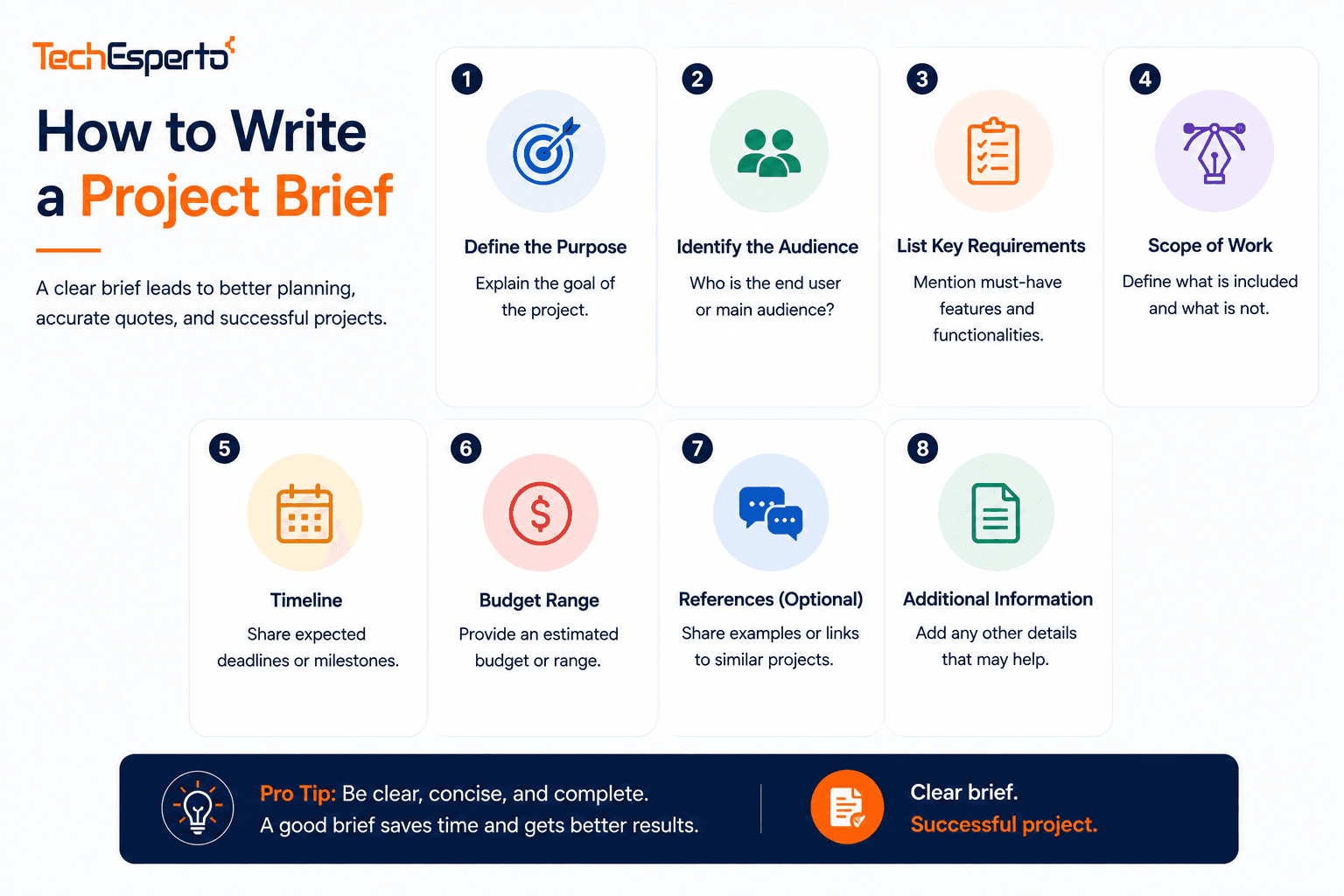
A good project brief is the cheapest way to get accurate quotes and comparable proposals. Vague briefs produce wide estimate ranges, because vendors price the uncertainty they cannot resolve, and they produce proposals you cannot compare because each firm assumed something different. Writing down objectives, constraints, and boundaries takes a day and improves every subsequent decision. This guide covers what belongs in a brief, what to leave open deliberately, and the omissions that most often cause quotes to be wrong.
Establishing Objectives Before Requirements
Briefs that open with a feature list invite vendors to price that list rather than to solve your problem, which forecloses better approaches they might have proposed. Starting with the business objective and the users affected gives suppliers the context to suggest alternatives, and gives you a basis for judging which proposals understood the situation. It also protects you later, since scope decisions during delivery can be tested against a stated objective rather than argued from preference.
Stating the Business Problem
Describe what is not working and what it costs. A brief explaining the problem receives more useful proposals than one specifying a solution without justification.
Defining Who the Users Are
Identify each user type and what they need to accomplish. Systems serving several roles carry substantially more scope than single-role tools, and vendors need this to estimate.
Setting Measurable Success Criteria
State how you will judge whether the project worked. Without criteria, acceptance becomes subjective and the finishing point becomes negotiable.
Explaining Why Now
Deadlines driven by regulation, contracts, or market events change what approach is sensible. Vendors need to know whether the date is genuine or aspirational.
Validating the Problem First
Where the underlying assumption is untested, say so. Approaching the work through MVP development is a reasonable response to genuine uncertainty.
Defining Scope and Its Boundaries
The most useful section of any brief is the one stating what is out of scope, because unstated exclusions become assumed inclusions in some proposals and not others. Explicit boundaries produce comparable quotes and prevent the disagreements that arise when a vendor priced something narrower than you imagined. This section also forces internal alignment, since stakeholders frequently discover during its writing that they held different views about what the project covered.
Listing Must-Have Capabilities
Describe what the system must do in terms of outcomes rather than screens. Prioritising into essential and desirable helps vendors propose phased approaches.
Stating What Is Excluded
Name the things you are not asking for, particularly adjacent features vendors might reasonably assume. This single section removes most estimate variance.
Describing Volumes and Scale
User counts, transaction volumes, and data sizes drive architecture. Systems designed for hundreds and for hundreds of thousands differ fundamentally in cost.
Clarifying Platforms Required
Web, iOS, Android, or some combination substantially changes effort. If undecided, say so and ask vendors to advise, rather than leaving it ambiguous.
Distinguishing Launch From Later Phases
Separating the first release from the longer roadmap lets vendors price what you are actually commissioning now while understanding where it leads.
Documenting Constraints and Existing Systems
Constraints are what make an estimate real. A project with no stated technical, regulatory, or organisational constraints will be priced as though none exist, and every one discovered afterwards becomes a change request. Integration requirements deserve particular attention, since connecting to existing systems is routinely the largest source of underestimation, especially where those systems are old, undocumented, or controlled by another party.
Listing Systems Requiring Integration
Name every system, what data must flow, and whether documented interfaces exist. Undocumented legacy systems should be flagged explicitly as unknowns.
Stating Technology Constraints
Mandated platforms, hosting requirements, or standards your organisation enforces need stating upfront. Discovering them after proposals wastes everyone’s time.
Identifying Regulatory Obligations
Data protection, sector rules, and accessibility standards change design and testing. Requirements such as HIPAA obligations belong in the brief rather than in a later conversation.
Describing Data Migration Needs
Existing data to be moved, and its condition, affects effort considerably. Vendors need to know volume, format, and quality rather than discovering these during delivery.
Being Realistic About Budget Range
Providing a range lets vendors propose something achievable within it. Withholding it produces proposals that miss in both directions and wastes review effort.
Setting Out Process, Decisions, and Deliverables
The final section covers how you intend to work together, which affects both price and outcome. Vendors price decision latency, and a project with unclear approval routes genuinely costs more to deliver. Stating who decides, how often you will meet, what you expect to receive, and how changes will be handled produces proposals matched to your working style rather than to the vendor’s default assumptions.
Naming the Decision Maker
Identify who approves scope and designs. Projects with committee approval and no single owner move slowly, and vendors should know this before quoting.
Stating Your Preferred Engagement Structure
Fixed scope, time-based, or phased arrangements suit different situations. Indicating a preference from the available engagement models helps vendors propose appropriately.
Listing Expected Deliverables
Specify what you receive beyond working software: source code, documentation, designs, and access credentials. Ambiguity about handover creates problems at the end.
Describing the Change Process
Explain how scope changes will be raised and approved. Agreeing this before work starts prevents mid-project disputes about what was included.
Asking About Post-Launch Support
Maintenance is a separate commitment worth pricing upfront. Requesting maintenance and support options within the proposal avoids negotiating them under pressure after launch.
Frequently Asked Questions
How long should a project brief be?
Long enough to cover objectives, scope boundaries, constraints, integrations, and process, which is usually a few pages rather than a formal specification. Detail should concentrate on constraints and exclusions, where ambiguity costs most in estimate accuracy.
Should I specify the technology in my brief?
Only where a genuine constraint exists, such as an organisational standard or an existing system. Otherwise describe requirements and let vendors propose, since prescribing technology without reason can eliminate better approaches.
Do I need to include a budget?
Providing a range is usually better than withholding it. Vendors can then propose something achievable, whereas concealing budget produces proposals that miss high and low and wastes review time on options you would never accept.
What is the most common omission in briefs?
Integration requirements and what is out of scope. Connecting to existing systems is the largest source of underestimation, and unstated exclusions get assumed differently by each vendor, making proposals impossible to compare fairly.
How detailed should requirements be?
Detailed about outcomes and constraints, lighter on implementation. Specifying screens and interactions before discovery locks in assumptions that may not survive contact with users, while leaving objectives vague makes accurate pricing impossible.
Should the brief include success criteria?
Yes. Stating how you will judge success gives vendors something to design toward and gives both parties an objective basis for acceptance, rather than leaving completion open to interpretation at the end of the project.