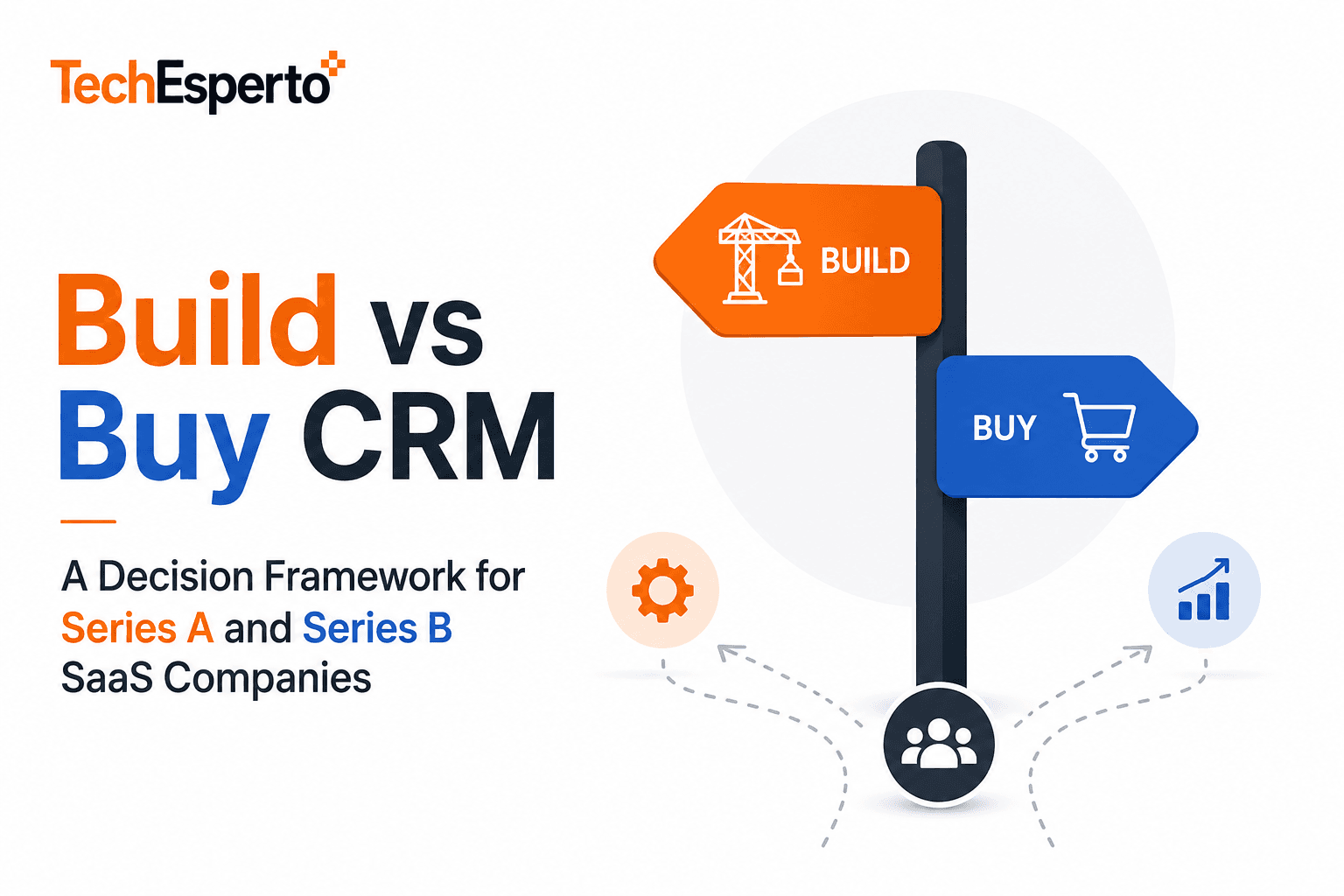
Every Series A and Series B SaaS company hits the same crossroads around 30–50 employees. The spreadsheet-and-HubSpot-Starter stack that worked for the first 18 months is breaking. Pipeline visibility is poor, customer success is reactive, marketing-to-sales handoff is leaking deals, and the leadership team is starting to lose confidence in the revenue forecast.
The question becomes: what do we run our revenue motion on?
Three paths exist. Most founders treat the decision as binary — “buy Salesforce or use HubSpot” — and miss the third option entirely. The right answer depends on team size, product complexity, growth trajectory, integration depth, and how strategic the CRM is to your specific business model. Generic advice doesn’t help; this framework does.
This article walks through the build vs buy decision specifically for SaaS companies between Series A and Series B (roughly 25–150 employees, $3M–$30M ARR). Drawn from the SaaS migrations and implementations we’ve delivered for companies in this exact stage.
The Three Real Paths
Most build-vs-buy conversations frame the choice as binary. The reality has three distinct paths, each with different economics, capabilities, and risks.
Path 1: Off-the-Shelf Enterprise CRM (Buy)
Salesforce, HubSpot Sales Hub Professional/Enterprise, Microsoft Dynamics 365, or similar. You configure pre-built software to fit your workflows. The vendor owns the platform; you own your data inside it.
Strengths:
- Fastest time to launch — weeks, not months
- Mature feature set with broad integration ecosystem
- Large pool of trained admins and consultants
- No engineering capability required to operate
Weaknesses:
- Per-user licensing scales linearly with headcount; gets expensive fast
- Customization beyond the basics requires expensive specialists (APEX developers for Salesforce, etc.)
- Vendor lock-in deepens over time as configuration accumulates
- You shape your business around the software’s assumptions, not the other way around
For SaaS at $200/user/month base licensing (Salesforce Enterprise), a 75-person team is $180,000/year in licensing alone before any add-ons. By Series B with 150 people, that’s $360,000/year. The trajectory is the problem.
See SuiteCRM vs Salesforce, Salesforce Hidden Costs, and our SuiteCRM vs Salesforce vs HubSpot 2025 comparison.
Path 2: Open-Source CRM With Implementation Partner (Hybrid)
SuiteCRM, EspoCRM, or similar open-source platforms, deployed and customized by an implementation partner. You get most of the maturity of off-the-shelf software with the cost structure of owning your own infrastructure.
Strengths:
- Zero per-user licensing — costs don’t scale with headcount the way enterprise CRMs do
- Full customization access including custom modules, workflows, and integrations
- No vendor lock-in at the platform level
- Lower 5-year TCO than enterprise alternatives for teams above ~30 users
Weaknesses:
- Requires either internal engineering capability or a managed support relationship
- Smaller pool of trained admins compared to Salesforce/HubSpot
- More upfront investment in implementation than basic SaaS subscriptions
- Less out-of-box marketing-automation depth than HubSpot
See What Is SuiteCRM, SuiteCRM Open Source Benefits for Businesses, SuiteCRM Review 2026, and open source CRM glossary entry.
Path 3: Custom-Built CRM (Build)
Engineering team builds CRM functionality from scratch, typically as part of the product itself or as an internal tool. Rare but appropriate for specific business models.
Strengths:
- Perfect fit for your specific workflows
- No vendor relationship to manage
- CRM functionality can become part of your product differentiation
Weaknesses:
- Substantial engineering investment (typically $200K–$750K+) that competes with product roadmap
- Ongoing maintenance cost ($75K–$200K/year) for features that aren’t your core competence
- You build commodity features (contact management, pipeline tracking) that thousands of CRMs already do well
- Reinventing wheels delays the work that actually differentiates your business
For most SaaS companies, building custom CRM is the wrong answer. The exceptions are specific and worth recognizing — see below.
See Custom CRM Development service and the broader Build vs Buy CRM framework.
Which Path Fits Which Situation
The right answer depends on five factors specific to your company.
Factor 1: Team Size and Trajectory
Under 25 users: Off-the-shelf almost always wins. HubSpot Sales Hub Starter or similar handles the workload at low total cost. Don’t over-engineer at this stage; you have bigger problems.
25–75 users (typical Series A): The crossover zone. Off-the-shelf still works but per-user costs start meaningful. Open-source CRM with implementation partner becomes economically interesting around 35–40 users. Custom build is almost never right at this stage — engineering capacity should be on product.
75–150 users (typical Series B): Open-source CRM with implementation partner is usually the right answer. Per-user economics on Salesforce/HubSpot have become painful; customization needs are real; engineering capacity to operate isn’t a problem at this scale.
150+ users (Series C+): Either continue with hybrid approach (cheaper, more flexible) or commit to enterprise CRM (more standard, larger talent pool). Custom build remains rarely right.
See our SaaS CRM solutions page and SaaS CRM case study for SaaS-specific architecture.
Factor 2: Product Complexity and Workflow Specificity
Simple SaaS product with standard B2B sales motion: Off-the-shelf or hybrid works fine. Pipeline, contact management, basic automation cover 90% of needs.
Product-led SaaS with complex usage-to-conversion attribution: Hybrid wins. You need custom integration between product analytics and CRM that off-the-shelf doesn’t handle elegantly.
Sales-led SaaS with complex multi-stakeholder enterprise deals: Off-the-shelf with significant customization or hybrid. Standard CRM workflows often don’t match enterprise sales reality.
Vertical SaaS with industry-specific workflows: Hybrid usually wins. Customization needs justify implementation partner; vertical-specific entities benefit from custom modules.
For specific verticals, see our healthcare, FinTech, finance, insurance, manufacturing, e-commerce, and real estate industry pages.
Factor 3: Integration Depth
Standard SaaS stack (Slack, Stripe, Intercom, marketing tools): Off-the-shelf integrates fine. No real differentiation by path.
Heavy product integration (CRM needs deep bi-directional sync with your product database): Hybrid wins. You can build proper middleware between your product and CRM without paying enterprise integration platform fees.
Custom data warehouse and BI integration: Hybrid wins. SuiteCRM’s REST API and webhook capabilities are competitive with enterprise alternatives at fraction of the cost.
See our SuiteCRM Integration service, CRM Integration Guide, SuiteCRM REST API Guide, REST API glossary entry, and Webhook glossary entry.
Factor 4: Compliance Requirements
Standard B2B SaaS, no industry-specific regulation: Any path works.
SOC 2 Type II required: Hybrid often wins. Custom-architected SuiteCRM with managed hosting passes SOC 2 audits cleanly; enterprise CRM with proper configuration also works but at higher total cost.
HIPAA, GLBA, or industry-specific frameworks: Hybrid usually wins. Building compliance into your CRM architecture is cheaper on open-source platforms than retrofitting it to enterprise platforms.
See CRM Data Security and Compliance, the healthcare CRM guide, the FinTech CRM guide, the HIPAA glossary entry, the GDPR glossary entry, and the RBAC glossary entry.
Factor 5: Engineering Capacity and Risk Tolerance
Limited engineering capacity, low risk tolerance: Off-the-shelf wins. You don’t want to manage CRM infrastructure or customization.
Adequate engineering capacity, comfortable working with implementation partner: Hybrid wins. You don’t have to operate the CRM yourself; the partner handles ongoing engineering and you focus on product.
Strong engineering capacity, CRM is strategically core to your product: Custom build is on the table — but only if CRM functionality is genuinely product differentiation, not generic infrastructure.
When Custom Build Is Actually Right
Custom build is rarely the right answer, but a few specific scenarios genuinely justify it.
Scenario 1: CRM functionality IS your product. If you’re building a vertical SaaS that includes CRM as a primary feature (e.g., agency management software, real estate brokerage tools, healthcare practice management), you’re not really building “internal CRM” — you’re building product functionality that happens to be CRM-shaped. Custom build is appropriate.
Scenario 2: Workflows so specific that off-the-shelf can’t be adapted. Rare, but exists. If your sales motion requires custom data models that no CRM supports natively (e.g., unique tokenization for cryptocurrency exchanges, particular regulatory workflows for niche financial products), build may be right.
Scenario 3: Massive scale where licensing economics break. At 1,000+ user scale, even open-source CRM with managed support reaches the point where pure custom development becomes economically competitive. Below that scale, hybrid wins.
For most Series A/B SaaS companies, none of these apply. Don’t talk yourself into custom build because it sounds more sophisticated.
The Specific Recommendation by Stage
Pre-Series A (under $1M ARR, under 25 employees):
HubSpot Starter, Pipedrive, or similar. Don’t over-think it. The strategic priority is finding product-market fit; CRM sophistication isn’t the bottleneck. See How to Choose a SuiteCRM Partner and Is Your Business Ready for CRM for diagnostics.
Series A ($3M–$10M ARR, 25–60 employees):
If economics matter and you have or can hire RevOps capability: hybrid approach with SuiteCRM and managed support. Year 1 budget: $45,000–$70,000 implementation + $4,500–$6,000/month ongoing. See our SuiteCRM Implementation service and pricing page.
If pure simplicity matters more than economics: HubSpot Professional. Higher per-user cost but minimal operational complexity.
Series B ($10M–$30M ARR, 60–150 employees):
Hybrid approach with SuiteCRM and managed support is usually the right answer. Year 1 budget: $60,000–$100,000 implementation + $5,500–$8,000/month ongoing. Per-user economics on enterprise alternatives have become painful at this scale.
If you’re already on Salesforce/HubSpot from Series A: the Salesforce renewal decision framework and Salesforce → SuiteCRM Migration service cover the migration path. The Migrate HubSpot to SuiteCRM guide covers the HubSpot path. See How to Migrate from Salesforce or Zoho to SuiteCRM for the broader migration framework.
Series C+ ($30M+ ARR, 150+ employees):
Both hybrid and enterprise CRM remain viable. The deciding factors at this stage are usually operational rather than economic — what your team is best-positioned to operate, what your investor/board expects, what your strategic technology direction looks like.
What Drives the Decision Wrong
Three patterns consistently lead SaaS companies to the wrong path.
Pattern 1: Defaulting to Salesforce because “everyone uses it.”
Common in Series A/B teams whose RevOps lead came from a larger company. Salesforce is the right answer for some teams, but defaulting to it without analysis costs 60–80% more than the right answer for most teams at this stage. See the Salesforce Hidden Costs Calculator (free) for actual TCO numbers.
Pattern 2: Custom-building because the engineering team finds it interesting.
Engineers will often advocate for build. Building software is what they do. Recognize this bias and weight it appropriately — engineering capacity is finite, and custom CRM doesn’t differentiate your product. See Free Salesforce Alternatives and Best Open Source CRM Software for the alternative landscape.
Pattern 3: Picking the cheapest implementation partner rather than the right one.
Build-vs-buy is settled in your favor toward “buy” only if execution quality is high. Cheap implementations of open-source CRM produce the same failure patterns as cheap implementations of any other platform. See Why SuiteCRM Implementations Fail, 11 Questions to Ask Before Picking a CRM Implementation Partner, and How to Choose a SuiteCRM Partner.
How to Make the Decision This Quarter
Five steps in order, executable in 4–6 weeks.
Step 1: Get clean numbers. Document current CRM cost (full TCO including admin time, integrations, add-ons). Project 24-month team growth. Calculate projected CRM cost at current trajectory.
Step 2: Document the actual gaps. What’s broken in your current setup? Pipeline visibility? Marketing-sales handoff? Reporting accuracy? Integration depth? Customization needs? Be specific.
Step 3: Run the 11-question evaluation. Use 11 Questions to Ask Before Picking a CRM Implementation Partner against 2–3 implementation partners and 1–2 off-the-shelf vendors. Compare the answers.
Step 4: Build the realistic TCO comparison. 5-year projection for off-the-shelf vs. hybrid for your specific team trajectory. Use realistic price escalation (7–9% annually for enterprise vendors) and realistic team growth.
Step 5: Decide and commit. The decision is more important than the perfect decision. Commit, allocate resources, and execute. Re-evaluate in 18 months when the data is in.
A free 30-minute strategy call walks through the framework against your specific situation. No pitch, no commitment.
What if we’re not sure what stage we’re at?
The clearest signal is per-user CRM cost as a percentage of revenue. If you’re spending more than 0.5% of ARR on CRM licensing alone, the math is starting to favor alternatives. Above 1%, the math strongly favors alternatives.
How long does migrating from HubSpot/Salesforce to SuiteCRM take?
Typical Series A/B SaaS migration: 6–10 weeks from kickoff to stable production. Bigger migrations (heavy customization, complex integrations) push to 12–14 weeks. See our SuiteCRM Migration service, Salesforce → SuiteCRM Migration service, the Migrate Salesforce to SuiteCRM Guide for 2026, and the Migrate HubSpot to SuiteCRM guide.
What about Zoho?
Zoho’s a reasonable middle option for some Series A/B SaaS teams — cheaper than Salesforce, more capable than HubSpot Starter, less flexible than self-hosted SuiteCRM. See SuiteCRM vs Zoho CRM comparison and How to Migrate from Salesforce or Zoho to SuiteCRM for context. For more open-source alternatives, see SuiteCRM vs Odoo, SuiteCRM vs Vtiger, and SuiteCRM vs EspoCRM.
Can we mix paths? Use Salesforce for sales but build custom for customer success?
Yes, this happens. Multi-platform CRM is common at Series B+ but adds integration complexity. The economics often work out worse than either pure path. Worth considering when specific workflows genuinely need custom but core CRM is fine off-the-shelf.
What about marketing automation specifically?
Marketing automation is often where HubSpot wins for SaaS at Series A. Sales Hub Starter + Marketing Hub is a reasonable Series A stack. The crossover where SuiteCRM with marketing automation extensions becomes economically better is around Series B scale. See our SuiteCRM Marketing Automation page and marketing automation glossary entry.
What about AI capabilities?
For SaaS teams interested in AI for CRM (lead scoring, email AI, chatbots), the build-vs-buy economics get more interesting. Custom AI on SuiteCRM costs significantly less than Einstein AI on Salesforce at Series B scale. See Complete Guide to AI for CRM in 2026, AI CRM Cost analysis, AI Lead Scoring Guide, AI Chatbots for CRM Lead Capture, and our AI for SuiteCRM service.
How do we know if hybrid will actually work for us?
The 30-minute consultation walks through this against your specific situation. We’ve done enough SaaS migrations and implementations to give you a candid view of whether hybrid is right for you or whether off-the-shelf is genuinely better. See our SaaS CRM case study for an example of a Series B SaaS deployment, our SuiteCRM vs Salesforce for Small Business analysis, and the Self-Hosted vs Cloud CRM analysis.
How do we get started?
Book a free 30-minute CRM strategy consultation. We’ll walk through your specific situation — team size, growth trajectory, integration needs, compliance requirements — and give you a candid recommendation. If hybrid isn’t right for you, we’ll say so.
For broader context: Ultimate CRM Buying Guide for 2026, SuiteCRM Cost Savings analysis, Build vs Buy CRM framework, 5 Signs You Need a CRM Partner, our engagement models, and our technology stack.
Frequently Asked Questions
The clearest signal is per-user CRM cost as a percentage of revenue. If you’re spending more than 0.5% of ARR on CRM licensing alone, the math is starting to favor alternatives. Above 1%, the math strongly favors alternatives.
Typical Series A/B SaaS migration: 6–10 weeks from kickoff to stable production. Bigger migrations (heavy customization, complex integrations) push to 12–14 weeks. See our SuiteCRM Migration service, Salesforce → SuiteCRM Migration service, the Migrate Salesforce to SuiteCRM Guide for 2026, and the Migrate HubSpot to SuiteCRM guide.
Zoho’s a reasonable middle option for some Series A/B SaaS teams — cheaper than Salesforce, more capable than HubSpot Starter, less flexible than self-hosted SuiteCRM. See SuiteCRM vs Zoho CRM comparison and How to Migrate from Salesforce or Zoho to SuiteCRM for context. For more open-source alternatives, see SuiteCRM vs Odoo, SuiteCRM vs Vtiger, and SuiteCRM vs EspoCRM.
Yes, this happens. Multi-platform CRM is common at Series B+ but adds integration complexity. The economics often work out worse than either pure path. Worth considering when specific workflows genuinely need custom but core CRM is fine off-the-shelf.
Marketing automation is often where HubSpot wins for SaaS at Series A. Sales Hub Starter + Marketing Hub is a reasonable Series A stack. The crossover where SuiteCRM with marketing automation extensions becomes economically better is around Series B scale. See our SuiteCRM Marketing Automation page and marketing automation glossary entry.
For SaaS teams interested in AI for CRM (lead scoring, email AI, chatbots), the build-vs-buy economics get more interesting. Custom AI on SuiteCRM costs significantly less than Einstein AI on Salesforce at Series B scale. See Complete Guide to AI for CRM in 2026, AI CRM Cost analysis, AI Lead Scoring Guide, AI Chatbots for CRM Lead Capture, and our AI for SuiteCRM service.
The 30-minute consultation walks through this against your specific situation. We’ve done enough SaaS migrations and implementations to give you a candid view of whether hybrid is right for you or whether off-the-shelf is genuinely better. See our SaaS CRM case study for an example of a Series B SaaS deployment, our SuiteCRM vs Salesforce for Small Business analysis, and the Self-Hosted vs Cloud CRM analysis.
Book a free 30-minute CRM strategy consultation. We’ll walk through your specific situation — team size, growth trajectory, integration needs, compliance requirements — and give you a candid recommendation. If hybrid isn’t right for you, we’ll say so.
For broader context: Ultimate CRM Buying Guide for 2026, SuiteCRM Cost Savings analysis, Build vs Buy CRM framework, 5 Signs You Need a CRM Partner, our engagement models, and our technology stack.